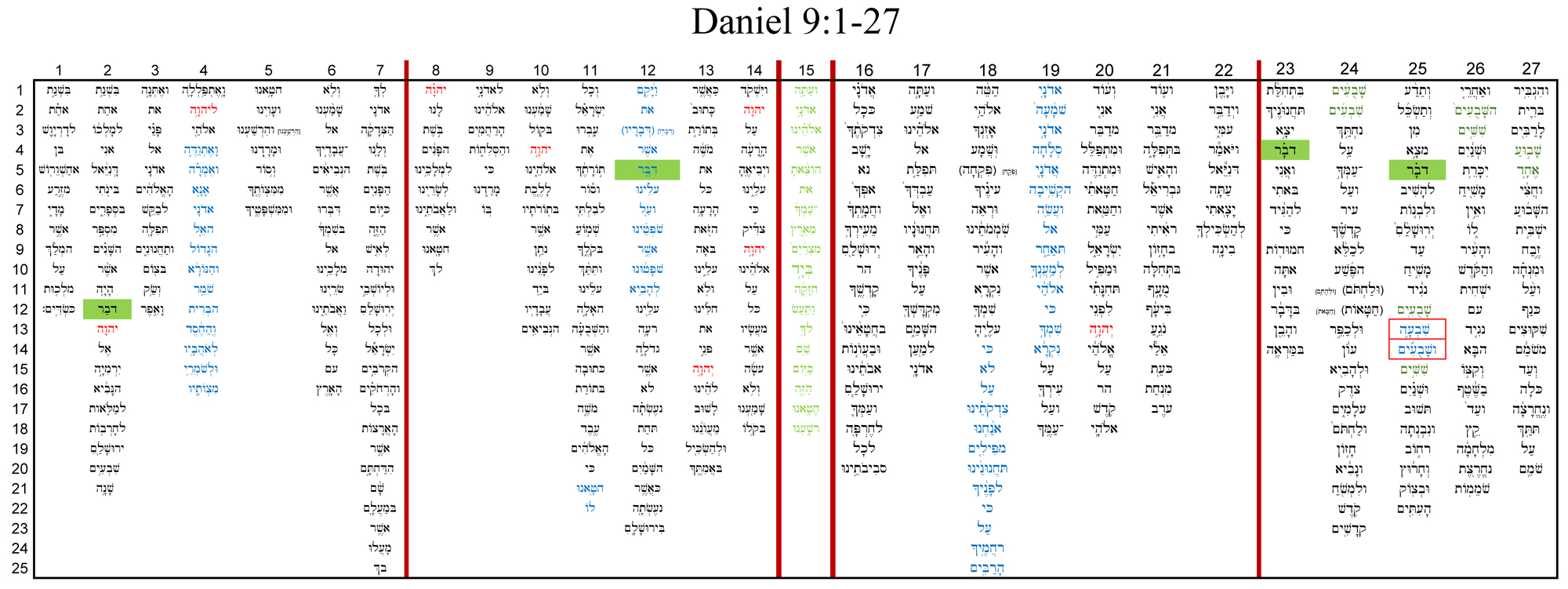
The literary and numerical structure of Daniel 9 is a masterfully designed passage. The structure of Daniel 9 reveals intentional patterns of word counts, letter counts, and symmetrical arrangements that reflect the literary sophistication of the Hebrew text.

Overview of the chapter

Yahweh's words (dabar) are the focus of each literary unit in Daniel 9. The Prince, is at the center of Yahweh's answer to Daniel's prayer for "covenant and mercy", that ancient oath of sevens sworn with Abraham.

A remarkable aspect of the literary structure of the Hebrew Bible is the possibility that the Tetragrammaton (יהוה) or name of YHWH is numerically and thematically woven into the very fabric of the text in the numbers 26 and 17. The concept of divine name-number structuring is known in Jewish tradition as ariga—literally “weaving” (Joseph Gikatilla). Though first explicitly recorded in 13th-century France (Claus Schedl), its origins stretch back the middle ages (Abudirham (1340)) and likely to biblical antiquity.

The number 26 reflects the sum of the traditional values of the Hebrew letters in the divine name: yod (10) + he (5) + waw (6) + he (5). The number 17 may represent a gematric variation of a conjectured form such as ’ahweh, analogous to “I am” in Exodus 3:14 (See Also), or it may simply derive from the sum of the individual digits in 26 (1+0+5+6+5). Strikingly, both 17 and 26 are also the numerical value of the Hebrew word kabod (כָּבוֹד), meaning “glory.” This theological and numerical association is grounded in Exodus 33:17–23, where God reveals His glory to Moses by proclaiming His name—these two concepts are linked throughout the Hebrew Scriptures and signify His manifest presence ( Bazak; Labuschagne).

Claus Schedl proposed that this “weaving” was a compositional technique originating in biblical times, with scribes intentionally embedding numerical representations of YHWH's name into the structure of the text. In a private letter shortly before his death, Schedl questioned whether medieval kabbalists had preserved this ancient scribal knowledge, suggesting that the biblical text may have been composed “nach der Zahlen des Gottesnamens” (according to the numbers of the divine name).


Would you like this to be footnoted with full citations, or keep it more integrated like this?

These patterns suggest a conscious literary strategy, whereby the text of Scripture was constructed with numeric precision to reflect the presence and character of God. In the case of Daniel 9, as this paper will explore, such numerical design appears to frame and emphasize key theological motifs—including the role of the “Prince,” the significance of the “Sevens,” and the overarching covenantal timeline—thus embedding divine identity within the text’s very structure.

The name YHWH woven into the fabric of the text There is a Jewish tradition— recorded for the first time, as far as we know, in the thirteenth century in France— that the name of God was woven into the very texture of Scripture. This does not mean that the tradition about this ‘weaving’ was invented at that time. For its origin we must look beyond the medieval kabbalistic tradition and go back to biblical antiquity. It was who brought the "ariga tradition to my attention. According to him, we should consider it a reminiscence of a scribal compositional technique that goes right back to biblical times until the finalization of the text of Holy Scripture in the first century of the Common Era. In a private letter to me (17-5-1986), a few weeks before his tragic death in a car accident he wrote: “Wäre es nicht möglich, dass in der späteren mittelalterlichen Kabbala noch das Wissen davon erhalten war, dass der biblische Text tatsächlich nach der Zahlen des Gottesnamens durchkomponiert wurde???!!!”. In other words, he suggested that this ‘weaving’ of God’s name into the text was carried out by means of the two numbers which represent the gematric values of the divine name, 26 and 17. The first divine name number, 26, represents the name yahweh, , an archaising form of the 3rd person form yihyeh, , “he is”. • 26 = y h w h, , = 10+5+6+5. In a private letter to Pieter van der Lugt (4-4-2011), Jacob Bazak drew our attention to the fact that Rab David, son of Joseph, son of David, in his book Abudirham (a commentary on the Jewish Prayer Book), written in Spain in 1340, noted concerning Psalm 136: “This psalm contains 26 verses like the number of the divine name y-h-w-h which is 26.” This is a very important piece of evidence showing incontestably that the use of the divine name number 26 for structuring purposes in the Hebrew Bible was still known in the Middle Ages. The divine name number 17 can of course be explained as the sum of the digits of the numbers 10, 5, 6 and 5 (1+0+5+6+5=17), but it is also possible that 17 is the numerical value of a conjectured ’ahweh, , which is to ’ehyeh, , “I am” (Ex. 3:14), as yahweh, , is to yihyeh, , “he is”: • 17 = ’ h w h, , = 1+5+6+5. The numbers 17 and 26 also both happen to be the numerical value of kabod, , or kabôd, , ‘glory’. Among the Jewish methods of computing gematric values, two are common: • in one, by which we get the positional or ordinal value (also known as Gematria 22): the letters have the value of their position in the alphabet, the alef – yod represent 1 – 10, but kaf = 11, lamed = 12, mem = 13, and so forth; and • in another, by which we get the decimal value (also known as Gematria 400) the letters alef through yod again represent the numerals 1 – 10, but kaf = 20, lamed = 30, mem = 40, etc….qof = 100, resh = 200, shin = 300, taf = 400. As far as I know it has always been taken for granted that the decimal values of yod through taf (10 through 400) were simply attributed to these letters. In my opinion, however, these values were calculated: they were achieved by multiplying the sum of the digits of their ordinal values by 10 (yod through tsadeh) and 100 (qof through taf).
The fact that 17 and 26 can stand for both the Name and the Glory is not surprising, since in the Bible the ‘name’ and the ‘glory’ of God were inextricably linked. This is most effectively demonstrated in Ex. 33:17-23, where Moses asks God to show him his glory and God responds by pronouncing his name in Moses’ hearing.

  1. Overview Of The Chapter
    1. The entire chapter contains 462 words, In the entire book of Daniel, the divine name יהוה (YHWH) appears only in this chapter (words can be checked at it can also be checked here (https://mechon-mamre.org/p/pt/pt3409.htm).
    2. The introduction (1–4) contains 23 words + 4 words + 23 words, forming a parallel symmetry (A, A1, B, C, C1): Daniel twice says "I set my face unto the Lord… I prayed unto Yahweh," which sets the context for his prayer with the phrase "דבר-יהוה אל-ירמיה" ("the word of Yahweh came to Jeremiah"), directing the reader’s focus to Jeremiah 25:8.
    3. The Hebrew for 'word' is dabar, and is used 4 times in the passage to reveal a theme.
      • It is used in verse 2 to describe the dabar of Yahweh that came to Jeremiah, and again in verse 12 about Yahweh's dabar or laws.
      • In verse 23 the angel Gabriel explains that he was dispatched with the “dabar” of YHWH concerning the prophecy of 70 weeks.
      • Finally in verse 25 the angle records the count of the weeks starts at the “dabar to restore and build Jerusalem.”
      • The word has a value of 26 (same as Yahweh). Numerically expressed then, the דבר יהוה (word of Yahweh) has the numerical value of 52.
  2. Daniels Prayer (1-19)
    1. The prayer has 268 words. The prayer divides equally between verses 12 and 13. (134+134)
      • Daniel’s prayer is structured around the repetition of 18 words: the first 18 describe the past, the middle 18 describe the present (and mark the center of the chapter with 222 words before verse 15 and 222 words after it — 222 + 18 + 222), and the final 18 words call on Yahweh to act in the future.
  3. Daniel’s Answer to Prayer (verses 20–27)
    2. Daniel’s prayer and its response are framed with 39 words summarizing his prayer (or dabar), centered on 3 key words—"While he was speaking in prayer" (or dabar), followed by 39 words describing Gabriel’s message (or dabar) to him.
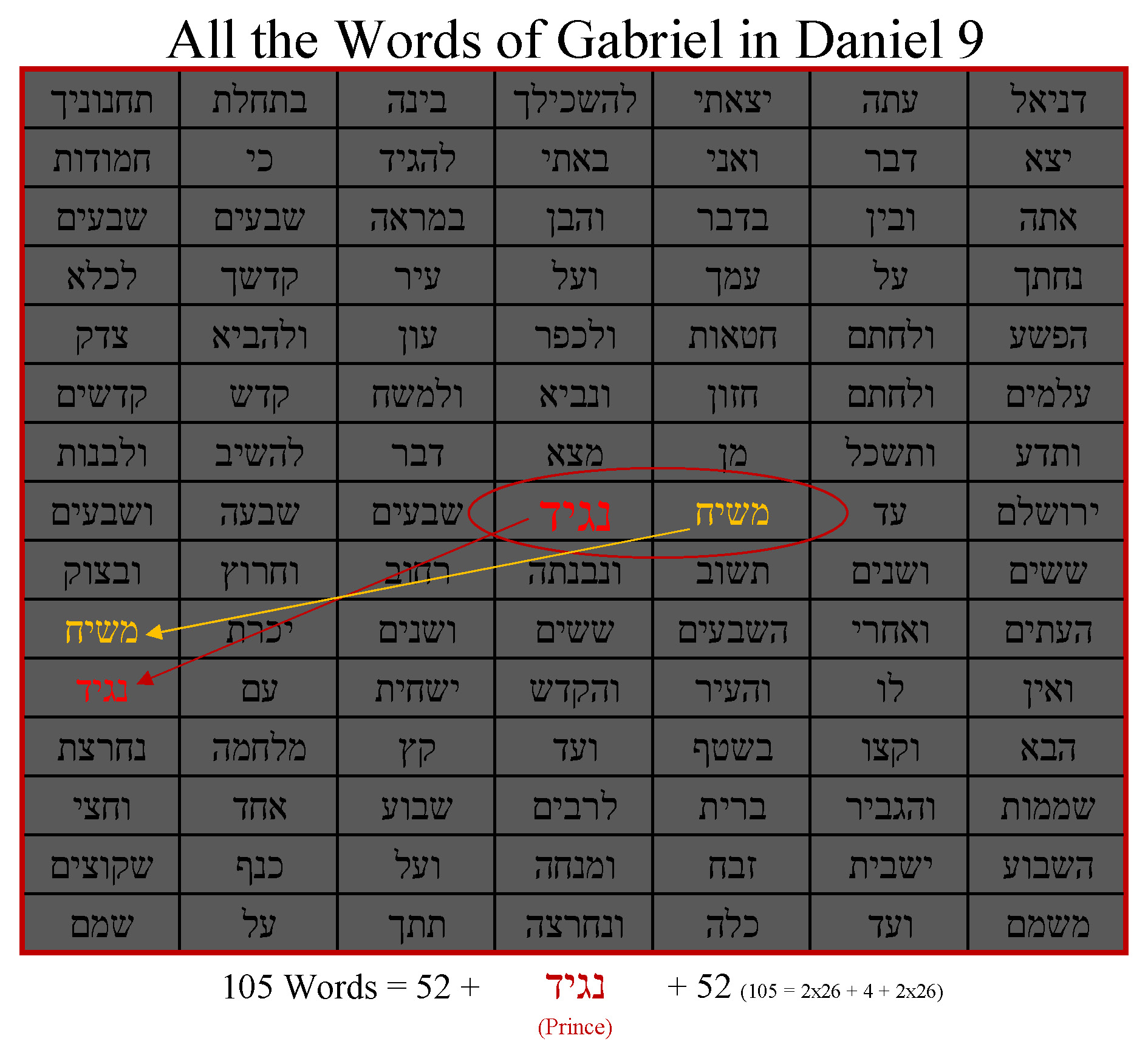
    3. In Verse 21, Gabriel comes to Daniel (The verse uses 17 Words to introduce him), the total words that he speaks to Daniel is 105
    - The first 5 words explain his purpose: Daniel’s reflection on the ancient oath of sevens led to the prophecy of the Seventy Sevens.
    4. The center of the narrative is Prince/Nagiyd (v.25).
    - There are 52 words (26x2) before after (52+Prince+52). Given that the "word of Yahweh" is also 52, this is what brings forth the Prince (52+Prince+52).
    - This phrase is also framed by 219 letters before and after (219+Prince+219).
    - Again the center is emphasized by 50 words before after the middle phrase "unto anointed prince sevens seven" (50 plus 'משוב נגיד שבעים שבג' plus 50)
    5. The 70 Weeks Prophecy (22b-27)
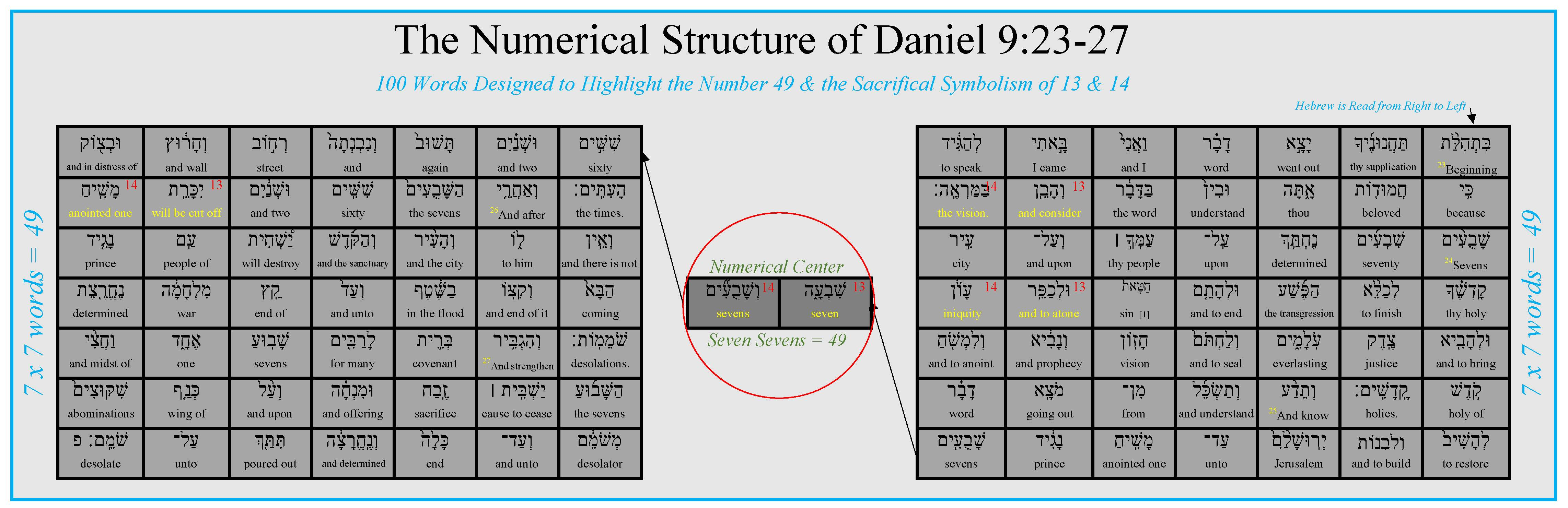
    1. Gabriel’s message contains exactly 100 words, describing how and what will happen (Verse 24-27).
    - The numerical center is the phrase "Seven Weeks" (šiḇ·ʿîmʹ šā·ḇu·‘îm / שבעה שבעים), which represents 49.
    - This central phrase is preceded and followed by 49 words each (49+2+49 OR 49+49+49 using seven weeks as a word pun)
    - There are 204 letters before the 10-letter phrase "Seven Weeks" and 204 letters after, reinforcing the symmetry (204 + 10 + 204).
    - The phrase mirrors a Jubilee cycle (7 sabbath years = 49). This central placement signals that the entire 70 Weeks prophecy (10 Jubilees) is based on Jubilee timing (Leviticus 25:8-10). Just as Jubilee brings release, return, and restoration, this period points to the arrival of the Anointed One and God's ultimate plan of redemption.
Key Takeaways

This chapter is about about the 70 Weeks is that they are Jubilee cycles (Seven Weeks, Sixty-Two Weeks, One Week) with a central focus on the Anointed Prince (likely the Messiah), indicating that the 70 weeks are a divinely ordered period leading up to a significant messianic event.

Powered by Forestry.md