The Resurrection is the foundation of all Christianity. If Jesus did not rise from the dead, then Christianity is false, the apostle Paul admits this in his letter to Corinth:

14. And if Christ has not been raised, then our preaching is in vain and your faith is in vain.

The belief in the resurrection of Jesus as a historical event, as opposed to alternative explanations, holds far more evidence over alternative explanations due to several reasons:

The Bible Is Reliable

Prophecy Confirms The Bible!

The Gospels of Matthew, Mark, Luke, and John are foundational texts for the Christian faith, documenting the life, teachings, death, and resurrection of Jesus Christ. The question of whether the Bible has been changed over time is a common concern among skeptics and believers alike. In an age of increasing information and misinformation, understanding the integrity of the biblical texts is essential. Many critics argue that the Bible, especially the Gospels, has been altered, edited, or even fabricated to fit theological agendas.

However, a closer examination of the historical and textual evidence reveals a different story—one that reveals the reliability and preservation of the original words of the Gospel writers.

About The Gospels

The Gospels fit the genre of ancient Greco-Roman biography, which aimed to record factual histories about individuals, rather than fictional stories.

The Genre of the Gospels: Historical Biography or Myth?

The genre of the Gospels—Matthew, Mark, Luke, and John—is a foundational issue in biblical studies and Christian apologetics. Determining their genre helps us assess their historical reliability and intended purpose. The Gospels fit the genre of ancient Greco-Roman biography (or bioi), characterized by an intent to document real lives within historical contexts. Critics, such as Rudolf Bultmann, argue that the Gospels contain theological embellishments, undermining their historical value.
Modern scholarship, including N.T. Wright’s The Resurrection of the Son of God, counters that the Gospels' emphasis on the physical resurrection—a radical claim in both Jewish and Greco-Roman contexts—points to a genuine historical core rather than mythologizing tendencies. Their reliance on eyewitness testimony, historical specificity, and lack of mythological elements all point to their authenticity as historical documents.

Key Characteristics of Greco-Roman Biography Found in the Gospels

Richard A. Burridge's "What Are the Gospels? A Comparison with Greco-Roman Biography" argues convincingly that the Gospels are best understood as examples of the ancient genre of Greco-Roman biography. Burridge compares the Gospels with well-known biographies from the Greco-Roman world, such as: Plutarch’s Lives, Suetonius’ Lives of the Caesars and Tacitus’ Agricola: Here's how Burridge makes his case:

  1. Focus on a Central Figure: Greco-Roman biographies typically center on a single individual, detailing their life, character, and deeds. The Gospels focus entirely on Jesus Christ, with their structure and content emphasizing His ministry, teachings, death, and resurrection.
  2. Selective Storytelling: Like other bioi, the Gospels do not aim to provide a comprehensive chronological history, but instead highlight key events and themes that reveal the subject's nature. For example, much of the Gospels' content is concentrated on Jesus' public ministry and Passion Week, paralleling the selective treatment in works like Plutarch's Lives. Unlike mythological texts, which often occur in timeless, otherworldly settings, the Gospels include verifiable historical details. For instance: the Genealogies in Matthew and Luke, as well as the Crucifixion under Pilate ground Jesus in a well-documented historical period (See Jesus Was A Real Person).
  3. Combination of Chronology and Themes :
    Greco-Roman biographies frequently blend chronological events with thematic explorations, as seen in the Gospels. For instance, Mark arranges Jesus' ministry geographically (Galilee, journey to Jerusalem, events in Jerusalem) while also exploring recurring themes like discipleship and the “Messianic secret.” . Both Greco-Roman biographies and the Gospels aim to teach and inspire their audiences like in Thucydides’ History of the Peloponnesian War. While bioi typically sought to extol virtues or philosophical ideals through the subject’s life, the Gospels aim to present Jesus as the divine Son of God and Savior.
  4. Use of Oral Traditions and Witness Accounts
    Ancient biographies frequently relied on oral reports and eyewitness testimony to construct their narratives, much like the Gospels, which reflect oral traditions passed down within early Christian communities. Luke’s prologue (Luke 1:1-4) explicitly states the reliance on eyewitnesses and careful investigation. Similarly, John claims direct testimony in John 21:24. Ancient biographers like Plutarch or Suetonius relied on eyewitness sources to ensure historical credibility. The Gospel writers' emphasis on firsthand accounts suggests their intent was historical, not mythical.
  5. Historical Context: The Gospels situate Jesus in a specific historical and cultural context, detailing real people, places, and events. References to figures like Pontius Pilate, Herod, and Caiaphas, as well as archaeological evidence confirming locations like The Town Of Nazareth, Capernaum and Jerusalem, support their historical grounding.

Craig Keener, in The Historical Jesus of the Gospels, argues that such specificity is inconsistent with myth making, which typically lacks concrete historical anchors. C.S. Lewis, a scholar of mythology, famously remarked:

“I have been reading myths all my life. I know what they are like. I know none that are like this.”

The Gospels lack the fantastical embellishments typical of myths, focusing instead on plausible, human experiences.
As Burridge concludes:

“The Gospels are biographies, albeit with their own distinctive features. They tell the story of a person, Jesus, whose life, teaching, and significance continue to transform lives.”

There is an abundance of proof showing the Gospels Are Reliable

The Reliability of the Gospels

The Gospels of Matthew, Mark, Luke, and John are foundational texts for the Christian faith, a wealth of historical and textual evidence supports their integrity. Early church traditions, manuscript evidence, and internal features affirm their reliability and preservation. The Gospels are closely tied to the apostles and their associates. Testimonies from early church figures like Papias and Polycarp confirm their authorship, with external corroboration from figures like Irenaeus. The consistency of embarrassing details, eyewitness testimony, and cultural accuracy further supports their authenticity. Textual criticism also demonstrates that over 99% of the New Testament text remains unchanged, offering a compelling case for the Gospels' preservation and trustworthiness.

The Gospels of Matthew, Mark, and Luke are called the Synoptic Gospels because they share many of the same narratives, often arranged similarly and sometimes using identical wording, which distinguishes them from the largely unique content of the Gospel of John. The term synoptic comes from the Greek σύνοψις (synopsis), meaning "a viewing together," and refers to how these Gospels present a unified and similar perspective on Jesus’ life and ministry. This strong parallelism among the three Gospels in content, arrangement, and specific language is widely attributed to literary interdependence, though the role of orality and memorization of sources has also been explored by scholars (@Goodacre2001-fa, @Derico2017-hs). Scholars have long debated the synoptic problem, which explores their literary connections and common sources.

Coming Soon: The Synoptic Problem

The Traditional View

The dating of the Gospels is a crucial aspect of understanding their historical reliability and authenticity. A common claim is that the Gospels were written decades after the life of Jesus, making them unreliable as historical accounts. Skeptics argue that the this large length of time from Jesus actual live allowed for distortions, legendary development, and theological embellishment. However, this assertion overlooks compelling evidence suggesting the Gospels were written much earlier, within the lifetime of eyewitnesses. This view, widely accepted in the past ([The Cambridge Companion to Biblical Interpretation (Cambridge Companions to Religion)]), suggests Mark was written first (around 6-70 A.D), followed by Matthew (around 80-85 A.D.) and then Luke (around 85-90 A.D.).

Critics often date the Gospels late (post-70 AD or later) based on several key arguments.

Top Five Reasons Critics Date the Gospels Late

  1. Prediction of the Temple's Destruction
    Critics argue Jesus' prophecy about the destruction of the Temple (Matthew 24:2, Mark 13:2) suggests it was written after the event in 70 AD, assuming accurate prediction is improbable (@Nolland2005-hn). This claim is bolstered by the Gospels’ lack of direct references to events like Nero’s persecution (64 AD) or the fall of Jerusalem, which critics interpret as selective silence reflecting hindsight rather than contemporaneity ([The Cambridge Companion to Biblical Interpretation (Cambridge Companions to Religion)])).

It is frequently noted that the earliest Gospels seem to presuppose the destruction of the city of Jerusalem and of the Jewish temple as happened in 70
c.e. For example, in Mark's gospel Jesus indicates that the nation of Israel will be (12:9) and that the Temple will not be left standing (13:1-2). Matthew
is even more explicit: here Jesus tells a parable in which God is portrayed as burning the city and killing its inhabitants (22:8). Luke has similar passages (e.g., 21:24). All these passages seem to presuppose that by the time the books were written, the destruction had happened.

  1. Markan Priority and the Synoptic Relationship
    Markan Priority—the widely-held belief that Mark was the first Gospel—plays a central role in dating. Critics date Mark around 70 AD based on its brevity, simpler theology, and references like the Olivet Discourse (Mark 13). They argue Matthew and Luke, which rely on Mark, must have been written later, in the 80s-90s AD. Furthermore, Luke’s prologue (Luke 1:1-4) acknowledges reliance on earlier accounts, implying time for oral and written traditions to develop.

  2. Development of Christology and Greek Influence
    Critics see an evolution in the portrayal of Jesus’ divinity across the Gospels. Mark’s implicit claims (e.g., Mark 10:18) are contrasted with John’s explicit theology (e.g., John 8:58). They argue this theological progression reflects decades of reflection. The use of Greek philosophical concepts, particularly in John’s prologue (logos in John 1:1-3), suggests a Hellenized context and composition late in the first century.

  3. Church Structure and Theological Disputes
    Critics point to references in the Gospels that suggest a developed church structure and debates over Gentile inclusion. For instance, Matthew 18:17 references church discipline, while Luke 4:24-27 highlights Gentiles receiving God’s blessings. These are interpreted as reflective of later community concerns, particularly after 70 AD, when the early church expanded to include Gentiles more prominently.

  4. Anonymity and Distance from Paul’s Theology
    Critics argue the Gospels’ supposed anonymity—where no original manuscripts name their authors—indicates they were written by later communities rather than eyewitnesses. Additionally, the Gospels’ lack of emphasis on Pauline theology, such as justification by faith (Romans 3:28), suggests they were either independent of Paul’s writings or composed in a context where his influence was not yet dominant.

Evidence Based Dating Of The Gospels:

Evidence-based dating examines textual clues, historical references, and early manuscript traditions to determine when the Gospels were written. Contrary to claims of late authorship, a growing body of evidence points to their origins within the first century, during the lifetime of eyewitnesses. Internal and external evidence build a compelling case for the early dating of the Gospels, including references to historical events, linguistic patterns, and citations by early church fathers. This approach provides a solid foundation for evaluating their credibility as historical documents.

The Gospels Were Composed Early, Before 70 AD

The Absence of Temple Destruction Commentary

The destruction of Jerusalem and its temple in 70 AD is a critical event conspicuously absent from the Gospels' narratives. Given the significance of this event to Jewish and early Christian communities, its omission is striking. For example, Jesus predicts the temple’s destruction (Mark 13:2, Matthew 24:2, Luke 21:6), but these predictions are presented without commentary or fulfillment.

Quote

"The lack of references to the destruction of the temple suggests that the Gospels were written prior to 70 AD."

Unlike other fulfilled prophecies (e.g., Judas’ betrayal), the Temple's destruction is not discussed as past tense in the Gospels, a notable omission if written post-70 AD. The Gospels present the prophecy as unfulfilled, a warning rather than a retrospective account. Though the gospels they always mention if an Old Testament Prophecy was fulfilled (Matthew 21:4-5, Mark 14:78-79, Luke 4:21, Acts 11:28). In any of the passages with Judas, they always went out of their way to show that he would later betray Jesus (Matthew 10:2-4, Matthew 26:25, Mark 3:16-19, Luke 6:16)it would be strange to not mention the Temple destruction in this forward looking language as well. If the Gospels were written after 70 AD, one would expect the authors to highlight the fulfillment of Jesus’ prophecy as evidence of His authority.

"An urgent question nonetheless presents itself to those who argue that these passages were written post-70, with the destruction of the temple in view: Why warn people of an event that has already happened?"

The early dating of the Gospels strengthens the argument that Jesus accurately predicted the fall of Jerusalem and the destruction of its temple. If the Gospels were written before 70 AD, it would indicate that Jesus' prophecy was recorded prior to the event, making His foreknowledge of the destruction even more remarkable. The lack of post-70 AD commentary on the fulfillment of the prophecy suggests that the authors were more concerned with preserving the authenticity of Jesus' words as spoken, rather than retroactively aligning them with historical events. This early record further affirms the credibility of Jesus as a prophet whose predictions came true, supporting the idea that His authority was divinely inspired.

Predictive Accuracy in the Gospels

Jesus’ Prophecy of Jerusalem's Fall

In the Gospels, Jesus is recorded predicting the destruction of Jerusalem, which occurred in 70 AD. Jesus foretold this event decades prior, describing specific details of the city’s downfall that would later be confirmed by historical accounts. For instance, in the Olivet Discourse, Jesus warns of a time when not “one stone will be left on another” regarding the Temple’s destruction, emphasizing both the city’s devastation and suffering for its inhabitants (Mark 13:1-2, Matthew 24:1-2, Luke 21:6).

First-century historians, including Josephus, later described how Roman forces under Titus besieged Jerusalem, leveled the Temple, and decimated the city, aligning with the prophecy Jesus gave. This remarkable fulfillment is seen by many as evidence of Jesus’ prophetic insight, highlighting both the reliability of the Gospels and their rootedness in real historical events.

See More: Jesus Predicted The Fall Of Jerusalem (Coming Soon)

The Evidence Support The 1st Century Authorship Of The Gospels

The Gospels Match Naming Patterns Of The Time

1st-Century Name Statistics

Historical Accuracy of Names in the New Testament

The names found in the New Testament, particularly in the Gospels and Acts, closely align with name frequencies from 1st-century Palestine, strengthening their historical credibility. The most common male names, like Simon and Joseph, mirror the period’s naming conventions. Rare names also match in rarity, and Greek names are proportionately represented. This alignment indicates that the texts reflect true naming trends of the time.

The Gospels Were Written By There Named Authors

Internal Evidence For Authorship

Firsthand eyewitness accounts

The Writing Style Matches The Named Disciples

The internal writing have always supported the Matthew, Mark, Luke/Acts and John have been written by the named individuals.

A Living Witness

Eyewitness Testimony:

The Gospels themselves claim to be based on eyewitness accounts (e.g., Matthew 9:9-13; John 21:24). Early Christian tradition strongly emphasizes the apostles as primary sources for information about Jesus. The Early Church would have needed written records quickly. The first generation of disciples began to age and pass away by the 60s AD. To preserve the teachings of Jesus, it was natural for the church to document his life and ministry during this period.

  • The Gospels claim direct or indirect eyewitness connections. For example, the Gospel of Mark is traditionally linked to Peter's testimony.
  • Early church tradition attests to the authors' identities (e.g., Matthew as an Apostle, Luke as Paul’s companion), emphasizing their proximity to events.
  • The Gospels frequently reference living witnesses to Jesus’ ministry, crucifixion, and resurrection (e.g., Luke 1:1-4; John 19:35).
  • Paul’s letters, some of which date to the early 50s, confirm the preservation of these traditions. In 1 Corinthians 15:3-8, Paul mentions over 500 witnesses of the resurrected Christ, many of whom were still alive.

"The existence of living eyewitnesses encouraged an early recording of the Gospels to preserve accurate accounts."

Subtle Agreements Supporting Gospel Reliability

Undesigned Coincidences in the Gospels

In Christian apologetics, Undesigned Coincidences refer to subtle, incidental agreements between different accounts in the Gospels and other historical records, providing additional evidence for their authenticity. These coincidences occur when one Gospel describes a detail that another Gospel indirectly corroborates, showing a deeper narrative coherence across the texts. Examples include how Mark recounts Herod’s feast and the descriptions by Josephus align, suggesting common traditions within Herod’s family that are based in history.

Additional examples, like matching place names, local customs, and tax records, further reveal these unplanned harmonies between Gospel accounts and historical sources. These subtle interconnections imply that Gospel authors drew from authentic events and oral traditions, rather than fabrication.

Manuscript Evidence and Early Citations

Fragments of Gospel manuscripts, such as The Earliest Manuscript P52, a fragment of John’s Gospel dated to approximately 125 AD, demonstrate that the Gospels were widely circulated by the early second century. Additionally, early church fathers like Ignatius (c. 108 AD) and Clement of Rome (c. 96 AD) quote or allude to Gospel material, implying their composition decades earlier.

"The textual evidence points to a period of rapid dissemination, indicating the Gospels were written significantly earlier than some critics propose."

Roman Relations in the Gospels

Unlike later texts such as Revelation, Acts and the Gospels portray Roman officials, such as Pontius Pilate and centurions, in a neutral or even positive light (Matthew 8:10, Luke 23:4, Acts 21:32, Acts 27:3, Mark 15:39) This attitude aligns with a pre-64 AD context, prior to Nero's persecution of Christians (Christian Persecution Under Nero). The Gospel of John, which was written after 70 A.D. also lacks this positive tone with Romans.

Detailed Jewish Practices and Laws

1st Century Jewish Practices

The Gospels describe Jewish practices, such as offering sacrifices at the Temple (Matthew 5:23-24), which became irrelevant after the Temple's destruction in 70 AD. Matthew also includes accounts of the suicide of Judas and the account of the guard at the tomb that would only matter to Jews that are in Jerusalem. Their inclusion implies these texts were written while such practices remained meaningful. Furthermore, the Gospels display precise knowledge of first-century Judaism and Palestine, including customs, geography, and social norms. In contrast, later works, such as Gnostic texts, lack this cultural and historical accuracy, reflecting their distance from the events. This coherence with the first-century context suggests the Gospels were shaped by eyewitnesses or their immediate contemporaries.

"The vivid portrayal of first-century life is best explained by early authorship by those familiar with the events or their immediate aftermath."

The Unfinished Story of Acts

"The timeline for Acts necessitates a first-century dating for the Gospels, particularly Luke and its precursor, Mark."

Acts

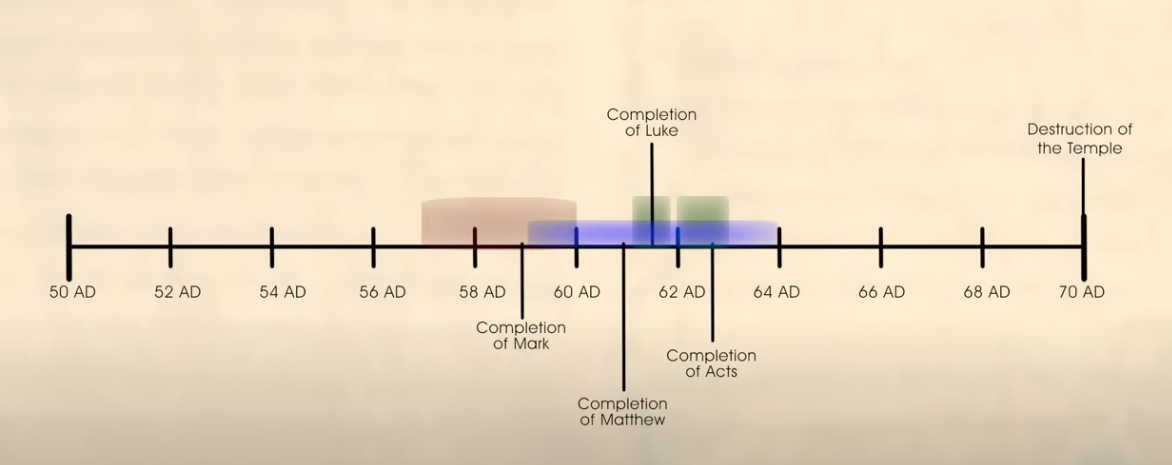
The Book of Acts provides a detailed account of the early Christian church, focusing on the ministries of Peter and Paul and the spread of the gospel from Jerusalem to Rome. Scholars generally date Acts to the early 60s AD, though some skeptical scholars propose a much later date, often in the late 1st or early 2nd century (@Pervo2006-vl, @KnoxUnknown-wz). However, both internal and external evidence strongly support an earlier date, likely around AD 62-64, shortly after the events it describes.

When Was Acts Written?

Internal Evidence

Acts provides several historical details that align with events before AD 64, suggesting it was written shortly after these events. The book mentions a change in governors from Felix to Porcius Festus (Acts 24:27) that occurred in 60 A.D. Festus later is the one that decides to send Paul for trial (Acts 27:1-2). The narrative ends with Paul still awaiting trial in Rome two years later, without narrating his trial, release, or death (Acts 28:16, Acts 28:30-31). This omission suggests the book was completed before these events occurred. Similarly, Luke omits the death of James, the brother of Jesus, in AD 62, despite including the death of James the Apostle earlier in the narrative. This supports the idea that Acts was finished before James's death.

Furthermore, Paul had not yet fulfilled his intention to bring the Gospel to Spain, as mentioned in his epistle (Romans 15:24, 28). Scholars infer that these factors point to a composition date around AD 62 (@Harnack2004-or, @Bernier2022-xz).

External Evidence

Acts is the sequel to the Gospel of Luke, which must predate it, placing Luke’s composition in the early 60s AD. Luke’s Gospel itself draws from the Gospel of Mark, suggesting Mark was written even earlier. Traditional accounts date Mark’s Gospel to the late 50s AD, during Peter’s ministry in Rome (@Bruce2007-tq). Early church fathers, such as Irenaeus and Clement of Alexandria, affirm Luke’s authorship and link Acts to the apostolic era (@Marshal1998-gp).

The political climate in Acts also reflects a pre-Neronian context, with Roman authorities generally appearing neutral or protective toward Christians (@Hemer1989-db).

Taken together, the internal and external evidence strongly support a composition date for Acts in AD 62-64, shortly after the events it narrates.

Dating The Gospels In Light Of Evidence

Matthew

Matthew Was Written Around 50-60 A.D.

The Gospel of Matthew is often dated earlier than 70 A.D. due to its focus on Jewish customs and its lack of reference to the destruction of the Temple.

Mark

Mark Was Written Around 50-60 A.D.

The Gospel of Mark is considered the earliest Gospel due to its brevity and lack of theological development seen in later texts.

Luke and Acts

Several factors suggest earlier authorship For the 3rd Gospel:

Luke/Acts Was Written Around 61-62 A.D.

The biggest factor for dating Luke early is the dating of the Book of Acts:

With Acts Show To be Early, The Gospel of Luke and the book of Acts show us that Luke is to most probable author

John

John Was Written Around 85-95 A.D.

The Gospel of John’s later date reflects its distinct theological focus and its audience of a broader, Hellenistic world.

Table Of Gospel Dates

Gospels/Acts

Book Date Author
Matthew 59-64 A.D. Matthew
Mark 57-60 A.D. Mark
Luke/Acts 60-63 A.D Luke
John 85-95 A.D. John

Pasted image 20241120075537.png

Who Wrote The Gospels?

A modern myth is that the Gospels were Anonymous, and that we can not know who wrote them. However the Gospels have been validated and accepted as credible accounts of the life and teachings of Jesus Christ.


Short Answer, Matthew, Mark, Luke and John!


Internal Evidence For Authorship

Firsthand eyewitness accounts

The Writing Style Matches The Named Disciples

The internal writing have always supported the Matthew, Mark, Luke/Acts and John have been written by the named individuals.

External Evidence

Early Church Tradition

Early Church Evidence

This validation comes from early Church figures, who confirmed the authenticity of these Gospels and their conveyed message of salvation. In addition to the manuscript evidence, the writings of early church fathers provide a further testament to the reliability of the Gospels. Figures like Ignatius, Polycarp, and Irenaeus quoted extensively from the Gospels in their own writings, often within a few decades of their composition. These references not only affirm the existence of the Gospels but also indicate that they were recognized and accepted as authoritative texts in the early church.

The Gospels Trace Back To The Apostles Themselves

Apostolic Authorship Evidence

There is evidence that the Gospels trace their origins directly to the apostles or their close associates though Papias and Polycarp. These two primary sources provide compelling evidence that traces the Gospels' origins directly back to the apostles, particularly the Apostle John. Papias of Hierapolis, writing in the early 2nd century, offers a direct link to the apostolic circle. His testimony, preserved by Eusebius, affirms the apostolic authorship of the Gospels of Matthew and John. Papias' account is further corroborated by Polycarp, a prominent early Christian bishop of Smyrna, who was a direct disciple of the Apostle John. Irenaeus, also highlights this connection. Both Papias and Polycarp's testimonies reinforce the authenticity of the Gospels as direct reflections of the apostles' teachings.The close association between the apostles and the authors of the Gospels lends strong credibility to the claim that these texts reflect the authentic teachings and events of Jesus' life.

Authenticity through Embarrassing Details

Criterion of Embarrassment

The criterion of embarrassment suggests that details potentially uncomfortable or disadvantageous to the early Christian movement would be unlikely to be fabricated. The Gospels include instances such as Peter’s denial of Jesus, the disciples’ frequent misunderstandings, and the women as the first witnesses to the Resurrection—at a time when women’s testimonies were culturally undervalued. These accounts add credibility to the narrative, as it’s improbable that the Gospel authors would invent details that could undermine their message. Such inclusions point toward a commitment to historical accuracy over embellishment.

The Disciples Accurately Remembered The Words Of Jesus

Coming Soon
Memory in Ancient Culture
Reliable Oral Tradition
Jesus Taught In Easy To Remember Sayings

Historical Evidence

Manuscript Evidence

We Have The Original Authenticated Texts

One of the strongest arguments for the authenticity of the Gospels lies in the sheer volume of manuscript evidence. Thousands of Greek manuscripts, along with translations in various languages, provide a robust framework for textual criticism. For instance, the New Testament boasts over 5,800 Greek manuscripts, with some dating back to within a century of the original writings. In comparison, other ancient texts, like those of Homer, survive in far fewer copies and with much later dates.

Textual critics have examined these manuscripts for variations, which are often minor and involve spelling, word order, or synonyms. Importantly, no substantial doctrinal changes arise from these variants. In fact, scholars like Bart Ehrman acknowledge that while there are differences among the manuscripts, "the vast majority of the changes are minor and do not affect the meaning of the text."

How Many Variations Is There Of The New Testament

Textual variants in the New Testament refer to any differences in spelling, word order, omission, addition, substitution, or total rewrite of the text from a standard text such as a printed version or a specific manuscript. According to Daniel B Wallace, a leading textual critic, there are approximately 400,000 variations in the New Testament alone-about three variants per word (IGNTP), Wasserman2018-jq.).

This staggering number of variants can be classified into four categories (Tim Barrnet).

Category 1: Neither meaningful nor viable

  • The first category includes over 200,000+ variants that are neither viable nor meaningful. These comprise over 75% of all textual variants, which means over 75% of textual variants have no effect on anything whatsoever. These variants mostly consist of spelling mistakes and do not alter the original text. (they don’t change the meaning and have no chance of being original)
    **Category 2: Viable but not meaningful **
  • The second category includes viable but not meaningful variants, which could alter the text but not change its meaning or intent. For instance, a variant in the spelling of a name. (they don’t change the meaning and have a chance of being original)
    Category 3: Meaningful but Not viable
  • The third category comprises meaningful but not viable variants, which are changes to the text that alter its message, such as adding a phrase or words that were not in the original text. (they do change the meaning, but have no chance of being original)
    Category 4:Both Viable and meaningful
  • Finally, the fourth and most significant category includes viable and meaningful variants, which have a good chance of being authentic and change the meaning of the text. However, this category accounts for less than 1% of all textual variants. (they do change the meaning and do have a chance of being original)

For Category 4, this example is from Bereanpatroit.com

Quote

I have a rather humorous example:

1 Thessalonians 2:7

But we proved to be gentle among you, as a nursing mother tenderly cares for her own children.

There’s a Textual Variant for the word “gentle”. Most manuscripts read “gentle”, some read “little children” and one manuscript reads “horses”. It’s easy to explain these variants when you see how these words are spelled in Greek, so here are the first three words of the verse in each Textual Variant:

  • Alla Egenēthēmen ēpioi (gentle)
  • Alla Egenēthēmen nēpioi (little children)
  • Alla Egenēthēmen hippioi (horses)

Context tells us that nēpioi (little children) can’t be intended, and since the previous word begins with “n”, it’s easy to see how the mistake was made (doubling the “n”). Often, one scribe would read while several other scribes copied. If you heard it read, you’d realize it’s an easy mistake to make because they sound almost identical. (Because the previous word ends with an “n” sound)

Further, there’s no possible way that hippioi (horses) was intended. It was a simple scribal error, easily noticed and just as easily corrected. (With a good chuckle. 🙂 ) Both Textual Variants are meaningful, but it’s nearly impossible for them to be original (they aren’t viable).

Despite the high number of variations, skeptical scholars such as Bart D. Ehrman agree that these variations do not affect the Christian doctrine (Carson1978-no.)). No substantial historical fact about Jesus or important Christian doctrine is questioned by the variations found in early Christian manuscripts. Most of the changes found in these manuscripts are a result of errors, such as slips of the pen, accidental omissions, inadvertent additions, misspelled words, and other blunders.

Even though there are over 400,000 variations, most of these are insignificant spelling mistakes and only about 40 lines or 400 words in the entire New Testament are in doubt. None of these 400 words affect any significant doctrine. Therefore, despite the variations, over 99% of the New Testament is the original words of the first Christians (Geisler1995-fy.).

These variations are a testament to how important preserving the gospel message has always been for Christians. Since the early church days when the apostles first wrote their gospels and epistles, Christians and scribes have taken great care to preserve the Bible and its message for future generations. Christians have taken great care to preserve the Bible and its message for future generations, and the variations are a testament to the importance of preserving the gospel message.

The Gospels Match Naming Patterns Of The Time

1st-Century Name Statistics

Historical Accuracy of Names in the New Testament

The names found in the New Testament, particularly in the Gospels and Acts, closely align with name frequencies from 1st-century Palestine, strengthening their historical credibility. The most common male names, like Simon and Joseph, mirror the period’s naming conventions. Rare names also match in rarity, and Greek names are proportionately represented. This alignment indicates that the texts reflect true naming trends of the time.

Jesus Original Sayings Are Preserved

Coming Soon- What Language Did Jesus Speak

The 4 Gospels Match The Beliefs Of The First Christians

Coming Soon-The Gospels Of The 1st Century

Multiple Attestation Of The Gospels

Coming Soon- The Single Narrative Of The Gospels
Undesigned Coincidences in the Gospels

Subtle Agreements Supporting Gospel Reliability

In Christian apologetics, Undesigned Coincidences refer to subtle, incidental agreements between different accounts in the Gospels and other historical records, providing additional evidence for their authenticity. These coincidences occur when one Gospel describes a detail that another Gospel indirectly corroborates, showing a deeper narrative coherence across the texts. Examples include how Mark recounts Herod’s feast and the descriptions by Josephus align, suggesting common traditions within Herod’s family that are based in history.

Additional examples, like matching place names, local customs, and tax records, further reveal these unplanned harmonies between Gospel accounts and historical sources. These subtle interconnections imply that Gospel authors drew from authentic events and oral traditions, rather than fabrication.


Prophecy Validates The Gospels

Ancient Prophecies Foretelling the Messiah

The Messiah Was Prophesied Before The New Testament Was Written!

Many passages in the Hebrew Scriptures foretell the coming of a Savior, and the Gospels present Jesus as the fulfillment of these ancient prophecies. For example, Isaiah 53 speaks of a suffering servant who would bear the sins of many, a description that matches closely with Jesus' crucifixion (Isaiah 53:3-5, Matthew 27:27-31). Micah 5:2 predicts that the Messiah would be born in Bethlehem, a prophecy confirmed in the Nativity accounts of Matthew and Luke (Matthew 2:1-6, Luke 2:4-7). Additionally, prophecies like the promise of a descendant of David (2 Samuel 7:12-16) and the role of the Messiah as a king bringing peace (Zechariah 9:9) align with the portrayal of Jesus in the Gospels. These predictions, written centuries before the New Testament texts, offer compelling evidence that the coming of the Messiah was part of a divine plan, fulfilled in the life, death, and resurrection of Jesus.

Predictive Accuracy in the Gospels

Jesus’ Prophecy of Jerusalem's Fall

In the Gospels, Jesus is recorded predicting the destruction of Jerusalem, which occurred in 70 AD. Jesus foretold this event decades prior, describing specific details of the city’s downfall that would later be confirmed by historical accounts. For instance, in the Olivet Discourse, Jesus warns of a time when not “one stone will be left on another” regarding the Temple’s destruction, emphasizing both the city’s devastation and suffering for its inhabitants (Mark 13:1-2, Matthew 24:1-2, Luke 21:6).

First-century historians, including Josephus, later described how Roman forces under Titus besieged Jerusalem, leveled the Temple, and decimated the city, aligning with the prophecy Jesus gave. This remarkable fulfillment is seen by many as evidence of Jesus’ prophetic insight, highlighting both the reliability of the Gospels and their rootedness in real historical events.

See More: Jesus Predicted The Fall Of Jerusalem (Coming Soon)

Jesus And The Resurrection Was Prophesied

The belief in the resurrection was not unforeseen. Ancient texts like Psalm 22 and Isaiah 53, written by David, are believed by many Christians to have prophesied about Jesus' crucifixion and resurrection. The consistency of these ancient texts with the New Testament accounts strengthens their credibility.

Jesus Was Foretold Hundreds Of Years Before He Was Alive

Jesus Was A Real Person

The existence of Jesus is confirmed by both Christian and non-Christian sources. Non-Christian sources acknowledge his birth in Bethlehem, his wisdom and miracles, his significant following during his lifetime, the founding of Christianity, his crucifixion, and the persistence of the Christian faith after his death.

Jesus Was Crucified and Buried

Jesus' crucifixion and burial are historical facts, supported by archaeological evidence from the same period, common Roman practice, and modern medical studies. The Romans generally respected Jewish customs, allowing the Jews to bury Jesus before the Passover. Jewish law, which demanded the burial of those who died by hanging on a tree the same day, further supports the notion of the burial of crucified victims.

See More: Was Jesus Buried

The Tomb Was Empty

After Jesus' crucifixion, the tomb he was placed in was found empty. The fact of the empty tomb was not disputed, even by critics of Christianity. The lack of Jesus' remains being presented by authorities, despite their interest in discrediting the Christian message, implies the empty tomb was indeed a reality.

The early Christian church has always believed in the empty tomb. According to the Gospels and Acts of the Apostles, the disciples of Jesus found the tomb empty three days after his crucifixion, and this event became the basis of the Christian belief in the resurrection of Jesus. The early Christian community preached the message of the empty tomb, and this belief is reflected in the writings of the New Testament and in the creeds of the early church.

Within just two months of the resurrection event (Acts 2:29-32) Peter and other eyewitness of the empty tomb started the first church in Jerusalem and preached with authority that Jesus had rose from the grave (Bauckham2017-ml, Bruce2003-ai, Bird2005-wu, Taylor1933-rl).

The First Christian Creed Supported the Empty tomb.

The 1 Corinthians 15:3-4 creed supports the empty tomb tradition by explicitly mentioning Jesus' burial and subsequent resurrection, suggesting a known tomb was found empty. Its early dating (early 30s AD) indicates the tradition was part of the foundational beliefs of the early Christian community. The creed's connection to eyewitnesses, such as Peter and James, adds credibility to the empty tomb narrative. The creed serves as a basis for the belief in Jesus' resurrection, with the empty tomb being a crucial component in supporting this belief. Overall, the language and historical context of the 1 Corinthians 15:3-4 creed lend support to the empty tomb tradition.

The Body Of Jesus Was Never Found

By AD 75, some Jewish circles were postulating that the empty tomb was the result of body theft, in an attempt to counter Christian arguments positing the resurrection. The fundamental implication in this response is the acknowledgment of the tomb being empty. This line of argumentation is believed to have roots in Jewish perspectives from around AD 30, as documented by scholars (Craig1984-pb), Stein2009-qz, Swinburne2003-tz).

“What was in dispute was not whether the tomb was empty but why it was empty. We have no early evidence that anyone, either Christian or non-Christian, ever alleged that Jesus’ tomb still contained his remains.”

Moreover, it is significant to note that no documented instances exist of the Jewish community or Christian opponents producing Jesus's body to disprove the resurrection. This point, analyzed by scholars such (Pannenberg2004-dc, Davis1993-wv, Craig1989-gr, Evans2004-sq, Anderson1968-jz, Moreland1987-wo), boosted the reliability the Christian narrative.

In the face of these debates, the early Christian church persevered and expanded, with the uncontested claim of the empty tomb a significant factor in its growth, as detailed by scholars (Pannenberg2013-ig), Godet1887-xs, Fairbairn1882-fa).

By AD 75, some Jewish circles began proposing the theory of body theft to counter Christian claims of resurrection, acknowledging the empty tomb as a fundamental premise. However, there is no early evidence to suggest that anyone, whether Christian or non-Christian, alleged the presence of Jesus' remains in the tomb. The absence of documented instances where Jesus's body was produced by opponents further strengthens the reliability of the Christian narrative, a point emphasized by various scholars. Despite debates surrounding the empty tomb, the early Christian church continued to thrive and expand, with the uncontested claim of the empty tomb playing a crucial role in its growth, as evidenced by scholarly analysis.

The belief in the empty tomb of Jesus has been a fundamental aspect of Christian faith since its earliest days. After the crucifixion, Jesus' followers reported discovering the empty tomb three days later, an event that underpins the Christian belief in Jesus' resurrection. The apostle Peter and others, having witnessed the empty tomb, began preaching in Jerusalem about Jesus' resurrection as early as two months after the event. This belief is reflected in the New Testament writings and early Christian creeds, such as the creed found in 1 Corinthians 15:3-4. Furthermore, historical evidence suggests that Jesus' body was never found, supporting the belief in the empty tomb. Therefore, the early Christian Church has consistently upheld the significance of the empty tomb as the cornerstone of their belief in Jesus' resurrection.

Many saw Jesus after He was killed

After Jesus' death, there were multiple instances where He appeared to individuals in different settings. The consistency of these accounts among diverse witnesses adds to their credibility. Importantly, the early church's belief in the physical nature of these appearances and the transformation of initial skeptics into believers strengthens the case for Jesus' resurrection.

The reported experiences with Jesus after His death happened in various settings, involving multiple people at different locations and times. Witnesses saw Jesus in Judea and Galilee, in town and countryside, indoors and outdoors, in the evening, by appointment and without prior appointment, close and distant, on a hill and by a lake, to groups of men and groups of women, to individuals and in groups of up to five hundred. Throughout these encounters, Jesus was seen standing, walking, and always engaging in conversation (Williams2018-tp).

The appearances of Jesus reported in the Bible are characterized by certain key elements. These elements bridge together to provide a compelling case for the reality of these appearances. Here are some noteworthy aspects of these encounters (The following list is partially taken from InspiringPhilosophy2016-ma:

Many People Saw Jesus!

Jesus Appeared in Individual and Group Settings

In various parts of the New Testament, the Bible recounts instances where Jesus appeared to people after his crucifixion. He appeared to the women disciples outside of the tomb, to Peter The Apostle, to 11 disciples, to Cleopas and his companion, James, to seven disciples on the shore, and to Paul the Apostle. One of the most notable of these instances is detailed in 1 Corinthians 15:3-7. Here, Paul lists several appearances of Jesus, including one where he appeared to more than 500 brethren at once. Similarly, the book of Acts (2:32; 13:30-32) features testimonies of Jesus' appearances, emphasizing their collective nature (Lake1907-tu, Craig1989-gr).

Consistency of Jesus' Appearances

The Bible reports consistent descriptions of Jesus' appearances to different individuals and groups, including the twelve disciples, Paul, James The Lesser (brother of Christ), the five women at the tomb, and possibly 500 others. These consistent accounts across a wide range of witnesses, who had diverse backgrounds and perspectives, add credibility to the reports of Jesus' appearances (Lake1907-tu, Craig1989-gr).

They Were Not Hallucinations

The Multisensory Experiences of the Appearances

According to the scriptures, the appearances of Jesus were multisensory experiences. These accounts include details of the disciples hearing Jesus' voice and seeing his figure (Acts 10:43-43; 22:7-9; 26:12-18). They also mention instances of physical touch, such as when Thomas was invited to touch Jesus' wounds (John 20:27). These multi-faceted experiences suggest a comprehensive, tangible encounter rather than a simple vision or dream.

See More Evidence

Absence of Realistic and Emotional Expectations for Resurrection

The Disciples Did Not Expect Jesus To Rise From The Dead

There's significant evidence to suggest that Jesus' disciples did not expect him to rise from the dead. Despite Jesus' own predictions of his resurrection (Mark 8:31, 9:31, 10:34), the concept was foreign to their Jewish beliefs and expectations about the Messiah. This lack of anticipation makes it less likely that the reported appearances were products of wishful thinking or hallucination.

See More Evidence

The Jews Were Not Expecting A Resurrection Event

The Appearances Were Physical

The Early Church's Belief in Physical Appearances

The early church consistently believed and taught that Jesus' appearances after his resurrection were physical, not just spiritual or visionary. J.H. O'Connell in his 2009 study, Jesus' Resurrection and Collective Hallucinations, explores this topic, reinforcing the view that the early Christians believed in a tangible, bodily resurrection.

See More Evidence

The First Christian Creed Supports A Physical Ressurection

Initial Skepticism Among the Witnesses

Doubting Thomas

Several of those who reported seeing the resurrected Jesus initially expressed skepticism, most notably Thomas (John 20:24-29). Known as "Doubting Thomas," he refused to believe the accounts of the other disciples until he saw Jesus with his own eyes and touched his wounds. These instance of skepticism and subsequent confirmation supports the authenticity of these experiences, demonstrating they weren't just accepted without question or scrutiny.

Doubting The Woman

The disciples did not beleive the witnesses of the resurection - the woman untill Peter and John confimed it with there own eyes. This is aligned with histories view of woman in the 1st century. See Cultural And Theological Implications Of Women Being The First To Witness The Resurrected Savior and Criterion Of Embarrassment

Conclusion

The appearances of Jesus after His death were witnessed by multiple individuals in various settings and times. These encounters occurred in different locations such as Judea and Galilee, indoors and outdoors, and involved groups of people as well as individual witnesses. The appearances were characterized by multisensory experiences, including hearing Jesus' voice, seeing His figure, and even physical touch. The consistency of these accounts among diverse witnesses adds credibility to their reports. Importantly, the early church believed in the physical nature of these appearances, and some witnesses initially expressed skepticism before being convinced of Jesus' resurrection. These elements collectively provide a compelling case for the reality of the reported appearances of Jesus after His resurrection.

The First Christians preached despite the persecution

After Jesus' crucifixion, his followers were fearful and demoralized. Yet, after the purported resurrection, they became emboldened, publicly preaching about Jesus and establishing the early Christian Church. This drastic transformation in behavior is hard to explain without a significant event like the resurrection.

I know the resurrection is a fact, and Watergate proved it to me. How? Because 12 men testified they had seen Jesus raised from the dead, then they proclaimed that truth for 40 years, never once denying it. Most were beaten, tortured, stoned and put in prison. They would not have endured that if it weren't true. Watergate embroiled 12 of the most powerful men in the world-and they couldn't keep a lie for three weeks...You're telling me 12 apostles could keep a lie for 40 years? Absolutely impossible.

After the Resurrection, the lives of the disciples changed dramatically. They were shown repeatedly failing to understand what The Son Of God had to endure. The Gospels record them running to save themselves at the time of Jesus' arrest; they were been timid, afraid, and depressed after witnessing the suffering of Jesus (Matthew 26:31-56; Mark 15:50; John 20:19). But after His resurrection, they became aggressive, bold, and full of joy. Less than 50 days after their entire lives were destroyed because of the death of Jesus, they were boldly preaching that Jesus was alive (Blackaby2008-ew), even to the point of death.

Jesus' Disciples and his skeptics became convinced that Jesus had appeared to them after his death.

The Disciples believed in the Resurrection of Jesus only after they saw him come alive. They claimed to have seen Him on several occasions for 40 days. Some of these disciples such as James, Jesus' own brother, and the famous Apostle Paul did not believe or follow Jesus while he was alive; however, after His Death, they were convinced that the Jesus that appeared to them alive was the risen Messiah.

It is important to note that the disciples endured persecution, and a number of them experienced martyrdom. The strength of their conviction indicates that they were not just claiming that Jesus had appeared to them after rising from the dead - they truly believed it. They willingly endangered themselves by publicly proclaiming the risen Christ. Many scholars, even skeptical ones, agree that the disciples truly believed that Jesus was alive and had appeared to them:

It is a historical fact that some of Jesus' followers came to believe that he had been raised from the dead soon after his execution. We know some of these believers by name; one of them, the apostle Paul, claims quite plainly to have seen Jesus alive after his death. Thus, for the historian, Christianity begins after the death of Jesus, not with the resurrection itself, but with the belief in the resurrection.

The Death Of The Apostles

These new Christians did not have money, power, or fame to gain; rather, they were persecuted from the beginning of their faith until they died

Those that followed and worshiped Jesus as Lord were persecuted, tortured and martyred. (OverviewBible has a good list that goes into detail).

1: Peter The Apostle:

The tradition that Peter suffered martyrdom in Rome is almost as old and as universal as the Bible itself. According to tradition, Peter was martyred in Rome under Emperor Nero's persecution of Christians, sometime around AD 64-68. The exact details of his death are not recorded in the Bible, but John records a conversation that Jesus had with Peter, where He may have been prophesying how Peter would die.

18. Truly, truly, I say to you, when you were young, you used to dress yourself and walk wherever you wanted, but when you are old, you will stretch out your hands, and another will dress you and carry you where you do not want to go.”

Some say that Peter was not in Rome, so He could not have died there, however there may be evidence that he not only visited Rome but may have died there as well.

Peter May Have Said He was in Rome:

There is no explicit mention that Peter was in Rome or not in Rome in the Bible. However in In 1 Peter 5:13, Peter refers to "the church that is in Babylon, chosen together with you, sends you greetings," which some scholars interpret as a reference to the Christian community in Rome. This interpretation is based on the idea that Peter was using "Babylon" as a code word for Rome (Ehrman1996-xv, Minear1965-rb), in order to avoid drawing attention to himself and the Christian community in Rome, which was facing persecution under the Roman Empire.

In the Old Testament, Babylon was a powerful and oppressive empire that conquered Judah and destroyed the Temple in Jerusalem, leading to the Babylonian exile. In the New Testament, the term "Babylon" is used symbolically to refer to Rome, which was seen as a similarly oppressive and pagan power. For example, in the book of Revelation, the term "Babylon" is used to refer to a great city that is the center of evil and corruption. Many scholars believe that this city is symbolic of Rome, which was the center of the Roman Empire and a place where Christians faced persecution (Dunn2003-mz).

There is strong church tradition

The early church fathers are unanimous in claiming that Peter died in Rome, by crucifixion, during the persecution of Nero in AD 64. The first extra-biblical witness to the death of Peter is Clement of Rome). Clement does not say where Peter was killed, as it appears to have been well known at the time of his writing, and indeed it is unlikely that the early Church could have known of the death of Peter without knowing where he died, and there is in neither case a single opposing tradition.

Ignatius seems plainly to imply that Peter had been in Rome. Irenaeus agrees that Peter served in Rome. The Roman Emperor Phlegon is said by Origin to have confused Jesus and Peter in his Chronicles. Dionysius, distinctly states that Peter labored in Rome, and Caius is a witness for it. Tertullian is the first external source to mention Peter's death by crucifixion as a known fact. Eusebius of Caesarea continues to report in his History of the Church that Peter was preaching in Rome and starting the Church where he would later be crucified.

He May Have Been Crucified Upside Down

The apocryphal Acts of Peter is the most well-known and earliest account that describes the crucifixion of Peter upside down. However, it is considered weakly attested as it is the only source that provides this specific detail. (Oakes2010-ks)). The Acts of Peter narrates that Peter was arrested and imprisoned in Rome, where he converted his jailer to Christianity and performed miracles. Nero, upon hearing about these miracles, ordered Peter to be crucified. At the end of the text, Peter flees Rome to avoid martyrdom. On the road Peter meets Jesus, who is traveling in the opposite direction. He asks Jesus, “Where are you going?” Jesus tells Peter that he is going to Rome “to be crucified again.” Peter realizes, from this, that he cannot flee from his fate and returns to Rome to be crucified upside down (Stoops2012-at).

Eusebius of Caesarea also passes this tradition down. He reports that Peter appears to have preached in Pontus, Galatia, Bithynia, Cappadocia, Asia, then at last to Rome, where he was crucified head-downwards (Josephus1927-dh).

Conclusion

The tradition of Peter's martyrdom in Rome is deeply rooted in early Christian history and corroborated by various sources outside the biblical text. While the Bible hints at Peter's future suffering in John 21:18, early Christian writings and church fathers like Clement of Rome, Ignatius, Irenaeus, Dionysius, Caius, Tertullian, and Eusebius provide more explicit accounts of his presence and subsequent death in Rome. This tradition is supported by the symbolic reference to "Babylon" in 1 Peter 5:13, widely interpreted by scholars as a codename for Rome, a city notorious for its persecution of Christians. The unanimity among the early church fathers regarding Peter's martyrdom in Rome, coupled with the lack of any opposing tradition, strengthens the historical credibility of this account. The detail of Peter being crucified upside down, primarily derived from the apocryphal Acts of Peter and acknowledged by Eusebius, although less attested, aligns with the narrative of Peter's humility and his desire to not emulate his Lord's crucifixion directly.

2: Andrew The Apostle:

A fourth-century account reports that Andrew was crucified upside down on a X shaped cross, like his brother Simon Peter, he did not feel he was worthy of dying in the same way his Master had.

3: James The Greater:

We know James died in A.D. 44 after he was beheaded by King Herod I from Luke's account of the Acts of the Apostles. He was the first martyr from among the twelve apostles (Acts 12:1-2).

4: John The Apostle:

John was believed to have died from natural causes, although he was immersed in a barrel of boiling oil but survived unharmed. He was then exiled on the Isle of Patmos before he was released and went to Ephesus where he died (A.D. 100-105).

See Philip Schaff, Papias of Hierapolis seems to suggest that John was killed by Jewish men.

5: Philip The Apostle:

Philip died in Hieropolis, Turkey by hanging (A.D. 80).

6: Nathanael The Apostle:

It is believed that Nathanael had ministered in Armenia and was flayed to death with knives in India, Another tradition claims he was beaten unconscious and drowned in the ocean. (De_Voragine2012-qs).

7: Matthew The Apostle:

It is said that Matthew died a martyr's death in Ethiopia. It is unknown the cause of death, one source says he killed with halberd (Foxe2020-zi), but the Talmund seems to support that he was stoned (Rodkinson2018-qf, Lardner2015-xn, Martin2012-tz ). Clement of Alexandria quotes Heracleon saying that he died of old age, but this has been rejected by scholars (Marx1979-ed).

8: Thomas The Apostle:

Ancient tradition says that specifies Thomas was martyred in Mylapore, noting that he was killed with a spear (Medlycott1905-ca, Farmer2011-ro, Cordier1920-us).

9: James The Lesser:

Tradition maintains that he was crucified at Ostrakine in Lower Egypt, where he was preaching the Gospel. (Schaff2015-sm)

10: Jude Thaddaeus:

Thaddaeus was martyred in Persia. He died via arrows according to the Acts of Simon and Jude found in the The Golden Legend (De_Voragine2012-qs)

11: Simon The Zealot:

It is believed that he ministered together with Thaddaeus and was killed with him in Persia, but another account from Ethiopian Christians claim he was crucified in Samaria (De_Voragine2012-qs). One Tradition says that Simon was crucified (McDowell2016-rq).
Moses of Chorene recorded that Simon the Zealot was martyred in the Kingdom of Iberia.In the sixteenth century, Justus Lipsius recorded that he was sawed in half ([Loffler_undated-qd).

12: Mathias The Apostle:

One tradition records that he was stoned by cannibals in Aethiopia (MacDonald1990-lt, Eusebius_of_Caesarea_Bishop_of_Caesarea2005-ro). Another tradition says, he was stoned by Jews in Jerusalem and then beheaded.

13: Paul The Apostle:

The death of Paul the Apostles and the rest of the church founders is often used in Christian apologetics when talking about evidence for the resurrection. It is said that Paul was martyred by Nero, possibly after Christians were blamed for the fire in Rome. Here is a list of sources that that talk about Paul’s death.

From Dionysius Of Corinth:

“Therefore you also have by such admonition joined in close union the churches that were planted by Peter and Paul, that of the Romans and that of the Corinthians: for both of them went to our Corinth and taught us in the same way as they taught you when they went to Italy; and having taught you, they suffered martyrdom at the same time.”

From the fragments of Caius:

"And I can show the trophies of the apostles. For if you choose to go to the Vatican or to the Ostian Road, you will find the trophies of those who founded this church."

---The History of the Church

From Sulpicius Severus’s Chronica:

“Afterwards, too, their religion was prohibited by laws which were enacted; and by edicts openly set forth, it was proclaimed unlawful to be a Christian. At that time Paul and Peter were condemned to death, the former being beheaded with a sword, while Peter suffered crucifixion.”

---Schaff, P. (Ed.)

Ignatius of Antioch wrote:

“I know both who I am, and to whom I write. I am a condemned man; you have been the objects of mercy. I am subject to danger; you are established in safety. You are the persons through whom those pass that are cut off for the sake of God. You are initiated into the mysteries of the gospel with Paul, the holy, the martyred, the deservedly most happy — at whose feet may I be found, when I shall attain to God! — who in all his letters makes mention of you in Christ Jesus.”

From Clement of Rome on the death Paul and Peter The Apostle:

“But not to dwell upon ancient examples, let us come to the most recent spiritual heroes. Let us take the noble examples furnished in our own generation. Through envy and jealousy the greatest and most righteous pillars [of the church] have been persecuted and put to death. Let us set before our eyes the illustrious apostles. Peter, through unrighteous envy, endured not one or two, but numerous labours; and when he had at length suffered martyrdom, departed to the place of glory due to him. Owing to envy, Paul also obtained the reward of patient endurance, after being seven times thrown into captivity, compelled to flee, and stoned. After preaching both in the east and west, he gained the illustrious reputation due to his faith, having taught righteousness to the whole world, and come to the extreme limit of the west, and suffered martyrdom under the prefects.”

Tertullian informs us in Prescription Against Heretics:

“Since, moreover, you are close upon Italy, you have Rome, from which there comes even into our own hands the very authority [of apostles themselves]. How happy is its church, on which apostles poured forth all their doctrine along with their blood! — where Peter endures a passion like his Lord’s! — where Paul wins his crown in a death like John’s!”

From John Chrysostom:

“Then therefore, when matters were in this state, some of the enemies of Paul, desiring to fan up the war to greater vehemence, and to make the hatred of the tyrant, which was felt towards him greater, pretended that they themselves also preached; (and they did preach the right and sound faith,) for the sake of the doctrine advancing more rapidly: and this they did, not with the desire to disseminate the faith; but in order that Nero, having learned that the preaching was increasing and the doctrine advancing, might the sooner have Paul led away to execution.”

Eusebius Of Casarea claimed that Paul was beheaded at the order of the Roman emperor Nero or one of his subordinates:

“Thus publicly announcing himself as the first among God's chief enemies, he was led on to the slaughter of the apostles. It is, therefore, recorded that Paul was beheaded in Rome itself, and that Peter likewise was crucified under Nero. This account of Peter and Paul is substantiated by the fact that their names are preserved in the cemeteries of that place even to the present day.“

From Lactantius:

“He [Nero] it was who first persecuted the servants of God; he crucified Peter, and slew Paul:”

We can also safely assume that no matter what kind of death Paul faced, he was prepared to meet his fate. He wrote in Philippians 1:21-24:

21. For to me to live is Christ, and to die is gain. 22. If I am to live in the flesh, that means fruitful labor for me. Yet which I shall choose I cannot tell. 23. I am hard pressed between the two. My desire is to depart and be with Christ, for that is far better. 24. But to remain in the flesh is more necessary on your account.

In 2002, a tomb, inscribed with the words "Paul apostle martyr" was discovered during excavations around the Basilica of Saint Paul Outside the Walls. It was declared to be the tomb of Paul the Apostle in 2005. In June 2009 a probe was used to examine the tomb, which revealed pieces of incense, purple and blue linen, and small bone fragments radiocarbon-dated to the 1st or 2nd century. According to the Vatican, these findings support the conclusion that the tomb is Paul's (The2009-hb).

The historical evidence surrounding the death of Paul the Apostle, as recounted by early Christian writers and church fathers such as Dionysius of Corinth, Caius, Sulpicius Severus, Ignatius of Antioch, Clement of Rome, Tertullian, John Chrysostom, Eusebius of Caesarea, and Lactantius, consistently portrays Paul as a martyr, most likely beheaded by the order of Emperor Nero. These accounts, affirm the strong tradition within early Christianity that Paul faced death with a firm conviction in his faith, exemplified by his own words in Philippians 1:21-24. The archaeological discovery in 2002 of a tomb bearing Paul's name and containing bone fragments dating back to the 1st or 2nd century provides additional physical evidence supporting the traditional narrative of Paul's martyrdom.

14: James - Brother Of Christ:

Josephus records how James dies in Antiquities of the Jews Book 20, Chapter 9, 1

Quote

  1. AND now Caesar, upon hearing the death of Festus, sent Albinus into Judea, as procurator. But the king deprived Joseph of the high priesthood, and bestowed the succession to that dignity on the son of Ananus, who was also himself called Ananus. Now the report goes that this eldest Ananus proved a most fortunate man; for he had five sons who had all performed the office of a high priest to God, and who had himself enjoyed that dignity a long time formerly, which had never happened to any other of our high priests. But this younger Ananus, who, as we have told you already, took the high priesthood, was a bold man in his temper, and very insolent; he was also of the sect of the Sadducees,[23] who are very rigid in judging offenders, above all the rest of the Jews, as we have already observed; when, therefore, Ananus was of this disposition, he thought he had now a proper opportunity [to exercise his authority]. Festus was now dead, and Albinus was but upon the road; so he assembled the sanhedrim of judges, and brought before them the brother of Jesus, who was called Christ, whose name was James, and some others, [or, some of his companions]; and when he had formed an accusation against them as breakers of the law, he delivered them to be stoned: but as for those who seemed the most equitable of the citizens, and such as were the most uneasy at the breach of the laws, they disliked what was done; they also sent to the king [Agrippa], desiring him to send to Ananus that he should act so no more, for that what he had already done was not to be justified; nay, some of them went also to meet Albinus, as he was upon his journey from Alexandria, and informed him that it was not lawful for Ananus to assemble a sanhedrim without his consent.[24] Whereupon Albinus complied with what they said, and wrote in anger to Ananus, and threatened that he would bring him to punishment for what he had done; on which king Agrippa took the high priesthood from him, when he had ruled but three months, and made Jesus, the son of Damneus, high priest.

Those Apostles that followed and worshiped Jesus as Lord were persecuted, tortured and martyred.

We have strong data on at least the martyrdoms of Peter, Paul, and James, the brother of Jesus, recorded by Josephus and Clement of Rome, both before the close of the First Century. Josephus, of course, was not a Christian, so we cannot argue that he wanted to make the Christians look good. Further, Roman historians like Tacitus and Suetonius, along with Roman governor Pliny the Younger also tell us that early Christians were persecuted and even killed. These were also non-Christian authors who were trying to disparage Christianity, not brag about believers. Then, just a few years later, others died for their faith, like Ignatius and Polycarp. Willing deaths show that the martyrs sincerely believed their own reports. So, just to preach Jesus in the early church context would expose the preacher to at least the possibility of death. Virtually no scholars would deny that this occurred. But please note that I generally base these points on the disciples' willingness to die, because this keeps me from having to prove the actual point and their being willing is all you need to show they were sincere.

This only tells us that the early Christians believed in what they were saying, though belief does not prove the truth of a claim. People can die for something that they believe in, even if the claim itself is false (Little_undated-ya, Moreland1987-wo ). Noteworthy examples of this include the Nazis "Master Race" conviction, the Jonestown, Branch Davidian and Heaven's Gate incidents, and Japanese civilians that committed suicide rather than being taken to prison by the Americans, believing that they would be mistreated (Sieg2007-ey).

As detailed in other submissions, other alternate Resurrection theories that may explain this do not hold up.

Scholors Unanimously Report That They Were Not Lying

See Also, listed taken from James Bishop and Belief Map:

The Transformed Life of the Disciples after the Resurrection of Jesus is evidenced by their willingness to endure persecution and martyrdom for their faith, and is supported by both Christian and non-Christian sources. Their conviction and the evidence of the Resurrection are strong indications that Jesus truly rose from the dead.

Alternative explanations do not work

Alternative explanations such as the Hallucination Theory, the Stolen Body Theory, the Swoon Theory, the Spirit Resurrection Theory, the Impostor Theory, and the Wrong Tomb Theory fail to convincingly account for the diverse and consistent accounts of Jesus' resurrection, the empty tomb, and the dramatic transformation of Jesus' followers.

Ever since Jesus rose from the dead, unbelievers have tried in vain to explain away all the evidence that Jesus rose on the third day. Many such theories have risen and fallen in popularity over time. However, given the mountain of evidence in favor that Jesus really did rise from the dad, not one theory has been able to account for all the individual pieces of evidences. Scholars have noted that each theory fails in multiple ways and that they are sad attempts to deny what is true and what the Bible has always reported accurately.

In conclusion, the belief in the resurrection of Jesus holds reasonable ground, supported by the reliability of the Gospels, external confirmations of Jesus' life, prophesies, and the unwavering faith of the early Christians despite severe persecution. The weaknesses in alternative explanations further underscore the strength of the resurrection narrative.

Jesus Claimed To Be The God Of Israel

The concept of Jesus Christ's divinity is a fundamental aspect of Christian theology. For those new to this topic, it's essential to understand how the Bible itself portrays Jesus not merely as a historical figure or prophet, but as God in human form. This understanding is drawn from various passages that collectively paint a picture of Jesus' unique divine nature and authority. The divinity of Jesus Christ is not only affirmed in the New Testament but is also foreshadowed in the Old Testament. The best way I have found to articulate how Jesus is God in the Bible is with using the acronym H.A.N.D.S. Jesus is given (Bowman2007-gc):

  • (H) oners: Jesus shares the honors that are due God
  • (A) ttributes: Jesus shares the attributes of God, including being eternal, all-powerful, all-knowing, and loving
  • (N) ames: Jesus has been given names that are above every other name, including God, Lord, King of kings,
  • (D) eeds: Jesus shares the deeds that God does
  • (S) eat: Jesus shares the seat of God's eternal throne

This article is an overview of the claim, visit the links to go into more depth on each subject.

YAHWEH to Come

In Christian theology, The Hebrew scriptures that collectively anticipate a Messiah with divine attributes. These prophecies set the stage for the New Testament's portrayal of Jesus. For instance, the book of Isaiah speaks of a child who will be born, bearing titles like "Mighty God" and "Everlasting Father" (Isaiah 9:6), with the same wording applied to God himself in Isaiah 10:21. This child would be named Immanuel, literally "God with us". (Isaiah 7:14). The prophet Jeremiah promises this king would be from David's line, who will be called "The LORD [YAHWEH - יהוה] our righteousness," (Jeremiah 23:5-6). Micah 5:2 calls him the "whose coming forth is from of old, from ancient days.", linking him to God himself (Daniel 7:9). Psalm 110:1 portrays a figure seated at God's right hand, a position of unparalleled honor that surpasses earthly kingship.

The later chapters of Isaiah contributes significantly to the Christian understanding of God's divine nature. Isaiah 48:16 stands out as a passage where the divine LORD [YAHWEH - יהוה0]], mentions being sent by the LORD [YAHWEH - יהוה], alongside the Spirit, suggesting a multi-personal nature of God, which Christians later understand as the Trinity. Perhaps the most striking is the vision in Isaiah 6:1-10. Here, Isaiah sees the LORD [YAHWEH - יהוה] sitting on a high and exalted throne filling the temple, with the seraphim calling out about His holiness and glory. The Gospel of John references this vision directly (John 12:41), saying that that Isaiah saw Christ's glory, making him God in this passage.

God Became Man In Jesus

In the New Testament, affirming Jesus' divine status are various narratives and teachings in the New Testament. Matthew 1:23 introduces Jesus as "Emmanuel," or "God with us," from Isaiah 9:6 and Isaiah 7:14. In John's Gospel Jesus is described as the eternal Word, existing with God from the beginning and being divine Himself (John 1:1). John gets this from the Old testament, where the Word is [YAHWEH - יהוה] manifesting in a visible form (Genesis 15; Jeremiah 1; 1 Samuel 3:1; Ezekiel 1) In John 5:17-18, Jesus equates His actions and being with God.

Jesus is presented as "God" in doxologies and titles though the rest of the New Testament (Romans 9:5; Titus 2:13; 2 Peter 1:1; Jude 1:25). This divinity is explicitly acknowledged by Thomas in John 20:28, where he addresses Jesus as "my Lord and my God," a declaration that Jesus does not refute . Acts 20:28 speaks of the church being purchased by God [Jesus] with his own blood. Hebrews 1:8 affirms Jesus as God by linking him to YAHWEH (Psalm 45:6). Colossians 1:15-17 and2 Corinthians 4:4 present Jesus as the very image of God. Jesus is called equal to God in Philippians 2:6. Lastly, Romans 9:5 and 1 John 5:20 can be seen as recognizing Jesus as "the true God."

Throughout Scripture, Jesus consistently claimed to be the Son of God, and this assertion was understood by the Jewish leaders as a claim to equality with God (John 5:17-23, 8:58-59, 10:30-39). Jesus never denied these claims but affirmed them (John 5:17-23,8:58-59, 10:30-39, 19:7; Matthew 26:63-65) and even uses passages like Psalm 82:6 to defend the claim. God himself calls Jesus His Son (Psalm 2:2, Mark 1:11) and His followers also claim this about Jesus as well (Matthew 14:33, 16:16; John 11:25; Romans 8:3-4).

When the Jews confront Jesus in John 10, demanding to know if He is the Christ. Jesus asserts that his high status as the Son is based on Him doing the works of His Father: the Father is in him. This phrase parallels Exodus 23:20-21,where the Name—Yahweh’s Presence—was in the angel of YAHWEH who himself is God (Genesis 16:7-14, 22:9-16, 31:11-13, 32:24-30; Exodus 3:1-5; Judges 6:11-24). This theme continues as Gods name dwells in the temple throughout the old testament (Ezra 6:12; 2 Chronicles 6:6; 1 Kings 5:4-6, 1 Kings 36:1) Jesus goes on to say that He and the Father are one, which is said in context of being the source of eternal life (John 10:30) and also claims to be "I AM" [ἐγὼ εἰμί], the same God that appeared to Moses (John 8:58) .

These assertions lead to accusations of blasphemy from the Jewish leaders, who prepare to stone Jesus for his perceived claim to be God. In his defense, Jesus cites Psalm 82:6, arguing that if scripture calls certain figures 'gods', why is it blasphemous for Him, sanctified and sent by the Father, to call Himself the Son of God? He urges belief in him based on his works, evidencing the mutual indwelling of the Father and the Son. These instances, along with His declaration and His affirmation being the figure of Daniel 7:13 (Matthew 26:64;Mark 14:62; Revelation 1:7) ultimately lead to his death. However, scripture say that Jesus, God, and the Holy Spirit all raised Jesus from the dead (Acts 2:24; Galatians 1:1; 1 Peter 3:18; Romans 1:4, 8:11; John 2:19, 10:17-18, 11:25;Revelation 1:18).

Jesus Is Glorified

Jesus has many titles that show him to be God Almighty, such as:

We Find it no surprise then that God is worthy of worship, Jesus was worshiped by all creation in the Bible and though ALL of Christian history.

The divinity of Jesus Christ is thoroughly affirmed in the Bible, illustrated by His title as the Son of God, with roots in both Testaments. In the Old Testament, prophecies like Micah 5:2 and Isaiah 9:6 foretell His eternal origins and divine titles, paralleling God's attributes. Jeremiah 23:5-6 further supports this with the title "The LORD our righteousness" attributed to a Messianic figure from the line of David. These are reflected in New Testament affirmations of Jesus' divine nature through His actions and words, such as forgiving sins (Mark 2:5-7), asserting His pre-existence (John 8:58), and declaring unity with the Father (John 10:30). His "I Am" statements in John's Gospel are direct claims to divinity(John 8:58-59,John 10:30-39), a claim that Jesus never refuted (John 5:17-23,John 8:58-59, John 10:30-39, John 19:7; Matthew 26:63-65). In the New Testament, several writers take Old Testament passages that refer to only God alone, and say they are about Jesus instead (John 12:41 - Isaiah 6:1-10; John 1:1 - Genesis 15; Jeremiah 1; 1 Samuel 3:1; Ezekiel 1; Hebrews 1:8 - Psalm 45:6;)). The Apostles constantly make Jesus and His name equal with God throughout the New Testament and also call him God Directly (John 20:28;Romans 9:5; Titus 2:13; 2 Peter 1:1; Jude 1:25). The historical evidence demonstrates that early Christian practices and beliefs-such as prayer, baptism, and worship-center on Jesus, demonstrating early recognition of His divinity. His resurrection and ascension seal His divine authority and victory (John 1:1-3; Colossians 1:16).

Powered by Forestry.md