The Gospels teach that Jesus was nailed to the cross and died for our sins, but is this compatible with what we know about Roman Capital punishment in the first century?

It turns out that this claim is true to history!

Crucifixion stands as one of history's most brutal forms of capital punishment, intertwining with cultural, legal, and medical narratives across civilizations. Contrary to common belief, the Romans were not the progenitors of crucifixion; this gruesome method was already in practice among Assyrians, Phoenicians, and Persians long before the Roman adaptation. The Romans, however, refined it into an excruciating art of death, primarily reserved for the most despised individuals within society. This form of execution was so severe that Roman citizens were almost always exempt, highlighting its status as a punishment for the lowest of the low (Tzaferis2015-zm)

"Although the Romans did not invent crucifixion, they perfected it as a form of torture and capital punishment that was designed to produce a slow death with maximum pain and suffering. (10,17) It was one of the most disgraceful and cruel methods of execution and usually was reserved only for slaves, foreigners, revolutionaries, and the vilest of criminals. (3,25,28) Roman law usually protected Roman citizens from crucifixion, (5) except perhaps in the case of desertion by soldiers.....
With arms outstretched but not taut, the wrists were nailed to the patibulum. (7,11) It has been shown that the ligaments and bones of the wrist can support the weight of a body hanging from them , but the palms cannot. (11) Accordingly, the iron spikes probably were driven between the radius and the carpals or between the two rows of carpal bones, (2,10,11,30) either proximal to or through the strong bandlike flexor retinaculum and the various intercarpal ligaments. Although a nail in either location in the wrist might pass between the bony elements and thereby produce no fractures, the likelihood of painful periosteal injury would seem great. Furthermore, the driven nail would crush or sever the rather large sensorimotor median nerve. (2,7,11) The stimulated nerve would produce excruciating bolts of fiery pain in both arms. (7,9) Although the severed median nerve would result in paralysis of a portion of the hand, ischemic contractures and impalement of various ligaments by the iron spike might produce a clawlike grasp.
Most commonly, the feet were fixed to the front of the stipes by means of an iron spike driven through the first or second intermetatarsal space, just distal to the tarsometatarsal joint. (2,5,8,11,30) It is likely that the deep peroneal nerve and branches of the medial and lateral plantar nerves would have been injured by the nails. Although scourging may have resulted in considerable blood loss, crucifixion per se was a relatively bloodless procedure, since no major arteries, other than perhaps the deep plantar arch, pass through the favored anatomic sites of transfixion. (2,10,11)"

The Romans' adaptation of crucifixion as a method of execution thus stands as a testament to their capacity for cruelty and their commitment to enforcing capital punishment as a deterrent. Roman citizens were typically spared from such a fate, showcasing the punishment's infamy.

The archaeological record provides concrete evidence of the brutal practice of crucifixion in ancient times. Two significant finds from the same period illustrate the reality of this form of execution. The first discovery, detailed by Gualdi-Russo et al. in their 2019 study, involves the body of a man buried in northern Italy around 2,000 years ago (Gualdi-Russo2019-pq). The remains exhibit signs that the individual died after being nailed to a wooden cross, suggesting that crucifixion was practiced beyond the boundaries of Judea.

In a similar vein, Tzaferis's 1970 research unveils another instance, focusing on the heel bone of a young male, aged between 20 and 23, found with a nail driven through it, indicative of crucifixion. This finding corroborates the historical narrative that crucifixion was a widespread method of execution during that era (Tzaferis1970-tv).
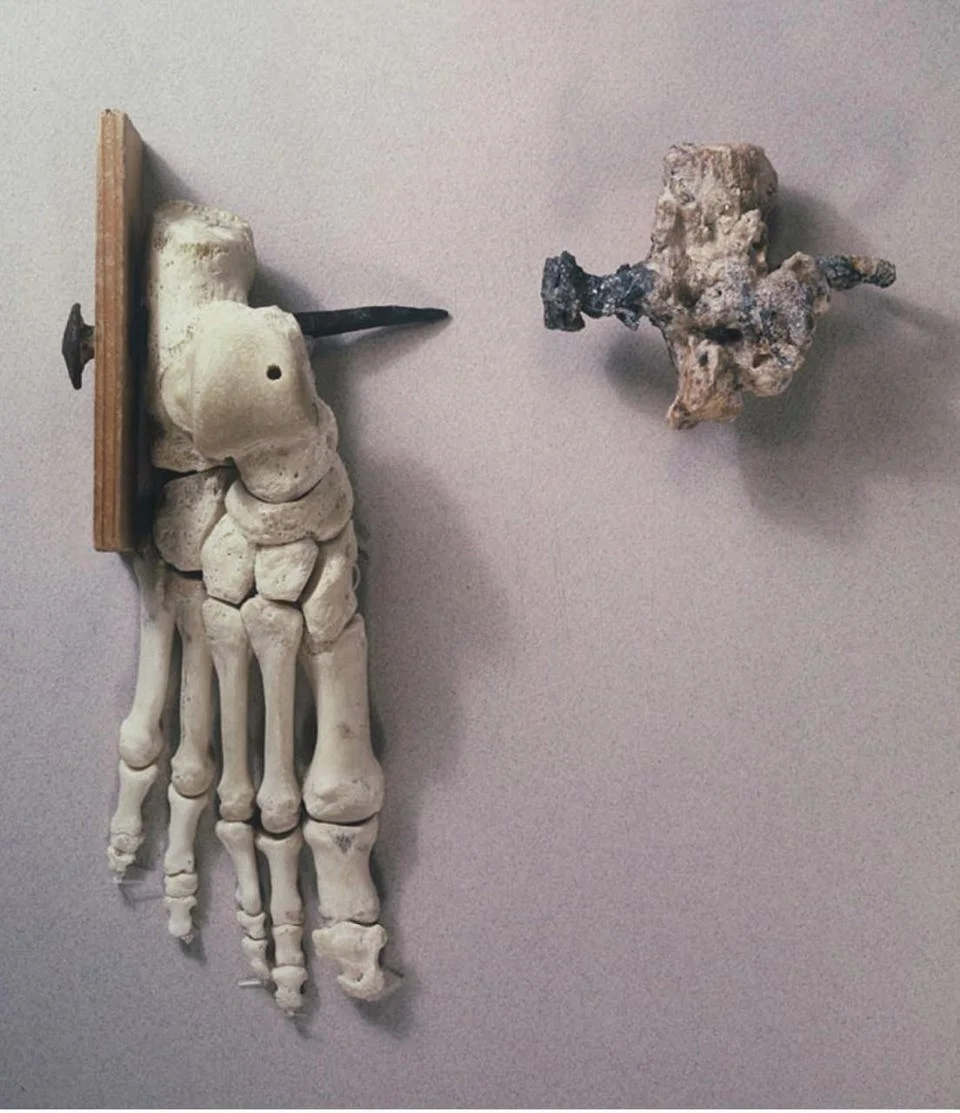
Crucifixion Victim.webp

Further adding to this gruesome picture, the Abba Cave discovery, as discussed by Elitzur in 2013 and later by Zondervan and Wright in 2019, reveals the remains of a man who was not only crucified but also beheaded (Elitzur2013-ik, Evans2009-ef). These people were buried even after the punishment they received from the Romans.

These archaeological findings offer a stark reminder of the harsh realities of ancient justice and punishment systems, particularly under Roman rule. They serve as a testament to the suffering endured by countless individuals, including, as historical and religious texts suggest, Jesus Christ himself.

We have multiple attestations from The New Testament. Passages that refer to this event include:

DID YOU KNOW?

We also know from historical Christian sources that Jesus was killed on the Cross.

Jesus's life is not only attested from the Gospels but from no Christian sources as well. These sources included that Jesus was killed on the cross.

There is archaeological evidence from the same period, common Roman practice, and modern medical studies to back up the death of Jesus. It is reasonable for us to conclude that Jesus was nailed on the cross as the Gospels record.

Powered by Forestry.md