In Christianity, specific names and titles are reserved for God to highlight His supreme power and divine status. Jesus possessing these divine titles necessitates His identity as God, for no mere creature can rightfully bear attributes exclusively reserved for the Almighty. Titles such as "Everlasting Father" and "The Mighty God" (Isaiah 9:6), "King of kings and Lord of lords" (Revelation 19:16; 1 Timothy 6:15), 7 claims of "I AM" (John 4:26; 6:20; 8:24, 28, 58; 13:19; 18:4-6; Exodus 3:14), "The Alpha and Omega", "First and the Last - Beginning and the End" (Revelation 1:8, 1:17-18, 21:6), and "Yahweh Our Righteousness" (Jeremiah 23:6) point to His deity. Furthermore, He is called the "Creator of Heaven and Earth" (John 1:3; Colossians 1:16), "Savior" (Titus 2:13; Isaiah 43:11), and the "Bridegroom" (Matthew 25:1-13;Isaiah 54:5), titles that Yahweh said were His alone.
The only alternative explanation—that Jesus replaced the God of the Old Testament—collapses because Jesus explicitly validated the God of the Old Testament. He affirmed, "The Lord our God, the Lord is one" (Mark 12:29), upheld Old Testament authority (Matthew 5:17-18), and proclaimed His unity with the Father: "I and the Father are one" (John 10:30). John claims that Jesus is the "The Word of God" from Genesis (). By bearing these divine titles while honoring the Old Testament God, Jesus reveals Himself not as a rival deity but as God incarnate. Understanding this facet is vital for grasping the Christian faith and influencing beliefs about salvation, divine worship, and God's revealed nature in the Scriptures.
List Of Jesus's Titles
Click the section below to see a description of each title, or look here to see the full table!
El-Gibbor (God of Might)
This following prophecy describes a child with divine titles, including "Mighty God (גּבּוֹר אַל)" and "Everlasting Father." This is evidence that the coming Messiah will be Yahweh Himself, Who will be born as a child, a descendant of David.
6. For to us a child is born, to us a son is given; and the government shall be upon his shoulder, and his name shall be called Wonderful Counselor, Mighty God [El-Gibbor], Everlasting Father, Prince of Peace.
The term for "Mighty God (גּבּוֹר אַל)" is “El-Gibbor” (lit “God of Might”) The very same title is applied in the next chapter to Yahweh, to Whom Israel is expecting to to return in the next chapter.
20. In that day the remnant of Israel and the survivors of the house of Jacob will no more lean on him who struck them, but will lean on the LORD, the Holy One of Israel, in truth. 21. A remnant will return, the remnant of Jacob, to the mighty God [El-Gibbor].
This is not just a Title for Yahweh in Isaiah, He is called "Mighty God (גּבּוֹר אַל)" in Jeremiah 32:18 ; Deuteronomy 10:17; and Nehemiah 9:32. This is a title for Yahweh
Everlasting Father (Hebrew: Abi'ad)
Once again in Isaiah 9:6 the same person described as the God of Might is also described as everlasting father "Everlasting Father" (Hebrew: Abi'ad). The term appears uniquely in this verse within the Book of Isaiah. The concept of God as an eternal Father or one who cares for His people does recur thematically in Isaiah (Isaiah 63:16, 64:8), Psalm 72:17; Deuteronomy 32:6 and Romans 8:15-16, but the exact title "Everlasting Father" is not repeated in the book. To be eternal and everlasting, one can not have a beginning, see Jesus Is The Alpha And Omega
It's also worth noting that we should also take the context of Isaiah 7:14
14. Therefore the Lord himself will give you a sign. Behold, the virgin shall conceive and bear a son, and shall call his name Immanuel.
This son, who is also the “El-Gibbor” (lit “God of Might”)" and "Everlasting Father" will be called Immanuel (God with us)". Those that are non-trinitarians will say that God was was with us through his representative Jesus during his time on earth, much like an ambassador. This statement in of itself is not false, as God truly was with us though Jesus, who intercedes on our behalf. However, when the fuller context of Isaiah is explored, it is evident that Immanuel simply being an ambassador/representative is not what the prophet had in mind.
These titles appear in the Bible as titles for God, particularly in Deuteronomy 10:17 and 1 Timothy 6:11, where God is described as the supreme ruler over all these titles. These titles are emphasized through repetition, a common Hebrew literary technique used to emphasize and intensify the meaning of the term. This stylistic technique, often seen in the Old Testament (Genesis 1:3,Isaiah 6:3) emphasizes, amplifies, shows completeness, or provides affirmation for the subject at hand. When applied to divine titles like "King of kings" or "Lord of lords," it expresses the utmost sovereignty and majesty over all Kings and over all Lords. This understanding is vital as it draws a direct parallel between the Old Testament understanding of God's sovereignty and Jesus' role in the New Testament. In the book of Revelation, the titles "King of kings" and "Lord of lords" (Revelation 17:14 and Revelation 19:16; 1 Timothy 6:15) are used to describe Jesus. The use of these titles is not just a claim of sovereignty but an declaration of Jesus' ultimate authority over all kings and lords just as God alone is supreme.
The title "Savior" is applied to Jesus in the New Testament (Luke 2:11; John 4:42;Titus 2:13;
Philippians 3:20; 2 Timothy 1:10; 2 Peter 1:11, 2:20, 3:2, 3:18; 1 John 4:14). However in the Old and New Testament God is declared as the only Savior (Isaiah 43:11; 45:21-22; Titus 2:10, Joel 2:32). By sharing this title, the scriptures assert Jesus's divine function in salvation,
Which Person Was The Savior Of Isreal
- I will recount the steadfast love of the LORD, the praises of the LORD, according to all that the LORD has granted us, and the great goodness to the house of Israel that he has granted them according to his compassion, according to the abundance of his steadfast love. 8. For he said, “Surely they are my people, children who will not deal falsely.” And he became their Savior. 9. In all their affliction he was afflicted, and the angel of his presence saved them; in his love and in his pity he redeemed them; he lifted them up and carried them all the days of old. 10. But they rebelled and grieved his Holy Spirit; therefore he turned to be their enemy, and himself fought against them. 11. Then he remembered the days of old, of Moses and his people. Where is he who brought them up out of the sea with the shepherds of his flock? Where is he who put in the midst of them his Holy Spirit, 12. who caused his glorious arm to go at the right hand of Moses, who divided the waters before them to make for himself an everlasting name, 13. who led them through the depths? Like a horse in the desert, they did not stumble. 14. Like livestock that go down into the valley, the Spirit of the LORD gave them rest. So you led your people, to make for yourself a glorious name.
In Isaiah 63:7-14, there is a reflection back to the time of the Exodus, clearly demonstrating all three personalities as present and active. The grammar indicates three separate Persons, all of Whom are identified with Yahweh (either in this passage or elsewhere) yet distinguished from one another. The LORD Yahweh is referred to in verse 7, the Angel of Yahweh in verse 9, and the Spirit of God in verses 10, 11, and 14. While God refers to Himself as the one responsible for Israel’s redemption from Egypt, in this passage three personalities are given credit. Yet, no contradiction is seen since all three comprise the unity of the one Godhead.
Introduction to the "Son of Man"
The term "Son of Man" is a central and distinctive title used by Jesus in the Gospels (Hebrew: בֶּן־אָדָם, ben-adam). Jesus often referred to Himself as the "Son of Man,", in fact it seems to have been His favorite term, it is used around 80 times in the New Testament. In the Hebrew Bible, "Son of Man" generally refers to a human being or mortal, as seen in the Psalms and Ezekiel. In Ezekiel 2:1-8, the term “Son of Man” is used extensively and is typically understood as a way of addressing the prophet Ezekiel himself (Swanson2015-le). However, the most significant and debated usage of "Son of Man" is found in Daniel 7:13-14. Here, the "Son of Man" appears in a vision as a heavenly figure coming with the clouds of heaven, approaching the Ancient of Days, and receives dominion, glory, and a kingdom that all peoples, nations, and languages should serve. It as this passage that Jesus claimed for himself in His trial (Mark 14:60-64).
The "Son of Man" Passage In Daniel
In Daniel 7:13-14, the "Son of Man" is described in a vision as coming with the clouds of heaven and approaching the Ancient of Days. He is given authority, glory, and sovereign power; all nations and peoples of every language worship him. His dominion is everlasting and will not pass away, and his kingdom is one that will never be destroyed.
9. “As I looked, “thrones were set in place, and the Ancient of Days took his seat. His clothing was as white as snow; the hair of his head was white like wool. His throne was flaming with fire, and its wheels were all ablaze. 10. A river of fire was flowing, coming out from before him. Thousands upon thousands attended him; ten thousand times ten thousand stood before him. The court was seated, and the books were opened. 11. “Then I continued to watch because of the boastful words the horn was speaking. I kept looking until the beast was slain and its body destroyed and thrown into the blazing fire. 12. (The other beasts had been stripped of their authority, but were allowed to live for a period of time.) 13. “In my vision at night I looked, and there before me was one like a son of man, coming with the clouds of heaven. He approached the Ancient of Days and was led into his presence. 14. He was given authority, glory and sovereign power; all nations and peoples of every language worshiped him. His dominion is an everlasting dominion that will not pass away, and his kingdom is one that will never be destroyed.
There are two subjects, the Ancient Of Days, which is God the Father based on passages like Ezekiel chapter 1, where the his throne is descripted in the same manor with fire and wheels. Then a second person described as the Son of Man Riding On The Clouds. In Ezekiel, the prophet sees a human figure sitting on Gods throne (Ezekiel 1:26-27) as well.
Cross References Of The Son Of Man Passage
It's easy to read this passage and miss everything being claimed. It's important to cross reference your Bible and read the context slowly.
Coming On The Clouds Of Heaven?
Daniel Boyarin observes that the phrase "Riding in the clouds", is used roughly 70 times in the Hebrew Bible (Such as Deuteronomy 33:26-27 or Psalm 104:3), consistently refers to God. In ancient Near Eastern cultures, including Jewish thought, cloud imagery was often associated with divinity. For example, in ugaritic texts the god Baal is called the "The one who rides the clouds" and it was the title of him. The old testament writes would take this title and give it to God, Deuteronomy 33:26, Psalm 68:32-33, Psalm 103:1-4 and Isaiah 19:1. This passage is the sole exception in the entire bible and its applied to a human. Everlasting Kingship was to belong only to the offspring of david, now we have a messianic king as both himan (Son of Man) and diety (The rider on the clouds) Heiser2015-it. Furthermore, Boyarin points out that the dominion, glory, and kingship given to the "Son of Man" in Daniel's vision are attributes typically reserved for God (See Attributes of God Credited To Jesus). The everlasting nature of his dominion and the universal scope of his authority suggest a role far beyond that of a mere human leader or king (Boyarin2012-pi).
The Attributes Of God Are Given To The Son Of Man
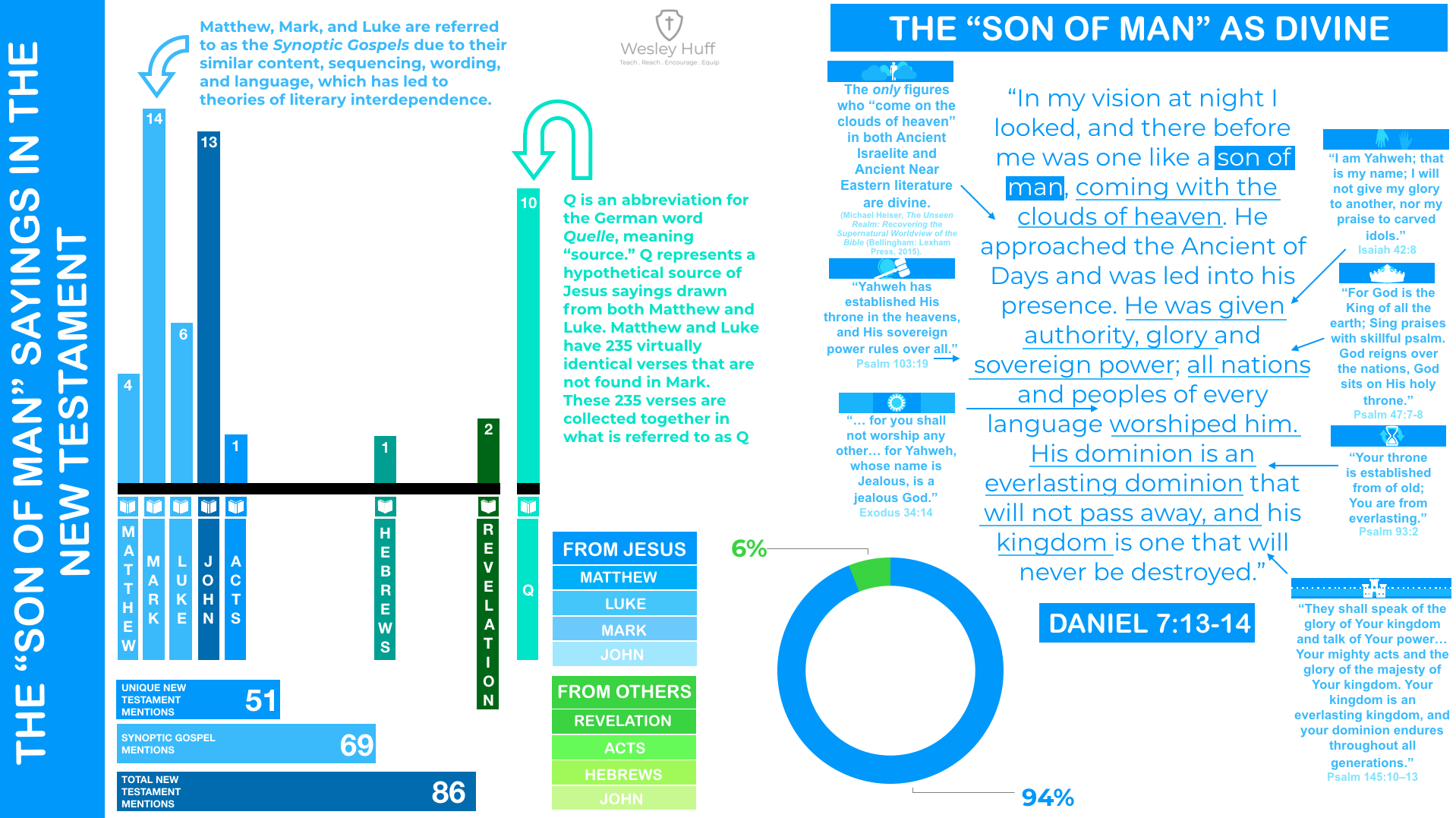
- Glory And Authority
The Son Of Man in this passage was given glory and Authority by the Ancient of Days. Jesus himself claims this authority as the Son of Man in the Gospels, tying it to His ability to forgive sins (See Jesus Claims Gods Authority and Jesus Is The Forgiver Of Sins), but Isaiah the prophet said that:
8. I am the LORD; that is my name; my glory (יָקַר yâqar) I give to no other, nor my praise to carved idols.
-
Sovereign Power
The Son Of Man is given the Sovereign power/kingdom (מַלְכוּ malkûw) of the Ancient of Days, this is to share in the essence of the Father for the Psalms say:
- The LORD has established his throne in the heavens, and his kingdom (מַלְכוּ malkûw) rules over all.
-
Reign of the Nations
The Bible is clear that it is God alone that ultimately rules all nations.
- For God is the King of all the earth; sing praises with a psalm! 8. God reigns over the nations; God sits on his holy throne.
-
Worship
The word worship is the Hebrew פְּלַח pelach which means to "Serve or Worship" is the same word used though the book of Daniel (Daniel 3:12, 14, 3:17-18, 3:28; 6:20; 7:14, 7:27 ) to describe worship to other Gods and the Ancient of Days, see also Jesus Is Worthy Of Worship. Moreover, the Septuagint Greek translation of Daniel uses the word latreuo for pelach (@Bowman2007-gc). -
The Everlasting Dominion
Everlasting in this context means no beginning and no end, a eternal kingdom that God alone controls (See also Jesus' claim to be The Alpha and Omega/First and Last):
- Your throne is established from of old; you are from everlasting.
10. All your works shall give thanks to you, O LORD, and all your saints shall bless you! 11. They shall speak of the glory of your kingdom and tell of your power, 12. to make known to the children of man your mighty deeds, and the glorious splendor of your kingdom. 13. Your kingdom is an everlasting kingdom, and your dominion endures throughout all generations. [The LORD is faithful in all his words and kind in all his works.]
Just Who Is The Son Of Man?
This figure has been interpreted in various ways. In Jewish thought, the Son of Man in this passage often represents an idealized Israel or a messianic figure who plays a role in the eschatological (end times) redemption. This second thought can be seen in additional Jewish texts, like the Book of Enoch from the Second Temple period, that depicts the "Son of Man" as a heavenly being (Enoch 46:1-3, Enoch 62:5-9, Enoch 69:26-29). while Ezekiel's visions (Ezekiel 1:26 and Ezekiel 8:2) describes a figure akin to "the appearance of the likeness of the glory of the LORD,".
Jesus favorite title for himself is Son of Man, but He did not mean it as a simple human as used throughout the Old Testament, but claims to be The Son of Man in Daniels visions during his trial (Mark 14:60-64, Matthew 26:57-66). It is with this context that we see He makes more claims about what the Son Of Man must do in Luke 17:24-26. Without the context of Daniel 7 and the actions/claims of Jesus in the Gospels, it's easy to miss just what Jesus is saying about himself when he calls himself the "Son of Man".The trial of Jesus, as narrated in Mark and Matthew, show us the most famous use of the title.
57. Then those who had seized Jesus led him to Caiaphas the high priest, where the scribes and the elders had gathered. 58. And Peter was following him at a distance, as far as the courtyard of the high priest, and going inside he sat with the guards to see the end. 59. Now the chief priests and the whole council were seeking false testimony against Jesus that they might put him to death, 60. but they found none, though many false witnesses came forward. At last two came forward 61. and said, “This man said, ‘I am able to destroy the temple of God, and to rebuild it in three days.’” 62. And the high priest stood up and said, “Have you no answer to make? What is it that these men testify against you?” 63. But Jesus remained silent. And the high priest said to him, “I adjure you by the living God, tell us if you are the Christ, the Son of God.” 64. Jesus said to him, “You have said so. But I tell you, from now on you will see the Son of Man seated at the right hand of Power and coming on the clouds of heaven.” 65. Then the high priest tore his robes and said, “He has uttered blasphemy. What further witnesses do we need? You have now heard his blasphemy. 66. What is your judgment?” They answered, “He deserves death.”
60. And the high priest stood up in the midst and asked Jesus, “Have you no answer to make? What is it that these men testify against you?” 61. But he remained silent and made no answer. Again the high priest asked him, “Are you the Christ, the Son of the Blessed?” 62. And Jesus said, “I am, and you will see the Son of Man seated at the right hand of Power, and coming with the clouds of heaven.” 63. And the high priest tore his garments and said, “What further witnesses do we need? 64. You have heard his blasphemy. What is your decision?” And they all condemned him as deserving death.
When confronted by the high priest about is Jesus is the Christ, Jesus not only confirms it but also claims that He is the Son of Man, and will be sitting at the right hand of Power, and coming with the clouds of heaven. This reference to Daniel 7:13 is perceived as a divine claim to be God, leading to accusations of blasphemy by the high priest, a term in Judaism defined as cursing God (according to myjewishlearning.com). This response indicates that Jesus's claim was interpreted as an assertion of divinity, given the exclusive association of such imagery with God in Jewish thought. Additionally, events like the Transfiguration (Matthew 17:1-9), where the Son of God is also called the Son of Man that would rise from the dead, or his teachings in Mark 8:31 further show his authority over life and death. Jesus use of "Son of Man" is a deliberate claim to divine authority.
All His Words Are Equal To Scripture
In the Gospels, Jesus' teachings are presented not just as teachings but as ultimate truths, God's Word itself. In passages like Mark 2:1; Matthew 5:20-22, 7:24-29, 24:35. Jesus takes God's commands in the Old Testament and adds to them, teaching that what He explains is what the God's words and Laws really meant.
In Matthew 5:20-22, Jesus doesn't just interpret the Law; He fulfills and expands it, stating, "For I tell you, unless your righteousness exceeds that of the scribes and Pharisees, you will never enter the kingdom of heaven. You have heard that it was said to those of old... But I say to you..." This shift from "You have heard" to "But I say to you" emphasizes His authority to redefine and deepen the understanding of the Law. The frequent use of the phrase "Amen, I say to you" throughout the Gospels is a testament to this divine authority. The Book of Acts continues this theme by referring to the spoken word and the Gospel as "the word of the Lord" (Acts 8:25, 13:44, 48-49;).
Similarly, in Matthew 7:24-29, Jesus concludes the Sermon on the Mount by comparing those who heed His words to a wise man who built his house on the rock, enduring all storms. The passage concludes with, "And when Jesus finished these sayings, the crowds were astonished at his teaching, for he was teaching them as one who had authority, and not as their scribes." This astonishment arises from His direct assertion of authority, contrasting with the scribes who relied on existing interpretations. Luke 4:32 and Mark 1:22 similarly notes the reaction to His teaching in the synagogues.
The Son Of Man Has Authority
Jesus' uses of the title "Son of Man" to show His divine authority. For example, in , while healing a paralytic, Jesus says:
10. But that you may know that the Son of Man has authority on earth to forgive sins” — he said to the paralytic — 11. “I say to you, rise, pick up your bed, and go home.”
This act and statement assert his divine role, as forgiving sins is traditionally exclusive to God. In Matthew 25:31-32, he describes the Son of Man's role in judgment:
31. “When the Son of Man comes in his glory, and all the angels with him, then he will sit on his glorious throne. 32. Before him will be gathered all the nations, and he will separate people one from another as a shepherd separates the sheep from the goats.
In a previous conversation with the Pharisees, Jesus references Psalm 110:1 to pose a critical question about the Messiah's lineage and nature:
41. Now while the Pharisees were gathered together, Jesus asked them a question, 42. saying, “What do you think about the Christ? Whose son is he?” They said to him, “The son of David.” 43. He said to them, “How is it then that David, in the Spirit, calls him Lord, saying, 44. “‘The Lord said to my Lord, “Sit at my right hand, until I put your enemies under your feet”’? 45. If then David calls him Lord, how is he his son?” 46. And no one was able to answer him a word, nor from that day did anyone dare to ask him any more questions.
By referring to Psalm 110:1, where David calls the Messiah 'Lord,' Jesus challenges their conventional understanding of the Messiah as merely a descendant of David. He implies that the Messiah, while a physical descendant of David, possesses a higher, divine status and nature.
In the New Testament, Jesus is symbolically portrayed as the Bridegroom or Husband (Matthew 22:2, 25:1-13, Mark 2:19, John 3:29, 2 Corinthians 11:2, Ephesians 5:25-27,Revelation 19:7-9, 21:2, 21:9;), a metaphor that illustrates the intimate and covenantal relationship between Christ and the Church. This imagery mirrors Old Testament descriptions of God as the husband to His people Israel (Isaiah 54:5; Jeremiah 31:32), highlighting a consistent theme of divine love and commitment.
John Shows Jesus Is The Bridegroom
This table highlights the symbolic parallels between Genesis 24 and John 4, showing how John draws upon Old Testament betrothal imagery to portray Jesus as the divine bridegroom and that Jesus is fulfilling the roles traditionally ascribed to God.
| Betrothal Element | Genesis 24 (Isaac & Rebekah) | John 4 (Jesus & Samaritan Woman) |
|---|---|---|
| The bridegroom travels to a foreign land and meets a woman at a well | Abraham’s servant travels to Mesopotamia and meets Rebekah at a well | Jesus travels to Samaria and meets a Samaritan woman at Jacob's well |
| There is dialogue about water | Abraham’s servant asks Rebekah for water from the well | Jesus speaks to the woman about "living water" (John 4:10) |
| The woman hurries home to report about the man | Rebekah returns home to report about the stranger | The Samaritan woman returns to her town to tell others about Jesus (John 4:28-29) |
| Invitation to visit the father-in-law’s home/town | The servant is invited to stay with Rebekah’s family | Jesus is invited to stay in the Samaritan town (John 4:40) |
| Betrothal arranged at a meal | A meal is shared before the servant proposes the marriage arrangement | Jesus reveals spiritual truths, leading to the people accepting Him as the Messiah |
| The male reveals his identity | The servant reveals he is from Abraham’s household | Jesus reveals His identity as the Messiah to the Samaritan woman (John 4:26) |
| The theme of "living water" weaves through this narrative to represent a gift from Jesus that offers eternal fulfillment, unlike the temporal satisfaction from the well’s water. In speaking to the Samaritan woman, Jesus extends this imagery to reveal a deeper spiritual truth: just as God is the source of spiritual life in the Old Testament, now Jesus himself offers this life-giving water, representing the Holy Spirit, to all who seek it. |
| Attribute | God in the Old Testament | Jesus in the New Testament |
|---|---|---|
| Bridegroom | God is called the bridegroom and husband of Judah (Isaiah 54:5, 62:5; Hosea 2:19-20; Jeremiah 3:14; Ezekiel 16:8 | Jesus is referred to as the bridegroom of the Church and Israel (Matthew 9:15; John 3:29; Revelation 19:7-9) |
| Living Water | God is called the living water, symbolizing spiritual sustenance (Jeremiah 2:13 , 17:13 ; Isaiah 55:1 ; Psalm 36:9; Zechariah 14:8; Ezekiel 47:1) | Jesus offers living water, representing eternal life and the Holy Spirit (John 4:10, 7:37-38; 1 Corinthians 10:4 Revelation 7:17; Revelation 22:1) |
John has gone out of his way to show that Jesus embodies God's presence through this "I am" declaration and the story of the Samaritan woman. This event symbolizes a new type of relationship between God and not just the Israelites but also the Samaritans and possibly all of humanity (Mayfield_undated-ug).
It is important to remember that this "I AM" saying only applies when used without a description/predicate, or what is called the the absolute form. The absolute form of "ἐγώ εἰμι" (without a predicate) is not attested in non-Jewish Greek texts, nor in the writings of Josephus and Philo of Alexandria, they are unique to the Bible alone (Williams2000-jf). There are 7 sayings without a predicate in John.
1. The Claim At The Well (John 4:26)
Jesus explicitly reveals His Messiahship with the Samaritan woman. During the conversation, the woman was sure that the Messiah would come and explain everything to them just as God promised in by Deuteronomy 18:15-18. Samaritan beliefs are rooted in the Pentateuch and they would be aware of the absolute ἐγώ εἰµι used as the divine name (Haencgen1959-tz, Williams2000-jf)
25. The woman said to him, “I know that Messiah is coming (he who is called Christ). When he comes, he will tell us all things.” 26. Jesus said to her, “I who speak to you am he ("I AM - ἐγώ εἰµι).”
This self-disclosure parallels Isaiah 52:6, where God speaks of making Himself known to His people as well as assages like Revelation 7:16 Isaiah 49:10. John is not just using the divine name but also paralleling the outline of two betrothal stories in (Genesis 24, Lincoln2019-cr). John narrates the story to show that Jesus is declaring himself the groom of Israel.
John Shows Jesus Is The Bridegroom
This table highlights the symbolic parallels between Genesis 24 and John 4, showing how John draws upon Old Testament betrothal imagery to portray Jesus as the divine bridegroom and that Jesus is fulfilling the roles traditionally ascribed to God.
| Betrothal Element | Genesis 24 (Isaac & Rebekah) | John 4 (Jesus & Samaritan Woman) |
|---|---|---|
| The bridegroom travels to a foreign land and meets a woman at a well | Abraham’s servant travels to Mesopotamia and meets Rebekah at a well | Jesus travels to Samaria and meets a Samaritan woman at Jacob's well |
| There is dialogue about water | Abraham’s servant asks Rebekah for water from the well | Jesus speaks to the woman about "living water" (John 4:10) |
| The woman hurries home to report about the man | Rebekah returns home to report about the stranger | The Samaritan woman returns to her town to tell others about Jesus (John 4:28-29) |
| Invitation to visit the father-in-law’s home/town | The servant is invited to stay with Rebekah’s family | Jesus is invited to stay in the Samaritan town (John 4:40) |
| Betrothal arranged at a meal | A meal is shared before the servant proposes the marriage arrangement | Jesus reveals spiritual truths, leading to the people accepting Him as the Messiah |
| The male reveals his identity | The servant reveals he is from Abraham’s household | Jesus reveals His identity as the Messiah to the Samaritan woman (John 4:26) |
| The theme of "living water" weaves through this narrative to represent a gift from Jesus that offers eternal fulfillment, unlike the temporal satisfaction from the well’s water. In speaking to the Samaritan woman, Jesus extends this imagery to reveal a deeper spiritual truth: just as God is the source of spiritual life in the Old Testament, now Jesus himself offers this life-giving water, representing the Holy Spirit, to all who seek it. |
| Attribute | God in the Old Testament | Jesus in the New Testament |
|---|---|---|
| Bridegroom | God is called the bridegroom and husband of Judah (Isaiah 54:5, 62:5; Hosea 2:19-20; Jeremiah 3:14; Ezekiel 16:8 | Jesus is referred to as the bridegroom of the Church and Israel (Matthew 9:15; John 3:29; Revelation 19:7-9) |
| Living Water | God is called the living water, symbolizing spiritual sustenance (Jeremiah 2:13 , 17:13 ; Isaiah 55:1 ; Psalm 36:9; Zechariah 14:8; Ezekiel 47:1) | Jesus offers living water, representing eternal life and the Holy Spirit (John 4:10, 7:37-38; 1 Corinthians 10:4 Revelation 7:17; Revelation 22:1) |
John has gone out of his way to show that Jesus embodies God's presence through this "I am" declaration and the story of the Samaritan woman. This event symbolizes a new type of relationship between God and not just the Israelites but also the Samaritans and possibly all of humanity (Mayfield_undated-ug).
2. The Claim On The Water
When stuck in a storm on the sea, the disciples were lost in the dark of the night. Then they saw Jesus and became frightened that he walked walking on water, supposing him to be a ghost (Matthew 14:26; Mark 6:50;). But Jesus comforts them in the midst of the storm with His next I AM Claim.
19. When they had rowed about three or four miles, they saw Jesus walking on the sea and coming near the boat, and they were frightened. 20. But he said to them, “It is I ("I AM - ἐγώ εἰµι); do not be afraid.” 21. Then they were glad to take him into the boat, and immediately the boat was at the land to which they were going.
By saying "I AM (ἐγώ εἰµι)"; do not fear," Jesus echoes the comforting words of God though Isaiah 43, where God assures His protection to the Israelites amidst troubles. According to Ball, every "Do Not Fear" fear combination in the Hebrew Bible comes from the mouth of God and Andrew Lincoln notes many of these statements also use "I AM" statements.
| Verse Reference | Verse |
|---|---|
| Genesis 15:1 | After this, the word of the Lord came to Abram in a vision: "Do not be afraid, Abram. I am your shield, your very great reward." |
| Genesis 26:24 | That night the Lord appeared to him and said, "I am the God of your father Abraham. Do not be afraid, for I am with you; I will bless you and will increase the number of your descendants for the sake of my servant Abraham." |
| Genesis 46:3 | "I am God, the God of your father," he said. "Do not be afraid to go down to Egypt, for I will make you into a great nation there." |
| Judges 6:23 | But the Lord said to him, "Peace! Do not be afraid. You are not going to die." |
| Isaiah 41:10 | So do not fear, for I am with you; do not be dismayed, for I am your God. I will strengthen you and help you; I will uphold you with my righteous right hand. |
| Isaiah 41:13 | For I am the Lord your God who takes hold of your right hand and says to you, Do not fear; I will help you. |
| Isaiah 43:1 | But now, this is what the Lord says— he who created you, Jacob, he who formed you, Israel: "Do not fear, for I have redeemed you; I have summoned you by name; you are mine." |
| Isaiah 43:5 | Do not be afraid, for I am with you; I will bring your children from the east and gather you from the west. |
| Isaiah 44:2 | This is what the Lord says— he who made you, who formed you in the womb, and who will help you: Do not be afraid, Jacob, my servant, Jeshurun, whom I have chosen. |
| Isaiah 54:4 | "Do not be afraid; you will not be put to shame. Do not fear disgrace; you will not be humiliated. You will forget the shame of your youth and remember no more the reproach of your widowhood." |
| Genesis 15:1 | After this, the word of the Lord came to Abram in a vision: "Do not be afraid, Abram. I am your shield, your very great reward." |
| Isaiah 41:4 | Who has done this and carried it through, calling forth the generations from the beginning? I, the Lord—with the first of them and with the last—I am he." |
| Isaiah 43:10 | "You are my witnesses," declares the Lord, "and my servant whom I have chosen, so that you may know and believe me and understand that I am he. Before me no god was formed, nor will there be one after me." |
| Isaiah 43:25 | "I, even I, am he who blots out your transgressions, for my own sake, and remembers your sins no more." |
| Isaiah 45:18 | For this is what the Lord says— he who created the heavens, he is God; he who fashioned and made the earth, he founded it; he did not create it to be empty, but formed it to be inhabited— he says: "I am the Lord, and there is no other." |
| Isaiah 46:4 | Even to your old age and gray hairs I am he, I am he who will sustain you. I have made you and I will carry you; I will sustain you and I will rescue you. |
| Isaiah 48:12 | "Listen to me, Jacob, Israel, whom I have called: I am he; I am the first and I am the last." |
| Isaiah 51:12 | "I, even I, am he who comforts you. Who are you that you fear mere mortals, human beings who are but grass." |
Just as God assured His people with "Do not fear" statements tied to His presence and protection, Jesus demonstrates His authority and divinity by walking on water and calming the disciples' fear. This parallel highlights that Jesus is the fulfillment of God’s promises, offering peace, protection, and salvation in the midst of life’s storms, confirming that He is indeed the God who was, is, and always will be.
3-5 The Three Claims To The Pharisees
The "I AM" statements in John 8 is part of a broader conversation where Jesus challenges the Jewish leaders' understanding of who He is. In John 8, Jesus is engaging in a heated dialogue with the Pharisees. The religious leaders question His authority and His identity, asking Him who He is. Throughout the chapter, Jesus repeatedly speaks of His divine origin and His unique relationship with the Father. The central issue is whether the people will recognize Jesus for who He truly is—God incarnate.
Jesus foretells His departure (death and ascension) and warns them that they will die in their sins if they do not believe in Him. This warning of Jesus that the Jews will die in their sins is stated in John 8:21 and then is repeated two times in John 8:24, He stresses that their failure to recognize His true identity will have eternal consequences. The only way of avoiding this fate is to believe Jesus as ἐγώ εἰµι. The people who have faith in Jesus will be forgiven for their sins and will be saved from death. In the following passages of John 8, Jesus makes a bold declaration:
24. I told you that you would die in your sins, for unless you believe that I am he (I am (ἐγώ εἰμι),) you will die in your sins.”
28. So Jesus said to them, “When you have lifted up the Son of Man, then you will know that I am he (I am (ἐγώ εἰμι)), and that I do nothing on my own authority, but speak just as the Father taught me.
58. Jesus said to them, “Truly, truly, I say to you, before Abraham was, I am (I am (ἐγώ εἰμι)).”
John 8:24 (Claim 3)
24. I told you that you would die in your sins, for unless you believe that I am he (I am (ἐγώ εἰμι),) you will die in your sins.”
After Jesus makes the statement in verse 24, the Jews still ask, "Who are you?"—showing their confusion and disbelief. Despite all that Jesus has said and done, they still do not grasp His divine identity. Jesus links belief in His divine identity to salvation. This references to Isaiah 43:10-11 when paired with his previous statements in John 8:18;
10. “You are my witnesses,” declares the LORD, “and my servant whom I have chosen, that you may know and believe me and understand that I am he (I am (ἐγώ εἰμι)). Before me no god was formed, nor shall there be any after me. 11. I, I am (I am (ἐγώ εἰμι)) the LORD, and besides me there is no savior.
The witnesses is Isaiah is Israel and God makes it plain that He is the only savior for Israel.
39. “‘See now that I, even I, am he (I am (ἐγώ εἰμι)), and there is no god beside me; I kill and I make alive; I wound and I heal; and there is none that can deliver out of my hand.
Jesus answers in John 8:26, asserting that His teachings come from God and He has the authority to condemn. The ἐγώ εἰµι phrases in John 8:23, 24, and 28 reinforce the idea that Jesus belongs to the divine realm, a space only accessible to God.
John 8:28 (Claim 4)
28. So Jesus said to them, “When you have lifted up the Son of Man, then you will know that I am he (I am (ἐγώ εἰμι)), and that I do nothing on my own authority, but speak just as the Father taught me.
He predicts in John 8:28 that when the Jews have lifted up (crucify) the Son of Man, they will realize that ἐγώ εἰµι. His sacrifice will lead to recognition and belief in His true identity that whoever believes in him will live forever (John 3:16). Just as those that came to believe that Jesus was the ἐγώ εἰµι in John 8:30. Jesus’ self-revelation itself generates people’s faith in him. These statements reveal His unique authority and power, which are attributes exclusively held by God. This portrayal is consistent with John 1:1-18, where Jesus is presented as fully divine from the beginning.
Additionally, Jesus is calling to Isaiah 52:13:
13. Behold, my servant shall act wisely; he shall be high and lifted up, and shall be exalted.
D.M. Ball relates this to Second Temple Jewish thought. In this tradition, understanding God's identity is closely tied to His actions in history. For example, God's identity is revealed through powerful acts like the Exodus. Similarly, Ball views Jesus' "lifting up" on the cross as a historic act through which humanity can identify God (Ball1996-uc).
John 8:58 (Claim 5)
After the previous two statements, Jesus tells the Jews that chose to believe in him to keep is word and they would be set free. However, the Jews argue that as descendants of Abraham, they have never been enslaved. Jesus clarifies that everyone who sins is a slave to sin, and only He, the Son, can provide true freedom.
The conversation escalates as Jesus challenges their claim to be Abraham's children, stating that if they were, they would follow Abraham's example of faith rather than seeking to kill Him. Jesus reveals that their actions align more with the devil, their true father, who rejects the truth. The Jews further insult Jesus by accusing Him of being a demon-possessed Samaritan, but He refutes this, saying He honors His Father and promises eternal life to those who keep His word. When the Jews question how Jesus can promise eternal life, since Abraham and the prophets died, Jesus responds that Abraham rejoiced to see His day. The Jews, shocked by Jesus' claim, question how He could have possibly seen Abraham. Jesus responds with the most powerful I AM statement in the chapter;
58. Jesus said to them, “Truly, truly, I say to you, before Abraham was (γενέσθαι), I am (ἐγώ εἰμι)."
One of the clearest of Jesus' "I am" statements, Jesus speaks with the divine name. The aorist infinitive γενέσθαι ("to become" or "to be created") is used in reference to Abraham's creation, indicating a past action. In contrast, the present tense ἐγώ εἰμι ("I am") used by Jesus is an ongoing, eternal existence. In Isaiah, a similar contrast is drawn between the present tense associated with YHWH (ἐγώ εἰμι) and the aorist tense ἐγένετο ("became") referring to other gods:
10. “You are my witnesses,” declares the Lord, “and my servant whom I have chosen, that you may know and believe me and understand that ἐγώ εἰμι ("I am he"). before me no god was ἐγένετο ("formed"), nor shall there be any after me.”
Isaiah 43:10 emphasizes YHWH's eternal existence in contrast to the temporal existence of other beings or gods (Ball1996-uc). The Isaiah Targum also makes connections between Abraham in this verse as well (Mayfield_undated-ug).
“Significantly, there Yahweh’s self- predication in terms of ego eimi is also contrasted with the temporal existence of another being, of whom the aroist tense ginomai is employed [...] Jesus’ claim to be the self-revelation of the one true God is now unmistakable.” (Lincoln2005-sc)
The reaction of Jesus' audience in verse 59, where they pick up stones to throw at Him, indicates that they clearly understood the gravity of His claim - blasphemy. This doesn't just show pre-exsistance of Abraham, but when viewed in light of Isaiah, creation itself (Mayfield_undated-ug).
16. Whoever blasphemes the name of the LORD shall surely be put to death. All the congregation shall stone him. The sojourner as well as the native, when he blasphemes the Name, shall be put to death.
The reaction of the Jews can only be explained by their perception of Jesus’ ἐγώ εἰµι pronouncement as a blasphemous claim to divinity. Only God is appropriate for this designation, with all otherclaimants guilty of blasphemy.
6. The Claim To His Disciples
The next claim takes place during the narrative of the Last Supper, where Jesus is having a final meal with His disciples before His crucifixion. Jesus is revealing to them crucial details about the coming betrayal and His identity.
18. I am not speaking of all of you; I know whom I have chosen. But the Scripture will be fulfilled, ‘He who ate my bread has lifted his heel against me.’ 19. I am telling you this now, before it takes place, that when it does take place you may believe that I am he.
Jesus refers to a specific prophecy, quoting from Psalm 41:9. This Psalm speaks about betrayal by a close friend. Jesus is alluding to Judas Iscariot, who will betray Him.
9. Even my close friend in whom I trusted, who ate my bread, has lifted his heel against me.
By saying in verse 18, "I know whom I have chosen," Jesus explains why He is revealing this information in advance. The reason for Jesus’ prediction is for his disciples to believe that ἐγώ εἰµι when the betrayal occurs. That is to say, the fulfillment of the betrayal will testify to Jesus as ἐγώ εἰµι. This prediction of Jesus seems to follow the prophetic tradition. According to Deuteronomy 18:18-22, the fulfillment of a prophecy will testify to the true prophet.
Moreover, Jesus stresses his identity as the Teacher, Lord, and master of his disciples and emphasizes that it is him who has chosen the disciples in John 13:12-20. Rabbis rarely choose their own disciples but Jesus is paralleling how God chose Israel as his own people. He wants His disciples to understand that His foreknowledge of the betrayal is not a random coincidence but a fulfillment of Scripture.
The fulfillment of this saying shows that Jesus knows and can predict the future. Andrew T. Lincoln has shown that In the Old Testament, only God has this power (Isaiah 41:21-23, Isaiah 42:9, Isaiah 43:8-13).
In Isaiah 44:7-8 God vindicates his divinity by reminding his people of what He has done for them and predicting what He will do. Jesus does the same thing by explaining to his disciples what he has done for them and predicting that he will be betrayed, Jesus even makes a prophecy as the verification of his divine identity in the exact way that God the Father vindicates his divinity with the prophecy. The prediction unveils both the divine identity and divine authority of Jesus since he is actually in control of his own circumstances and is able to guarantee the fulfillment of his mission.
7. The Claim To The Soldiers (John 18:4-6)
In the culmination of the I AM Statements, Jesus makes his biggest statement at the moment of His betrayal. He had spent His last night in the garden with His disciples, and had just been so stressed about events to transpire that Jesus sweat blood. It was at this moment when Judas came with an angry mob to arrest Jesus. Rather then timidity going with his captors Jesus approaches and boldly declares I AM;
4. Then Jesus, knowing all that would happen to him, came forward and said to them, “Whom do you seek?” 5. They answered him, “Jesus of Nazareth.” Jesus said to them, “I am he. (I AM - ἐγώ εἰμι)” Judas, who betrayed him, was standing with them. 6. When Jesus said to them, “I am he (I AM - ἐγώ εἰμι),” they drew back and fell to the ground. 7. So he asked them again, “Whom do you seek?” And they said, “Jesus of Nazareth.” 8. Jesus answered, “I told you that I am he (I AM - ἐγώ εἰμι). So, if you seek me, let these men go.”
It is Jesus’ I AM - ἐγώ εἰμι pronouncement that causes the dramatic reaction of the arresting people. The Jewish mob knew what was being said, for they "they drew back and fell to the ground". They were afraid of the one claiming to be I AM. This matches how others in the Bible react when they see the glory of God such as in Ezekiel 1:28;
28. Like the appearance of the bow that is in the cloud on the day of rain, so was the appearance of the brightness all around. Such was the appearance of the likeness of the glory of the LORD. And when I saw it, I fell on my face, and I heard the voice of one speaking.
Or Daniel 10:9
9. Then I heard the sound of his words, and as I heard the sound of his words, I fell on my face in deep sleep with my face to the ground.
What's unique about this passage compared to the other 6 (I AM) saying of John is that in both John 18:5 and 18:6, ἐγώ εἰμι by itself forms an independent sentence. This way of ἐγώ εἰμι pronouncement has never been used by God. In the Septuagint, YHWH’s ἐγώ εἰμι pronouncements
always form a part of the sentence, such as the ones in Exodus 3:14; Deuteronomy 32:39; Isaiah 41:4,43:10, 43:25; 46:4,48:12, 51:12, 52:6.
Jesus' declaration of (I AM - ἐγώ εἰμι) claims the sacred name of God, marking a pivotal point in the narrative. Unlike any previous pronouncement of I AM, His independent statement is unambiguous claim to authority and divinity, instilling fear in those who came to arrest Him. This powerful affirmation reveals that even in the face of betrayal and imminent suffering, Jesus stands firmly in His identity as I AM.
The name of the Davidic king and Messiah Who will come to restore Israel will be “Yahweh our righteousness.”
5. “Behold, the days are coming, declares the LORD, when I will raise up for David a righteous Branch, and he shall reign as king and deal wisely, and shall execute justice and righteousness in the land. 6. In his days Judah will be saved, and Israel will dwell securely. And this is the name by which he will be called: ‘The LORD [Yahweh] is our righteousness.’
The New Testament reveals that Jesus possesses authority over all creation, as highlighted in passages like
Matthew 11:25-27, 28:18 andPhilippians 2:9-11, a sovereignty traditionally held by God alone. Additionally, Jesus is depicted as sitting on God's throne in Psalm 110:1, Matthew 22:44, and Revelation 3:21, a position denoting the ultimate authority and sovereignty. Such imagery, typically exclusive to God, emphasizes Jesus's elevated status and His active participation in divine rulership.
All His Words Are Equal To Scripture
In the Gospels, Jesus' teachings are presented not just as teachings but as ultimate truths, God's Word itself. In passages like Mark 2:1; Matthew 5:20-22, 7:24-29, 24:35. Jesus takes God's commands in the Old Testament and adds to them, teaching that what He explains is what the God's words and Laws really meant.
In Matthew 5:20-22, Jesus doesn't just interpret the Law; He fulfills and expands it, stating, "For I tell you, unless your righteousness exceeds that of the scribes and Pharisees, you will never enter the kingdom of heaven. You have heard that it was said to those of old... But I say to you..." This shift from "You have heard" to "But I say to you" emphasizes His authority to redefine and deepen the understanding of the Law. The frequent use of the phrase "Amen, I say to you" throughout the Gospels is a testament to this divine authority. The Book of Acts continues this theme by referring to the spoken word and the Gospel as "the word of the Lord" (Acts 8:25, 13:44, 48-49;).
Similarly, in Matthew 7:24-29, Jesus concludes the Sermon on the Mount by comparing those who heed His words to a wise man who built his house on the rock, enduring all storms. The passage concludes with, "And when Jesus finished these sayings, the crowds were astonished at his teaching, for he was teaching them as one who had authority, and not as their scribes." This astonishment arises from His direct assertion of authority, contrasting with the scribes who relied on existing interpretations. Luke 4:32 and Mark 1:22 similarly notes the reaction to His teaching in the synagogues.
The Son Of Man Has Authority
Jesus' uses of the title "Son of Man" to show His divine authority. For example, in , while healing a paralytic, Jesus says:
10. But that you may know that the Son of Man has authority on earth to forgive sins” — he said to the paralytic — 11. “I say to you, rise, pick up your bed, and go home.”
This act and statement assert his divine role, as forgiving sins is traditionally exclusive to God. In Matthew 25:31-32, he describes the Son of Man's role in judgment:
31. “When the Son of Man comes in his glory, and all the angels with him, then he will sit on his glorious throne. 32. Before him will be gathered all the nations, and he will separate people one from another as a shepherd separates the sheep from the goats.
In a previous conversation with the Pharisees, Jesus references Psalm 110:1 to pose a critical question about the Messiah's lineage and nature:
41. Now while the Pharisees were gathered together, Jesus asked them a question, 42. saying, “What do you think about the Christ? Whose son is he?” They said to him, “The son of David.” 43. He said to them, “How is it then that David, in the Spirit, calls him Lord, saying, 44. “‘The Lord said to my Lord, “Sit at my right hand, until I put your enemies under your feet”’? 45. If then David calls him Lord, how is he his son?” 46. And no one was able to answer him a word, nor from that day did anyone dare to ask him any more questions.
By referring to Psalm 110:1, where David calls the Messiah 'Lord,' Jesus challenges their conventional understanding of the Messiah as merely a descendant of David. He implies that the Messiah, while a physical descendant of David, possesses a higher, divine status and nature.
In the book of Revelation, the titles "Alpha and Omega" signify the beginning and the end. Alpha is the first letter and Omega is the last letter of the Greek alphabet. Together, they function as an inclusio—a rhetorical device that encompasses the totality of a subject—signifying that God is the sum of all existence from beginning to end.
Revelation 1:8 attributes the title "Alpha and Omega" to the Lord God, who is identified as the Almighty. Revelation 21:6 echoes this sentiment, as the one seated on the throne of Heaven proclaims, "It is done. I am the Alpha and the Omega, the Beginning and the End." The Old Testament says it is God will be the one to come to judge the earth.
10. Behold, the Lord GOD comes with might, and his arm rules for him; behold, his reward is with him, and his recompense before him.
Paul also says this in agreement with Isaiah in his letter to the Romans.
10. Why do you pass judgment on your brother? Or you, why do you despise your brother? For we will all stand before the judgment seat of God; 11. for it is written, “As I live, says the Lord, every knee shall bow to me, and every tongue shall confess to God.” 12. So then each of us will give an account of himself to God.
Revelation 22:13 clearly attributes these titles to Jesus, as He declares, "I am the Alpha and the Omega, the First and the Last, the Beginning and the End." The speaker is definitively identified as Jesus based on the surrounding text. The New testament also teaches that the Father will not judge the word (John 5:20-22), but Jesus will and is coming (Matthew 25:31; Mark 14:62; Acts 17:31; 2 Corinthians 5:10; 1 Peter 4:5; Revelation 1:7, 22:20). Earlier in the same chapter of Revelations, verses 12 and 16 clearly attribute the speech to Jesus:
12. “Behold, I am coming soon, bringing my recompense with me, to repay each one for what he has done. 13. I am the Alpha and the Omega, the first and the last, the beginning and the end.”
By using the same titles "Alpha and Omega" for both Jesus and the Lord God, Revelation intertwines Jesus's identity with that of God.
First and the Last - Beginning and the End
In the Old Testament, particularly in the book of Isaiah, God is repeatedly described as the "First and the Last" (Isaiah 41:4; Isaiah 44:6; Isaiah 48:12). The use of this title asserts that God is the origin and culmination of all things, existing before creation and remaining after its end. This concept is crucial in understanding the nature of God as depicted in the Hebrew Scriptures: He is the beginning and the end, the one who was, who is and who is to come (Revelation 4:8).
In the New Testament, this title is once again ascribed to God in Revelation 21:6. However, this title is claimed by Jesus Christ in Revelation 1:17-18, "I am the First and the Last. I am He who lives, and was dead, and behold, I am alive forevermore,". Revelation 2:8 and Revelation 22:13 reiterate this title for Jesus once again.
The Bible Claims God Created Everything ALONE
Scripture begins with the affirmation that God created the universe (Genesis 1:1), The Bible is also clear that God alone made the universe and asserts that God actively sustains His creation.
6. “You are the LORD, you alone. You have made heaven, the heaven of heavens, with all their host, the earth and all that is on it, the seas and all that is in them; and you preserve all of them; and the host of heaven worships you.
Throughout the book of Isaiah we find God claims sole responsibility for creation
24. Thus says the LORD, your Redeemer, who formed you from the womb: “I am the LORD, who made all things, who alone stretched out the heavens, who spread out the earth by myself,
12. I made the earth and created man on it; it was my hands that stretched out the heavens, and I commanded all their host.
God continues to claim that He gives life to everything (Isaiah 42:5) and it was his words that made everything in creation (Psalm 104:5-9, Genesis 1) beautifully illustrates how God established and maintains the earth and its natural laws. Even in the New Testament we find God needs nothing (Acts 17:25) as He continues to life to all creation.
The New Testament Claims That Jesus Created Everything ALONE
John starts off his gospel in the New Testament declaring Jesus to be the word of God himself (Jesus Is The Word Of God), paralleling the Genesis opening to show that Jesus was there in the beginning with God (John 1:1). John 1:3, 10 asserts,
3. All things were made through him, and without him was not any thing made that was made...10 He was in the world, and the world was made through him, yet the world did not know him."
Similarly, Colossians 1:16 affirms that:
16. For by him all things were created, in heaven and on earth, visible and invisible, whether thrones or dominions or rulers or authorities — all things were created through him and for him.
We find that these verses teach that Jesus was their at the beginning of creation, and God worked though Jesus to make everything. This seems like it could possibly fit in with the Old Testament theology, although it seems more like an addition to the Jewish belief. However this is not where the New Testament stops talking about Jesus.
The Gospels are replete with instances where Jesus demonstrates divine sovereignty over nature. He calms storms (Matthew 8:23-27), multiplies food (Matthew 14:13-33, 15:32-39), and even controls the catch of fish (John 21:1-14). These events reveal His authority over the natural world, a characteristic often attributed to God. Not only was Jesus there at creation, the Bible teaches that Jesus actively holds creation together just as God does (Romans 11:36). Colossians 1:17, this directly contrasts with the old testament that says God alone created and sustains the universe.
17. And he is before all things, and in him all things hold together.
Hebrews 1:2-3 continues this reasoning, not only did God make the world though The Son, Jesus is "upholding the universe by the word of his power," a clear testament to His continuous action in maintaining creation. 1 Corinthians 8:6 directly compares both God and Jesus, saying they both created the universe and sustains it:
6. yet for us there is one God, the Father, from whom are all things and for whom we exist, and one Lord, Jesus Christ, through whom are all things and through whom we exist.
Furthermore, Hebrews 1:10 takes the Old Testament claim about God the Father in Psalm 102 and applies it directly to Jesus:
10. And, “You, Lord, laid the foundation of the earth in the beginning, and the heavens are the work of your hands;
Thus, the Christian scriptures present a unified vision of God's and Jesus' roles in creation. Initially, the Old Testament attributes creation and maintenance of the universe solely to God. However, the New Testament extends these divine attributes to Jesus, portrays Jesus not merely as a part of creation but as central to its existence and ongoing existence.
In Judaism, the "Word of the Lord" (Devar Adonai) is understood as God's communication to humanity, primarily conveyed through the prophets. It's not just a phrase for spoken language but often appears in a tangible, visible form, indicative of God's direct intervention or presence. In Genesis 15, God's Word comes to Abram in a vision, in Jeremiah 1:9 the Word of the Lord extends His hand and touches Jeremiah's mouth. In 1 Samuel 3, the Word of the LORD comes to Samuel in a vision at night. Ezekiel 1:1-3 tells us that the Word of the Lord came to him in a vision once more.
To claim to be the The Word of the Lord [YAHWEH - יהוה] is more then speaking on Gods behalf, it is a aspect of how God chooses to reveal himself. The similar phrase "word of God" in the biblical context, reflects both the living, active presence of God in the world and the specific messages or commands He imparts. He speaks through His creation (Psalm 19:1), through ancient prophets (Hosea 12:10; Hebrews 1:1), through the Holy Spirit (John 16:13; Ephesians 6:17; Acts 16:6), through Scripture (Hebrews 4:12), and through the person of His Son, Jesus Christ (John 14:9).
Jesus showed a link between the written Word of God and Himself, in that He is the subject of the written Word (John 5:39) and His speech is called the Word of the Lord in Luke 22:61-62 and Acts 11:16. In a vision of glory, John would see Jesus once again called "The Word Of God, and in Revelation 1:2 the word of God is linked with the testimony of Jesus Christ. Revelation 19:11-16 directly calls Jesus the Word of God and leader of heaven's armies, echoing the role attributed to the Angel of the Lord in Joshua 5:13-15.
11. Then I saw heaven opened, and behold, a white horse! The one sitting on it is called Faithful and True, and in righteousness he judges and makes war. 12. His eyes are like a flame of fire, and on his head are many diadems, and he has a name written that no one knows but himself. 13. He is clothed in a robe dipped in blood, and the name by which he is called is The Word of God. 14. And the armies of heaven, arrayed in fine linen, white and pure, were following him on white horses. 15. From his mouth comes a sharp sword with which to strike down the nations, and he will rule them with a rod of iron. He will tread the winepress of the fury of the wrath of God the Almighty. 16. On his robe and on his thigh he has a name written, King of kings and Lord of lords.
John starts his gospel with Jesus being described as the eternal Word, existing with God from the beginning and being divine Himself (John 1). It was in the beginning that Jesus [The Word Of God] made the world (Hebrews 11:3).The consistent reference to Jesus as the Word, reveal His divine nature and identity as God Himself.
The concept of the cornerstone is rich with significance in both architectural and theological contexts, particularly in the Bible. In ancient construction, the cornerstone was essential for establishing the integrity and alignment of a structure. It served as a reference point for all other measurements and placements, ensuring that everything was built correctly. In the New Testament, we can also read that Jesus was referred to as a cornerstone, as Paul said,
19. So then you are no longer strangers and aliens, but you are fellow citizens with the saints and members of the household of God, 20. built on the foundation of the apostles and prophets, Christ Jesus himself being the cornerstone, 21. in whom the whole structure, being joined together, grows into a holy temple in the Lord.
In this passage, Paul says that Christ is the chief cornerstone and the foundation of the members of the Church of Christ. He alone joins the entire building of the Church to become a Holy temple. However, in the Old Testament God is establish as the cornerstone that will bring salvation to Israel.
- Oh give thanks to the LORD, for he is good; for his steadfast love endures forever! 2. Let Israel say, “His steadfast love endures forever.” 3. Let the house of Aaron say, “His steadfast love endures forever.” 4. Let those who fear the LORD say, “His steadfast love endures forever.” 5. Out of my distress I called on the LORD; the LORD answered me and set me free. 6. The LORD is on my side; I will not fear. What can man do to me? 7. The LORD is on my side as my helper; I shall look in triumph on those who hate me. 8. It is better to take refuge in the LORD than to trust in man. 9. It is better to take refuge in the LORD than to trust in princes. 10. All nations surrounded me; in the name of the LORD I cut them off! 11. They surrounded me, surrounded me on every side; in the name of the LORD I cut them off! 12. They surrounded me like bees; they went out like a fire among thorns; in the name of the LORD I cut them off! 13. I was pushed hard, so that I was falling, but the LORD helped me. 14. The LORD is my strength and my song; he has become my salvation. 15. Glad songs of salvation are in the tents of the righteous: “The right hand of the LORD does valiantly, 16. the right hand of the LORD exalts, the right hand of the LORD does valiantly!” 17. I shall not die, but I shall live, and recount the deeds of the LORD. 18. The LORD has disciplined me severely, but he has not given me over to death. 19. Open to me the gates of righteousness, that I may enter through them and give thanks to the LORD. 20. This is the gate of the LORD; the righteous shall enter through it. 21. I thank you that you have answered me and have become my salvation. 22. The stone that the builders rejected has become the cornerstone. 23. This is the LORD's doing; it is marvelous in our eyes. 24. This is the day that the LORD has made; let us rejoice and be glad in it. 25. Save us, we pray, O LORD! O LORD, we pray, give us success! 26. Blessed is he who comes in the name of the LORD! We bless you from the house of the LORD. 27. The LORD is God, and he has made his light to shine upon us. Bind the festal sacrifice with cords, up to the horns of the altar! 28. You are my God, and I will give thanks to you; you are my God; I will extol you. 29. Oh give thanks to the LORD, for he is good; for his steadfast love endures forever!
The Psalmist is praising Yahweh saying that God is the cornerstone that was rejected by Israel and gives Him praise for sending salvation anyways. The cornerstone holds a profound significance in biblical architecture, particularly in relation to Solomon's Temple. Constructed during King Solomon’s reign, this temple was designed as a dwelling place for the LORD, symbolizing His presence among the Israelites and serving as a pivotal point in their worship and identity (1 Kings 6:37; 1 Kings 7:9). Scripture records the solemnities with a sanctifying ceremony (Ezra 3:10-11; Haggai 2:15,Haggai 18-23; Zechariah 3:9; Zechariah 4:9-10; Zechariah 8:9).
- Then Solomon assembled the elders of Israel and all the heads of the tribes, the leaders of the fathers' houses of the people of Israel, before King Solomon in Jerusalem, to bring up the ark of the covenant of the LORD out of the city of David, which is Zion...10. And when the priests came out of the Holy Place, a cloud filled the house of the LORD, 11. so that the priests could not stand to minister because of the cloud, for the glory of the LORD filled the house of the LORD. 12. Then Solomon said, “The LORD has said that he would dwell in thick darkness. 13. I have indeed built you an exalted house, a place for you to dwell in forever.” 14. Then the king turned around and blessed all the assembly of Israel, while all the assembly of Israel stood. 15. And he said, “Blessed be the LORD, the God of Israel, who with his hand has fulfilled what he promised with his mouth to David my father, saying, 16. ‘Since the day that I brought my people Israel out of Egypt, I chose no city out of all the tribes of Israel in which to build a house, that my name might be there. But I chose David to be over my people Israel.’ ... 20. Now the LORD has fulfilled his promise that he made. For I have risen in the place of David my father, and sit on the throne of Israel, as the LORD promised, and I have built the house for the name of the LORD, the God of Israel. 21. And there I have provided a place for the ark, in which is the covenant of the LORD that he made with our fathers, when he brought them out of the land of Egypt.” 22. Then Solomon stood before the altar of the LORD in the presence of all the assembly of Israel and spread out his hands toward heaven, 23. and said, “O LORD, God of Israel, there is no God like you, in heaven above or on earth beneath, keeping covenant and showing steadfast love to your servants who walk before you with all their heart; ... 27. “But will God indeed dwell on the earth? Behold, heaven and the highest heaven cannot contain you; how much less this house that I have built! 28. Yet have regard to the prayer of your servant and to his plea, O LORD my God, listening to the cry and to the prayer that your servant prays before you this day, 29. that your eyes may be open night and day toward this house, the place of which you have said, ‘My name shall be there,’ that you may listen to the prayer that your servant offers toward this place. 30. And listen to the plea of your servant and of your people Israel, when they pray toward this place. And listen in heaven your dwelling place, and when you hear, forgive.
While it is hard to verify, there is a rabbinic story about the temple that Solomon built (Wikipedia-contributors2024-lv, PriestapUnknown-cc,Unknown2015-cw, Unknown2017-zk, BlogwenUnknown-ud):
According to Jewish tradition, the stone specifically designed to be the cornerstone for Solomon’s temple was created and sent to the worksite at what is now the Temple Mount during the early days of construction about 970 B.C (1 Kings 5:17). The story goes that builders kept stumbling into an odd-shaped stone as they worked on less essential portions of the project. The contractor, thinking the quarry had made a mistake, had the stone thrown away. The stone was moved to the Kidron Valley. Sometime later, the contractor sent to the quarry asking for the chief cornerstone. The quarry sent back a message saying it had already been delivered. When the contractor argued that he had never received the stone, someone reminded him of the oddly shaped stone, the one that did not seem to fit his plans, that he had rejected. Sure enough, that was the stone that would support the whole building. When the time came to lay the rejected cornerstone, it had to be “resurrected” from the brush in the Kidron Valley to anchor the great temple. All the people from King Solomon on down to the lowliest slave recognized what the Lord had done! The builders meant well, but they had their own ideas on how the Temple was to be built. After they acknowledged their mistake, the temple was completed and there was great joy at the dedication (2 Chronicles 7:1-5).
To further establish the truth that Jesus is the cornerstone, we can look to the prophetic words of Isaiah. Though His prophet, God asserts that He has already laid a cornerstone in Zion, that will serve as Justice and Righteousness.
16. therefore thus says the Lord GOD, “Behold, I am the one who has laid as a foundation in Zion, a stone, a tested stone, a precious cornerstone, of a sure foundation: ‘Whoever believes will not be in haste.’ 17. And I will make justice the line, and righteousness the plumb line; and hail will sweep away the refuge of lies, and waters will overwhelm the shelter.”
God uses Zechariah to further talk about this cornerstone:
8. Hear now, O Joshua the high priest, you and your friends who sit before you, for they are men who are a sign: behold, I will bring my servant the Branch. 9. For behold, on the stone that I have set before Joshua, on a single stone with seven eyes, I will engrave its inscription, declares the LORD of hosts, and I will remove the iniquity of this land in a single day. 10. In that day, declares the LORD of hosts, every one of you will invite his neighbor to come under his vine and under his fig tree.”
Jesus claims to be the Vine and the Branch of Jeremiah 23:5,Isaiah 11:1-2 in
Revelation 22:16 . In Revelation Jesus is also revealed have the same traits of seven eyes:
6. And between the throne and the four living creatures and among the elders I saw a Lamb standing, as though it had been slain, with seven horns and with seven eyes, which are the seven spirits of God sent out into all the earth.
In the writings of Peter, he makes the parallel that Christ is cornerstone chosen by God to secure a promise and that those who trust Christ will never be put to shame.
4. As you come to him, a living stone rejected by men but in the sight of God chosen and precious, 5. you yourselves like living stones are being built up as a spiritual house, to be a holy priesthood, to offer spiritual sacrifices acceptable to God through Jesus Christ. 6. For it stands in Scripture: “Behold, I am laying in Zion a stone, a cornerstone chosen and precious, and whoever believes in him will not be put to shame.” 7. So the honor is for you who believe, but for those who do not believe, “The stone that the builders rejected has become the cornerstone,” 8. and “A stone of stumbling, and a rock of offense.” They stumble because they disobey the word, as they were destined to do.
Jesus himself says that He is this cornerstone (Mark 12:10, Luke 20:17, Matthew 21:42, Acts 4:11) when He talks His parables about the vineyard.
42. Jesus said to them, “Have you never read in the Scriptures: “‘The stone that the builders rejected has become the cornerstone; this was the Lord's doing, and it is marvelous in our eyes’?
The concept of the cornerstone, serves as a subtle point in understanding the identity of Jesus Christ as God, particularly in relation to the temple as the dwelling place of God's presence. In the Old Testament the temple is constructed as a sacred space for God's presence, foundational to Israel's worship and identity. God Himself is called the cornerstone that is rejected by builders for this temple, something Christ claims for himself. This idea is illustrated in the rabbinic tradition surrounding the construction of Solomon’s temple, where the builders initially rejected an oddly shaped stone that later proved to be the chief cornerstone, essential for the temple's integrity. Prophetic texts, such as Isaiah 28:16, present a cornerstone associated with justice and righteousness, anticipated as the messianic figure who would restore Israel and dwell among His people.
Transitioning to the New Testament, Jesus not only claims the role of the cornerstone but also embodies its attributes. He claims to the "Branch", "Vine" and "Stone" in Jeremiah 23:5 and Isaiah 11:1.Revelation 5:6 describes Him as a Lamb with seven eyes, paralleling Zechariah's vision of a stone with seven eyes. Jesus is explicitly identified as the cornerstone in passages such as Ephesians 2:19-21, where He becomes the foundation of the Church, which is seen as a spiritual temple where God's presence dwells. Peter reinforces this in 1 Peter 2:4-8, depicting Jesus as a "living stone" crucial for the spiritual structure of believers. This imagery indicates that Christ, as the cornerstone, is foundational to the spiritual house of God's people—His temple. Since the cornerstone is essential for the temple, which symbolizes God's dwelling, and both God and Jesus are identified as the cornerstone, it follows that Jesus is indeed the same God who resided in the temple. Thus, if Jesus is the cornerstone of the spiritual temple—the Church—He must also be understood as God Himself.
Jesus fulfills the role of a messenger in fact he was "The Messenger Of The Lord" not unlike the figure we see in the Old Testament. Jesus shared in God's glory and presence (John 17:4-6) came down from heaven (John 6:38) to do God's will (John 5:30), manifested God's name to his people (John 17:4-6), and his work (John 4:34). W. F. Howard notes in his analysis of the fourth gospel that:
“He who sent me,” is found on the lips of Jesus no less than twenty-six times, whilst the verb ajpostevl (used by John with precisely the same meaning) occurs eighteen times in the Gospel for the Son’s mission from the Father, and three times in the First Epistle. The term “He who sent me” is in this Gospel a divine title, and when the Auctor ad Hebraeos called Jesus “the Apostle of our confession,” he expressed in one noun what St. John proclaims in a verbal phrase on almost every page.
A contemporary of John’s disciple, Polycarp [c. AD 70 156], Justin was active in Ephesus and in Rome. Both cities were key centers of Christianity. Ephesus, for example, was the final home of John the apostle (Adv. haer. 3.3.4), Mary the mother of Jesus
Günther Juncker) Notes that early church fathers like Polycarp, Justin Marytr, Irenaeus and Tertullian all used the word angel to describe a role of Christ in connection to passages like Isaiah 9:6 and some fathers like Theophilus Of Antioch supported the concept, although they do not expressly use the title. Irenaeus and Tertullian believed that all the OT Theophanies (Appearance of God in a bodily form) were appearances of Christ. It was Christ, “the Word of God,” who walked with Adam in the Garden of Eden, who appeared to Abraham as God and Lord in Genesis 18:80, who appeared to Jacob in Genesis 28:81 and to Moses in Exodus 3:82.
It should be stressed that they all used angels as a role, ie the messenger, not of Christ's nature. In fact, over time the use of angels to describe Christ started to be applied less over time because of how easy it was to confuse the teaching that Jesus is God and not a created being. in On The Flesh of Chirst Tertullian states:
He has been, it is true, called “the Angel of great counsel,” that is, a messenger, by a term expressive of official function, not of nature. For He had to announce to the world the mighty purpose of the Father, even that which ordained the restoration of man. But He is not on this account to be regarded as an angel, as a Gabriel, or a Michael.
Hippolytus, Clement, Origen, Cyprian, Novatian, Victorinus, Eusebius, Athanasius, Hilary, and Epiphanius, all referred to Christ by the title Angel as well (Günther Juncker) ). All of this stems from the New Testament teaching, as Günther Juncker continues on to say at the conclusion of his work:
For John, Christ was always the Logos, the Messenger, and Revealer of the Father. But for John Christ was also God. And it was Christ’s glory which was seen in all of the OT theophanies: cf. John 1:14-18, 3:13, 8:19 ,John 8:56-59, 12:41. (While this may seem like a hasty generalization, we are virtually compelled to it by John’s view of the transcendence and invisibility of the Father.) But John is not unique in this regard. That the preexistent Son of God was active in the OT is axiomatic to much of the NT. The best-known passage is 1 Corinthians 10:1-4. But note also 1 Corinthians 10:9 and Jude 5. For in the latter two passages the best textual readings place Christ squarely into the Exodus theophanies. It is not simply a matter of typology but of the “real presence” of Christ.
In the context of Christian theology, Jesus is often seen as fulfilling the role of a messenger from God, akin to figures depicted in the Old Testament. In addition to his role as a messenger, early church fathers and New Testament writers also portrayed Jesus as the fulfillment of the figure of the Angel of the Lord in the Old Testament. This understanding is evident in passages such as John 1:14-18, where Jesus is described as the Logos, the Messenger, and Revealer of the Father. Other New Testament references, like 1 Corinthians 10:1-4 and Jude 5, further affirm Christ's active presence in Old Testament events. This belief persisted among early Christian theologians, including Hippolytus, Clement, Origen, and Athanasius, who referred to Jesus as the Angel. Early church fathers like Polycarp, Justin Martyr, Irenaeus, and Tertullian used the term "angel" to describe Christ's role as a messenger, although they emphasized that this designation was in terms of function, not nature. Over time, however, this terminology became less common due to concerns about potential confusion regarding Jesus' divine nature. Nonetheless, the concept of Jesus as the divine messenger who reveals God's will to humanity remains central to Christian belief, as reflected in various passages from both the Old and New Testaments.
Only God Can Forgive Sins
The biblical narrative consistently teaches that all sin ultimately transgresses against God Himself (Daniel 9:9; Exodus 34:7). Nevertheless, Scripture affirms that God, in His boundless mercy, stands ready to forgive those who earnestly seek Him and repent (Psalm 130:4-8; Jeremiah 31:34; Isaiah 43:25). As human beings are created in God's image (Genesis 1:27), actions that harm others or oneself are not only personal offenses but are viewed as affronts against God. The term 'image' (selem) in historical contexts often refers to an idol or physical representation, suggesting that humans, as God's 'images,' are meant to embody and reflect His character and authority on earth (Richard_Middleton2005-jw, Day2014-tu). When we sin against each other, it's not just a violation against another person; it's a desecration of the divine image within us, hence a direct offense against God Himself.
Forgiveness for sins primarily resides with God and the directly affected individual. For instance, if a person wrongs another—such as in the case of sexual abuse—it is not within a third party's authority or right to extend forgiveness on behalf of the victim. This is because forgiveness, in a biblical context, is deeply personal and contingent upon the relationship between the victim and the transgressor, and ultimately, between the individual and God. Only the aggrieved party has the prerogative to forgive the offender for the personal harm done, just as only God can forgive the sin as it is an offense against His divine order and law.
Jesus Forgives Sins In The Place Of God
The Bible is also clear that Jesus can and does forgive sin as well (Mark 2:5-12;
Luke 5:20-21, 5:20, 7:48; Acts 5:31; Matthew 9:2; Colossians 3:13; James 5:15; 1 John 1:9, 2:12;), Mark describes this as the authority to forgive sins:
5. And when Jesus saw their faith, he said to the paralytic, “Son, your sins are forgiven.” 6. Now some of the scribes were sitting there, questioning in their hearts, 7. “Why does this man speak like that? He is blaspheming! Who can forgive sins but God alone?” 8. And immediately Jesus, perceiving in his spirit that they thus questioned within themselves, said to them, “Why do you question these things in your hearts? 9. Which is easier, to say to the paralytic, ‘Your sins are forgiven,’ or to say, ‘Rise, take up your bed and walk’? 10. But that you may know that the Son of Man has authority on earth to forgive sins” — he said to the paralytic — 11. “I say to you, rise, pick up your bed, and go home.” 12. And he rose and immediately picked up his bed and went out before them all, so that they were all amazed and glorified God, saying, “We never saw anything like this!”
When Jesus declared that the Son of Man "has authority on earth to forgive sins," He was revealing His identity (Colossians 2:9; Philippians 2:6-7). He is not claiming to exercise a delegated power; rather, He is stating that He is forgiveness itself. This aligns with the biblical understanding that only God can forgive sins, thereby asserting Jesus as the exact image of everything God is (Hebrews 1:3). Thus, the act of forgiving sins directly associates Jesus with the divine, conclusively affirming His identity as God manifested in the flesh (John 10:30). This also is seen in the Old Testament by the Angle that could forgive sins (The Angel Of The Lord Clothes Us In Righteousness And Forgives Sins)
1. Bread of Life / Bread from Heaven - John 6:35, 41, 48. 51
In John 6:35-51, Jesus proclaims Himself as the source of eternal life, following the miracle of feeding the 5,000 with five loaves and two fish (John 6:1-15). After witnessing this miracle, the crowd seeks Jesus in Capernaum, desiring more physical bread (John 6:25-30), but He redirects their focus to spiritual nourishment, emphasizing belief in Him as the path to eternal life.
35. Jesus said to them, “I am ("I AM (ἐγώ εἰµι)") the bread of life; whoever comes to me shall not hunger, and whoever believes in me shall never thirst. 36. But I said to you that you have seen me and yet do not believe. 37. All that the Father gives me will come to me, and whoever comes to me I will never cast out. 38. For I have come down from heaven, not to do my own will but the will of him who sent me. 39. And this is the will of him who sent me, that I should lose nothing of all that he has given me, but raise it up on the last day. 40. For this is the will of my Father, that everyone who looks on the Son and believes in him should have eternal life, and I will raise him up on the last day.” 41. So the Jews grumbled about him, because he said, “I am ("I AM (ἐγώ εἰµι)") the bread that came down from heaven.” 42. They said, “Is not this Jesus, the son of Joseph, whose father and mother we know? How does he now say, ‘I have come down from heaven’?” 43. Jesus answered them, “Do not grumble among yourselves. 44. No one can come to me unless the Father who sent me draws him. And I will raise him up on the last day. 45. It is written in the Prophets, ‘And they will all be taught by God.’ Everyone who has heard and learned from the Father comes to me — 46. not that anyone has seen the Father except he who is from God; he has seen the Father. 47. Truly, truly, I say to you, whoever believes has eternal life. 48. I am ("I AM (ἐγώ εἰµι)") the bread of life. 49. Your fathers ate the manna in the wilderness, and they died. 50. This is the bread that comes down from heaven, so that one may eat of it and not die. 51. I am ("I AM (ἐγώ εἰµι)") the living bread that came down from heaven. If anyone eats of this bread, he will live forever. And the bread that I will give for the life of the world is my flesh.”
In this passage, Jesus makes several significant ""I AM (ἐγώ εἰµι)"" statements, each revealing His divine role in providing eternal life. In John 6:35, He declares, ""I AM (ἐγώ εἰµι)" the bread of life," emphasizing that He is essential for spiritual sustenance, just as physical bread is necessary for survival. When the Jews grumbled about his saying in verse 41 and questioned who he really is, He repeats that he is the bread of life (48) and that all must come to him for eternal life. Stating once again at John 6:51 - "I AM the living bread that came down from heaven; if anyone eats of this bread, he will live forever."
The Bread of Life in the Context of Scripture
Jesus’ declaration follows the miraculous feeding of the 5,000, a sign that parallels God’s provision of manna for the Israelites in the wilderness ( Exodus 16; Numbers 11:6-9). Manna, a miraculous bread from heaven, sustained the Israelites, but it only met their physical needs temporarily. In contrast, Jesus presents Himself as the true bread from heaven that brings eternal life, fulfilling and surpassing the Old Testament symbolism of God’s provision.
The Old Testament frequently depicts God as the provider of sustenance. Psalm 78:24 and Nehemiah 9:15 recount how God fed His people in the wilderness, foreshadowing the greater provision of Christ. Isaiah also prophesies a time when God's people will no longer hunger or thirst (Isaiah 49:10) and calls all to come and be spiritually nourished (Isaiah 55:1-3). These themes continue into Revelations (Revelation 7:16; Revelation 22:177), where eternal life and satisfaction are promised to those who come to Christ.
Comparison with Living Water
This dialogue also mirrors Jesus’ conversation with the Samaritan woman in John 4:7-26. Just as He offered her “living water” that would forever quench her thirst (John 4:14), He now offers “living bread” that ensures eternal life (John 6:51). Both bread and water are used by Jesus to point beyond physical needs to the spiritual sustenance found in Him. In both cases, Jesus concludes by revealing His divine identity through the I AM (ἐγώ εἰµι)" declaration.
Sign 1
The Sign - Jesus Feeds Five thousand
The feeding of the five thousand (John 6:1-15) is the "sign that confirms Jesus' "I am the bread of life" claim (John 6:35-51), but also symbolically connects Him to God's provision for Israel. Just as God provided manna from heaven to sustain the Israelites in the wilderness ( Exodus 16; Numbers 11:6-9)., Jesus provides bread to feed the multitudes. The crowd’s recognition of Him as "the Prophet who is to come into the world" (John 6:14) demonstrates their acknowledgment of His divine authority, though their understanding remains focused on the physical miracle. The twelve baskets of leftovers (John 6:13) represent the twelve tribes of Israel. This detail signifies that Jesus, like God in the wilderness, is the ultimate provider for His people. While the Israelites received manna daily to sustain them physically, Jesus now offers Himself as the "living bread"(John 6:51) that grants eternal life. His provision is abundant, just as the baskets were filled to overflowing, showing that His life is more than sufficient for all who believe.
The Bread of Life in the Context of Scripture
Jesus’ declaration follows the miraculous feeding of the 5,000, a sign that parallels God’s provision of manna for the Israelites in the wilderness ( Exodus 16; Numbers 11:6-9). Manna, a miraculous bread from heaven, sustained the Israelites, but it only met their physical needs temporarily. In contrast, Jesus presents Himself as the true bread from heaven that brings eternal life, fulfilling and surpassing the Old Testament symbolism of God’s provision.
The Old Testament frequently depicts God as the provider of sustenance. Psalm 78:24 and Nehemiah 9:15 recount how God fed His people in the wilderness, foreshadowing the greater provision of Christ. Isaiah also prophesies a time when God's people will no longer hunger or thirst (Isaiah 49:10) and calls all to come and be spiritually nourished (Isaiah 55:1-3). These themes continue into Revelations (Revelation 7:16; Revelation 22:177), where eternal life and satisfaction are promised to those who come to Christ.
Comparison with Living Water
This dialogue also mirrors Jesus’ conversation with the Samaritan woman in John 4:7-26. Just as He offered her “living water” that would forever quench her thirst (John 4:14), He now offers “living bread” that ensures eternal life (John 6:51). Both bread and water are used by Jesus to point beyond physical needs to the spiritual sustenance found in Him. In both cases, Jesus concludes by revealing His divine identity through the I AM (ἐγώ εἰµι)" declaration.
Sign 1
The Sign - Jesus Feeds Five thousand
The feeding of the five thousand (John 6:1-15) is the "sign that confirms Jesus' "I am the bread of life" claim (John 6:35-51), but also symbolically connects Him to God's provision for Israel. Just as God provided manna from heaven to sustain the Israelites in the wilderness ( Exodus 16; Numbers 11:6-9)., Jesus provides bread to feed the multitudes. The crowd’s recognition of Him as "the Prophet who is to come into the world" (John 6:14) demonstrates their acknowledgment of His divine authority, though their understanding remains focused on the physical miracle. The twelve baskets of leftovers (John 6:13) represent the twelve tribes of Israel. This detail signifies that Jesus, like God in the wilderness, is the ultimate provider for His people. While the Israelites received manna daily to sustain them physically, Jesus now offers Himself as the "living bread"(John 6:51) that grants eternal life. His provision is abundant, just as the baskets were filled to overflowing, showing that His life is more than sufficient for all who believe.
2. Light of the World - John 8:12
Here, Jesus is likened to a light that brightens our path,guiding humanity out of darkness and into salvation. The idea of light symbolizing God's presence is deeply rooted in Old Testament theology.
12. Again Jesus spoke to them, saying, “I am the light of the world. Whoever follows me will not walk in darkness, but will have the light of life.”
By saying, “I AM (ἐγώ εἰµι) the light of the world,” Jesus is asserting that He, as the Word, is the ultimate revelation of God, guiding people out of spiritual darkness. In Exodus 13:21-22, God guided the Israelites through the wilderness with a pillar of fire, symbolizing His presence as light. Isaiah 42:6-7 speaks of a servant who will be a "light to the nations," opening the eyes of the blind to bring them out of darkness. Psalm 119:105 refers to God's Word as a "lamp unto our feet,". In John 1:1, Jesus is described as the Word (Logos), and this idea is reinforced in Mark 2:2 (See Jesus Is The Word Of God).
The "I AM" statement echo's God's self-revelation to Moses in Exodus 3:14. By declaring Himself the "light of the world," Jesus is positioning Himself as the fulfillment of these Old Testament promises and now brings spiritual illumination to all who follow Him, showing the way to eternal life.
Sign 2
The Sign - Healing The Man Born Blind
The healing of the man born blind is the sign that confirms Jesus' claim as the "light of the world." In John 9:1-11, Jesus heals a man blind from birth, using mud to restore his sight. This miracle not only physically restores the man’s vision but also symbolizes spiritual enlightenment. Jesus says, "We must do the works of him who sent me while it is day; night is coming when no one can work" (John 9:4), highlighting His role as the light who brings clarity and salvation to a darkened world.
3. The Gate For The Sheep - John 10:7
In this statement, Jesus says He is the door through which His followers can enter into safety and rest, like sheep entering a secure pen. Jesus is the only way to salvation and a relationship with God, connecting this claim with His later statement in John 14:6, "I am the way, the truth, and the life." This also links to the next "I AM" statement where He describes Himself as the Good Shepherd.
7. So Jesus again said to them, “Truly, truly, I say to you, I am the door of the sheep. 8. All who came before me are thieves and robbers, but the sheep did not listen to them. 9. I am the door. If anyone enters by me, he will be saved and will go in and out and find pasture.
This connects to Old Testament imagery, where the temple curtain (veil) separated people from God's presence in the Holy of Holies (Exodus 26:33). Only the high priest could pass through that curtain once a year (Leviticus 16:2). When Jesus died on the cross, the curtain was torn in two (Matthew 27:50-51), symbolizing that He is now the "door" or way into God's presence. Just as the curtain once blocked the way, now through Jesus, everyone can come to God directly for salvation and spiritual safety (Hebrews 9:3-7). TJohn 14:6connects to His later statement in John 14:6, where He declares that He is the only way to the Father.
Sign 3
The Sign - The Healing Of A Paralyzed Man At The Sheep Gate
The sign that matches this "I Am" statement is found in John 5:1-9, where Jesus heals a man who had been paralyzed for 38 years near the Sheep Gate in Jerusalem. This gate was where sheep were brought for sacrifice at the temple. Jesus often refers to His people as sheep. Just as the paralyzed man was separated from healing and restoration at the Sheep Gate, unable to enter on his own, the people of God were separated from His presence by the curtain in the temple, which blocked the Holy of Holies. This separation represents sin and the barriers that keep humanity from God.
The Holy of Holies, separated by a curtain (veil), was the most sacred place in the temple, and only the high priest could enter, once a year, to make atonement for the people (Exodus 26:33; Leviticus 16:2). When Jesus died, the temple curtain was torn in two (Matthew 27:50-51), symbolizing the removal of the barrier between God and humanity. Now, through Jesus, the true "door," all can access God's presence directly, just as the healed man could rise and walk freely. This sign points to Jesus as the one who opens the way to God, much like the torn curtain, granting full access to the divine presence and offering salvation to all who believe.
7. Vine / Vineyard - John 15:1-5
In John 15:1-5, Jesus declares, "I am the true vine," and that those who believe in him are the branches that offshoot from him. The idea is that if you cut yourself off from him, you will die in the same way a branch does. Moreover just as branches need to be connected to the vine to bear fruit, so too do believers need to remain united with Him to live a fruitful Christian life.
- “I am the true vine, and my Father is the vinedresser. 2. Every branch in me that does not bear fruit he takes away, and every branch that does bear fruit he prunes, that it may bear more fruit. 3. Already you are clean because of the word that I have spoken to you. 4. Abide in me, and I in you. As the branch cannot bear fruit by itself, unless it abides in the vine, neither can you, unless you abide in me. 5. I am the vine; you are the branches. Whoever abides in me and I in him, he it is that bears much fruit, for apart from me you can do nothing.
The imagery of the vine and vineyard is deeply rooted in Old Testament symbolism. In Isaiah 5:1-7, Israel is depicted as a vineyard that failed to produce good fruit despite the diligent care of its owner, symbolizing the nation’s failure to live righteously. Jesus’ claim to be the “true vine” contrasts with this failure, suggesting that He embodies what Israel was meant to be—a true source of spiritual fruitfulness. Similarly, Psalm 80:9-17 compares Israel to a vine brought out of Egypt and planted in fertile land, yet struggling due to divine displeasure. Jesus, as the true vine, offers a renewed hope for spiritual thriving. In Jeremiah 2:21, Israel is described as a choice vine that has become wild and unfruitful, highlighting the contrast with Jesus, who provides the true means to bear the fruit of righteousness. Ezekiel 17:5-10 uses the vine to symbolize the kings of Israel and their unfaithfulness, but Jesus’ assertion as the true vine indicates that He is the genuine source of life and fruitfulness, surpassing the failed leadership of the past.
God is often shown to be the source and active sustainer of physical and spiritual life (Genesis 2:7; Job 33:4; Colossians 1:16-17; Psalm 75:3). But Jesus uses this I AM claim to make himself the source of life.
Sign 7
The Sign - Turning Water To Wine At Cana
The first sign John references complements the theme of newness found throughout the book's opening chapters. Jesus turning water into wine at Cana (John 2:1-11) reveals him as the source of life and inspires his newly called disciples to put their faith in him as the Messiah.
In the Old Testament, water is often associated with the old covenant and ritual purification practices of Israel. The jars used for the water in this miracle were specifically employed for Jewish purification rites (John 2:6), reflecting the traditional practices of the old covenant. This is similar to the ceremonial washings described inExodus 30:18-21, which were required for purification and access to God's presence.
By turning this water into wine, Jesus is illustrating the transition from the old covenant to the new one, which He came to establish. This transformation also ties directly into Jesus’ declaration that He is the true vine (John 15:1) The wine represents the new covenant—joyful, abundant, and transformative, contrasting with the old system marked by ritualistic observance. This shift is akin to the prophetic vision in Jeremiah 31:31-34, where God promises a new covenant that will bring a deeper, more intimate relationship with Him. Through Jesus, the true vine, believers are grafted into a living relationship with God, bearing much fruit and experiencing the transformative power of the new covenant.
satisfy.
In this metaphor, Jesus likens himself to a vine, with his followers as the branches. He is the source that nourishes and sustains the spiritual life of his followers. This idea is echoed inIsaiah 5:1-7,
6. The Way and The Truth And Life - John 14:6
In this statement, Jesus says that He is the exclusive path to God, the ultimate embodiment of truth, and the source of everlasting life. His declaration is a bold claim that echoes many Old Testament teachings about God's guidance, truth, and life-giving power.
6. Jesus said to him, “I am the way, and the truth, and the life. No one comes to the Father except through me.
Way
Throughout Scripture, the “way” often symbolizes God's path of guidance for His people. In Exodus 33:13, Moses asks God, "Show me now your ways, that I may know you." Similarly, Psalm 25:4, 27:11, 86:11 pleads for God to make known his "way" and provide a path and in Psalm 119:59, the author reflects, "When I think on my ways, I turn my feet to your testimonies,".
Isaiah 40:3 speaks of "A voice crying: 'In the wilderness prepare the way of the Lord; make straight in the desert a highway for our God,'" foretelling the coming of the Messiah. Isaiah 62:10 also urges, "Go through, go through the gates; prepare the way for the people." Jesus fulfills this role by declaring Himself the "Way," guiding believers directly to the Father as the ultimate path of salvation, just as God guided His people in the Old Testament.
Truth
In the Old Testament, truth is synonymous with God's faithfulness and trustworthiness. Psalm 25:5 declares, "Lead me in your truth and teach me, for you are the God of my salvation." Similarly, Psalm 43:3 asks, "Send out your light and your truth; let them lead me." Both verses express the desire to be led by God's truth as the foundation of life.
Psalm 86:11 links truth with knowing God, saying, "Teach me your way, O Lord, that I may walk in your truth; unite my heart to fear your name." This truth is not just intellectual but also experiential, requiring trust in God’s faithfulness. Psalm 119:160 proclaims, "The sum of your word is truth, and every one of your righteous rules endures forever," showing that God's Word itself is the embodiment of truth.
1 Kings 17:24 demonstrates the recognition of God’s truth through His prophets when the widow says to Elijah, "Now I know that you are a man of God, and that the word of the Lord in your mouth is truth." This highlights that God's messengers speak truth by His authority. Isaiah 45:19 reassures, "I the Lord speak the truth; I declare what is right." God’s words are always aligned with what is righteous and trustworthy. By claiming to be "the truth," Jesus is asserting that He embodies the very truth of God, fulfilling these Old Testament promises of God’s faithfulness and trustworthiness.
Life
Jesus, as the "Life," reflects God's role as the life-giver in passages like Psalm 36:9 and Psalm 68:20, where life is depicted as flowing from God. He claims that eternal life is only found in Him, the source of all spiritual and eternal vitality.
Just as God in the Old Testament was the source of life, truth, and guidance for His people, Jesus now reveals Himself as the only way to access the Father. His statement in John 14:6 encapsulates the core of Christian belief that no one can come to God except through Jesus, who provides the path, the knowledge, and the life needed to reach eternal salvation.
Here, Jesus affirms that He is the exclusive path to God, the embodiment of truth, and the source of everlasting life just as God himself is theses things (Psalm 36:9, Psalm 68:20). There is no other way to God, but though him.
Sign 6
The Sign - Healing Of The Royal Officials Son
In John 4:46-54, the nobleman approaches Jesus in Galilee, pleading for Him to heal his sick son. Jesus responds, "Go. Your son will live." The nobleman believes Jesus' words and starts his journey home. On his way, his servants meet him with the news that his son was healed at the very hour Jesus spoke those words.
This miracle affirms Jesus' claim to be "the Way, the Truth, and the Life." As the nobleman travels on his way, the healing of his son confirms the truth of Jesus' promise. The son’s recovery represents the life Jesus offers, demonstrating that He is indeed the path to God, the embodiment of divine truth, and the source of eternal life.
5. Resurrection - John 11:25
In John 11:25, Jesus declares, “I am the resurrection and the life,” asserting His divine authority over both life and death. By making this statement, Jesus takes on a role that, in the Old Testament, is exclusively reserved for God. His claim to be the source of resurrection and life is a profound assertion of His divine power and identity.
25. Jesus said to her, “I am the resurrection and the life. Whoever believes in me, though he die, yet shall he live,
The Old Testament clearly attributes control over life and death to God alone. Deuteronomy 32:39 asserts that God alone has the power to give life and bring death. Similarly, 1 Samuel 2:6 andJob 1:21 emphasize that only God has the authority to determine life and death. Psalm 56:13 and Psalm 104:29-30 acknowledges God's role in sustaining and giving life, while 2 Kings 5:7 shows God's authority over healing and restoration. Even extra biblical sources like 2 Maccabees 7:1-38 those who have hope in resurrection and life through God's power. Finally, Daniel 12:2 speaks of a future resurrection where God will raise the dead to everlasting life or shame. This prophecy highlights the expectation of God's intervention in resurrection, a role Jesus claims for Himself by saying .
By declaring Himself as the resurrection and the life, Jesus is not only affirming His ability to bring physical resurrection but also claiming to be the source of eternal life. This statement signifies that He is appropriating the divine power of God, aligning His identity with the God of the Old Testament who alone has dominion over life and death. In doing so, Jesus is making a bold declaration of His divine nature and His role in fulfilling the promises of God, offering both resurrection and eternal life to those who believe in Him.
Sign 5
The Sign - Jesus Raises Lazarus From The Dead
In John 11:1-44, the sign that Jesus performs is the dramatic resurrection of His friend Lazarus, who had been dead for four days. This miracle takes place in Bethany, where Jesus arrives after Lazarus has been entombed. Lazarus had been dead for four days, a period considered beyond hope for resurrection according to Jewish belief. But Jesus commands the stone to be removed from the tomb. Despite objections due to the potential stench of decomposition, Jesus calls Lazarus out of the tomb, and the dead man emerges, alive and well.
This act of raising Lazarus from the dead directly validates Jesus' declaration in John 11:25, where He claims, “I am the resurrection and the life.” By performing this miracle, Jesus demonstrates His authority over death and life, showcasing His power to not only restore life to the physically dead but also to offer eternal life to those who believe in Him. This event was so impactful that it prompted the Sanhedrin to intensify their plot against Jesus, seeing Him as a serious threat to their authority and the status quo.
4. Good Shepherd - John 10:11-14
In John 10:11-14, Jesus declares, “I am the good shepherd. The good shepherd lays down his life for the sheep.” This statement is profound, as it not only illustrates His commitment to His followers but also aligns with the divine role of God as depicted in the Old Testament.
11. I am the good shepherd. The good shepherd lays down his life for the sheep. 12. He who is a hired hand and not a shepherd, who does not own the sheep, sees the wolf coming and leaves the sheep and flees, and the wolf snatches them and scatters them. 13. He flees because he is a hired hand and cares nothing for the sheep. 14. I am the good shepherd. I know my own and my own know me,
In the Old Testament, God is profoundly depicted as the shepherd of His people, a theme that deeply influences Jesus' claim to be the "good shepherd." In Ezekiel 34:1-16, God contrasts the failure of Israel's leaders with His own perfect care, promising to personally tend to His flock by seeking out the lost, healing the injured, and guiding them to good pastures. Genesis 48:15 and 49:24 reference God as the shepherd who has guided Jacob from his youth. Psalm 23:1-4 further elaborates on this image, portraying God as a shepherd who provides, leads, and protects, guiding His people through life's trials and restoring their souls. Psalm 80:1 and Psalm 100:3-4 call upon God as the "Shepherd of Israel," highlighting His role in leading and caring for His people, while Micah 7:14 envisions God guiding His people with a staff. These passages collectively depict God as the good shepherd who is intimately involved in the lives of His people, ensuring their safety and well-being. Jesus is claiming to take on this role of a shepherd, even saying that all the sheep of Israel and Gods people are His and obey Him.
27. My sheep hear my voice, and I know them, and they follow me.
In biblical context, "good" is a descriptor that carries moral weight and perfection, often associated with God. The connection between "good" and divine nature is emphasized in the encounter between Jesus and the rich young ruler (Mark 10:18, Luke 18:19), where Jesus asks;
18. And Jesus said to him, “Why do you call me good? No one is good except God alone.
By this, Jesus is not denying His own goodness; rather, He is leading the young man (and the readers) to understand that if He is indeed "good," it must be recognized that He is one with God (John 10:30;) as only God embodies the ultimate standard of goodness. Moreover, the good shepherd's willingness to lay down his life for the sheep contrasts sharply with the hired hand who abandons the sheep in times of danger (John 10:12-13). Therefore, when Jesus proclaims Himself as the "good shepherd," He is doing more than making an analogy to His care and guidance. He is claim the role and titles of God.
Sign 4
The Sign - Entering Room When Door Shut
The event of Jesus entering a locked room after His resurrection (John 20:19-31) confirms His earlier statement, "I am the good shepherd" (John 10:1-18). In His initial teaching, Jesus contrasts the good shepherd, who enters through the door, with a thief, who sneaks in "some other way." However, in this resurrection appearance, Jesus enters the room despite the doors being locked, which resembles the behavior of a thief. This unusual act might seem to contradict His shepherd claim, but when viewed through the lens of substitution and role-switching, this act actually reinforces His identity as the good shepherd.
The theme of twins and role-switching in the Old Testament helps to explain this. Thomas, whose name means "twin" (Didymus), is the only disciple named in this passage. In the Bible, twins often symbolize role reversals, like Jacob and Esau (Genesis 25:24-26), Perez and Zerah (Genesis 38:27-30), and Ephraim and Manasseh (Genesis 48:13-20).
The story of Judah and Benjamin from Genesis 43-44 is crucial for understanding Jesus' actions. In this story, Judah offers to take the place of his younger brother Benjamin, who is falsely accused of stealing Joseph’s silver cup. Judah willingly steps into Benjamin’s role as the "thief," offering to bear the punishment so that Benjamin can go free. This act of substitution foreshadows Christ’s sacrifice, where He takes the place of sinners.
In John 20, Thomas steps into the role of Benjamin as the "accused." He doubts Jesus' resurrection and demands to see and touch Jesus' wounds to believe. Here, Jesus mirrors Judah, becoming the substitute for those who are accused or doubting. By entering the locked room in an unexpected way, Jesus symbolizes taking on the appearance of a "thief" (as He did on the cross) to save His followers demonstrating His authority over the physical world (entering the room despite locked doors). This act affirms His earlier declaration as the good shepherd who lays down His life for the sheep.
Through this sign, Thomas moves from doubt to faith. Just as Benjamin was accused but freed by Judah’s sacrifice, Thomas is spiritually freed from his doubt by encountering the risen Jesus. Thomas, the doubter, becomes the believer, declaring, "My Lord and my God!" (John 20:28). His transformation becomes a model of redemption, showing that even those who doubt can find faith through Christ’s revelation and sacrifice.
In Judaism, the "Word of the Lord" (Devar Adonai) is understood as God's communication to humanity, primarily conveyed through the prophets. It's not just a phrase for spoken language but often appears in a tangible, visible form, indicative of God's direct intervention or presence. In Genesis 15, God's Word comes to Abram in a vision, in Jeremiah 1:9 the Word of the Lord extends His hand and touches Jeremiah's mouth. In 1 Samuel 3, the Word of the LORD comes to Samuel in a vision at night. Ezekiel 1:1-3 tells us that the Word of the Lord came to him in a vision once more.
To claim to be the The Word of the Lord [YAHWEH - יהוה] is more then speaking on Gods behalf, it is a aspect of how God chooses to reveal himself. The similar phrase "word of God" in the biblical context, reflects both the living, active presence of God in the world and the specific messages or commands He imparts. He speaks through His creation (Psalm 19:1), through ancient prophets (Hosea 12:10; Hebrews 1:1), through the Holy Spirit (John 16:13; Ephesians 6:17; Acts 16:6), through Scripture (Hebrews 4:12), and through the person of His Son, Jesus Christ (John 14:9).
Jesus showed a link between the written Word of God and Himself, in that He is the subject of the written Word (John 5:39) and His speech is called the Word of the Lord in Luke 22:61-62 and Acts 11:16. In a vision of glory, John would see Jesus once again called "The Word Of God, and in Revelation 1:2 the word of God is linked with the testimony of Jesus Christ. Revelation 19:11-16 directly calls Jesus the Word of God and leader of heaven's armies, echoing the role attributed to the Angel of the Lord in Joshua 5:13-15.
11. Then I saw heaven opened, and behold, a white horse! The one sitting on it is called Faithful and True, and in righteousness he judges and makes war. 12. His eyes are like a flame of fire, and on his head are many diadems, and he has a name written that no one knows but himself. 13. He is clothed in a robe dipped in blood, and the name by which he is called is The Word of God. 14. And the armies of heaven, arrayed in fine linen, white and pure, were following him on white horses. 15. From his mouth comes a sharp sword with which to strike down the nations, and he will rule them with a rod of iron. He will tread the winepress of the fury of the wrath of God the Almighty. 16. On his robe and on his thigh he has a name written, King of kings and Lord of lords.
John starts his gospel with Jesus being described as the eternal Word, existing with God from the beginning and being divine Himself (John 1). It was in the beginning that Jesus [The Word Of God] made the world (Hebrews 11:3).The consistent reference to Jesus as the Word, reveal His divine nature and identity as God Himself.
- The Ancient Of Days (Micah 5:2) See The Divine Son Of Man
- He WAS, And IS And IS TO COME. (Revelation 1:8)
- Jesus Is The Messenger From God and is the The Revealed Identity Of The Angel Of The Lord
Sure! Here's the formatting for the verses you provided, following the same style:
Colossians 1:15-17; Hebrews 1:3; John 1:1;
14; Revelation 4:11; Hebrews 1:8-12;**
Let me know if you need any more!