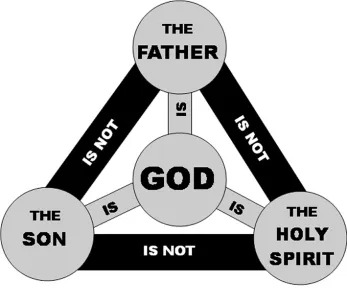
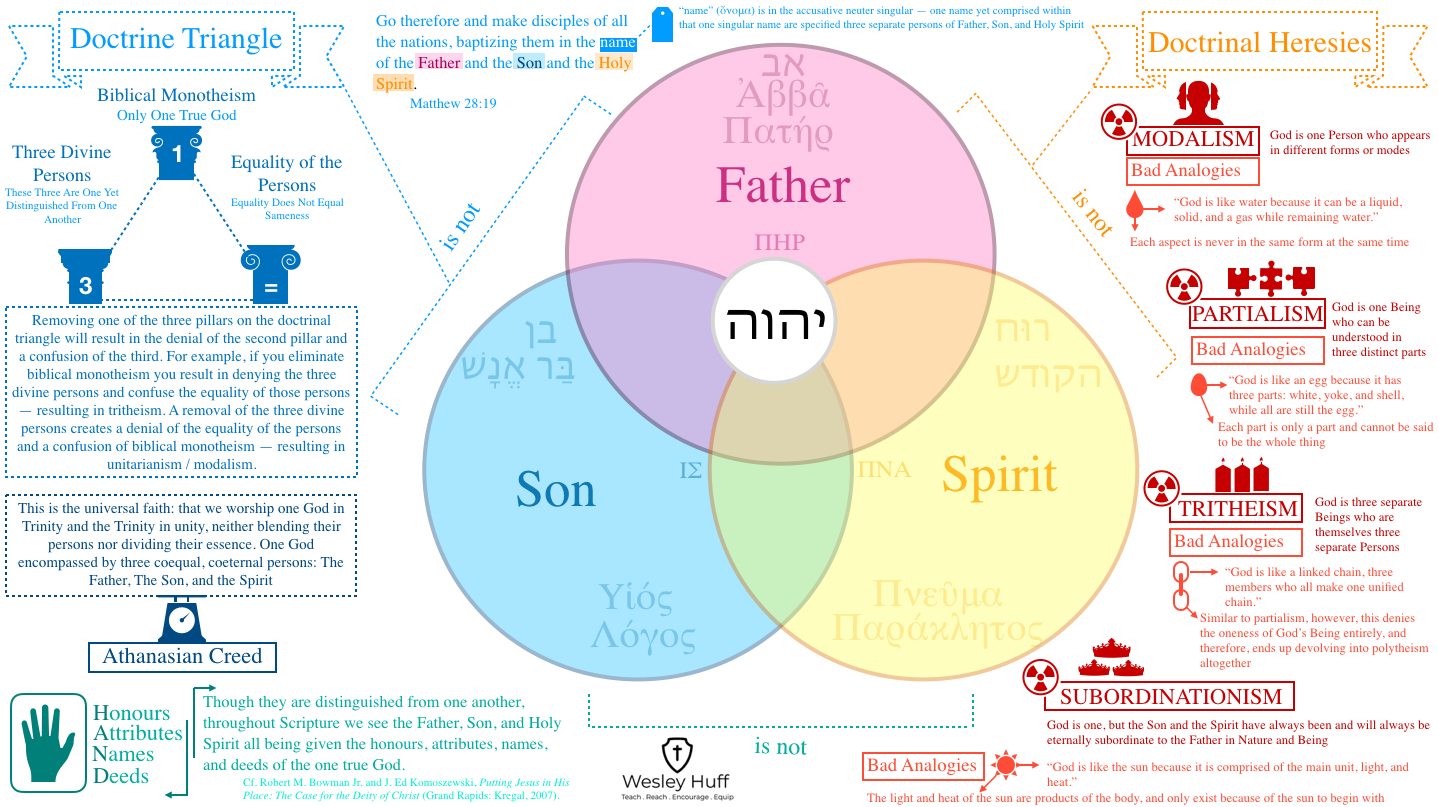
The Trinity is the Christian doctrine that describes God as one Being in three distinct persons: the Father, the Son (Jesus Christ), and the Holy Spirit. Each person is fully and equally God, sharing the same divine essence, yet they are not the same person.
What the Trinity Is:
The word Trinity is not in the bible, rather it is a doctrine that comes form the Three Truths (Apologetics2018-bt).
One God: There is only one God, not three separate gods.
The Bible is clear on this in both Testaments that there is One God (The Biblical Affirmation Of One God). This is the God of the Jews, The God of Abraham, Isaac and Jacob. Jesus himself affirms this by quoting the Shema, the Jewish prayer that defines the entire religion.
“Hear, O Israel: The LORD our God, the LORD is one (אֶחָד – Hebrew: echad).
This is the first pillar of the Trinity
Three Persons: The Father, Son, and Holy Spirit are distinct but coexist in unity.
Jesus made many claims to be God, but He Always taught that God The Father was in Heaven. The Holy Spirit is credited to being God in the New Testament, but Jesus clarified that The Holy Spirit was not the Father and not The Son. We can see in Matthew that Christians are to make disciples of all nations in the Name of the Father, The Son and The Holy Spirit. At the baptism of Jesus in Mark 1, we can see all three persons are present and interacting with one another. All three are clearly shown to be separate from one another.
The is the second pillar of the trinity.
Co-equal and Co-eternal: Each person is fully God and has existed eternally without hierarchy.
“Listen to me, O Jacob, and Israel, whom I called! I am he; I am the first, and I am the last. 13. My hand laid the foundation of the earth, and my right hand spread out the heavens; when I call to them, they stand forth together. 14. “Assemble, all of you, and listen! Who among them has declared these things? The LORD loves him; he shall perform his purpose on Babylon, and his arm shall be against the Chaldeans. 15. I, even I, have spoken and called him; I have brought him, and he will prosper in his way. 16. Draw near to me, hear this: from the beginning I have not spoken in secret, from the time it came to be I have been there.” And now the Lord GOD has sent me, and his Spirit.
The Creator who is speaking claims to have been sent by the other Lord God and His Spirit! In Genesis 1:1-3 God (Elohim, which is a plural), the Spirit of God and the Word of God (and God said…), are all involved in the creation of the universe (Shema). Jesus even claims to have existed before time (John 8:58)
This is the third pillar of the trinity
The Trinity, embedded in both the Old and New Testaments , emerges from hints in the Old Testament, such as Genesis 1:26 (Stewart_undated-fo), and prophetic references like Isaiah 9:6. It is not a doctrine that is discoverable through general revelation or human reasoning, as God's unique triune nature is wholly reliant on His special disclosure in Scripture (Zaspel2017-ce). The Old Testament lays the groundwork for the Trinity (The Trinity Foreshadowed In The Old Testament) and has God portrayed with a plural nature (The Plurality Of God In The Old Testament). The New Testament shows us a more revealed doctrine and consistently presents a triad of Father, Son, and Holy Spirit to be God. In the New Testament, these hints from the Old Testament are unraveled, with Jesus affirming His relationship with the Father and the Holy Spirit (John 10:30). This triadic pattern is evident throughout various passages that explicitly reference the roles and interactions of God, Christ, and the Spirit. From Matthew 28:19's commission to baptize in the name of the Father, Son, and Holy Spirit, to 2 Corinthians 13:14's benediction invoking the grace of the Lord Jesus Christ, the love of God, and the fellowship of the Holy Spirit.
These triadic references are not isolated occurrences but are all throughout the New Testament (Luke 4:1-12), from the birth of Jesus, as seen in Luke 1:35 and the baptism of Jesus in Luke 3:21-22, to the empowering of believers through the Holy Spirit in Acts 1:4-8 and2:33, 2:38-39. The Trinity is consistently highlighted in teachings, miracles, and the work of salvation, reinforcing the biblical understanding of the Father, Son, and Holy Spirit as distinct persons within the Godhead (John 4:10-25, 7:37-39, 7:14-16, 20:21-22; Acts 1:4-8, 2:332:38-39; 5:3-4, 5:9, 5:30-32; 7:55-56; 10:36-38, 44-48; 11:15-18; 15:8-11; 20:38; 28:25-31; ). The early Christian community, as recorded in Acts and the Epistles, understood and worshipped God in a Trinitarian framework, as seen in the Pauline benedictions (2 Corinthians 13:14) and Peters' teachings (1 Peter 1:2).
Removing any of the three core doctrines of the Trinity—One God, Three Persons, and Co-equal and Co-eternal—undermines the entire of Christian faith. Affirming one God is essential to monotheism; without it, we risk falling into polytheism. The Bible is clear on this in both Testaments (The Biblical Affirmation Of One God). Eliminating the distinct personhood of the Father, Son, and Holy Spirit reduces God to a single role and makes the Bible contradict itself (Matthew 3:16-17; John 1:1-14, 14:16-17;Rev 5:13-14). Denying their co-equality and co-eternality disrupts the full divinity of each person, leading to a distorted view of Jesus and the Holy Spirit.
Confusion of Persons: The Father is not the Son, and the Son is not the Holy Spirit; they have unique roles and relationships (See The Holy Spirit Is Not The Father Or Son).
A Literal Division: It does not mean God is split into parts or that He changes forms.
In essence, the Trinity expresses the complexity of God’s nature while affirming His oneness.
The concept of Jesus Christ's divinity is a fundamental aspect of Christian theology. For those new to this topic, it's essential to understand how the Bible itself portrays Jesus not merely as a historical figure or prophet, but as God in human form. This understanding is drawn from various passages that collectively paint a picture of Jesus' unique divine nature and authority. The divinity of Jesus Christ is not only affirmed in the New Testament but is also foreshadowed in the Old Testament. The best way I have found to articulate how Jesus is God in the Bible is with using the acronym H.A.N.D.S. Jesus is given (Bowman2007-gc):
(H) oners: Jesus shares the honors that are due God
(A) ttributes: Jesus shares the attributes of God, including being eternal, all-powerful, all-knowing, and loving
(N) ames: Jesus has been given names that are above every other name, including God, Lord, King of kings,
(D) eeds: Jesus shares the deeds that God does
(S) eat: Jesus shares the seat of God's eternal throne
This article is an overview of the claim, visit the links to go into more depth on each subject.
YAHWEH to Come
In Christian theology, The Hebrew scriptures that collectively anticipate a Messiah with divine attributes. These prophecies set the stage for the New Testament's portrayal of Jesus. For instance, the book of Isaiah speaks of a child who will be born, bearing titles like "Mighty God" and "Everlasting Father" (Isaiah 9:6), with the same wording applied to God himself in Isaiah 10:21. This child would be named Immanuel, literally "God with us". (Isaiah 7:14). The prophet Jeremiah promises this king would be from David's line, who will be called "The LORD [YAHWEH - יהוה] our righteousness," (Jeremiah 23:5-6). Micah 5:2 calls him the "whose coming forth is from of old, from ancient days.", linking him to God himself (Daniel 7:9). Psalm 110:1 portrays a figure seated at God's right hand, a position of unparalleled honor that surpasses earthly kingship.
The later chapters of Isaiah contributes significantly to the Christian understanding of God's divine nature. Isaiah 48:16 stands out as a passage where the divine LORD [YAHWEH - יהוה0]], mentions being sent by the LORD [YAHWEH - יהוה], alongside the Spirit, suggesting a multi-personal nature of God, which Christians later understand as the Trinity. Perhaps the most striking is the vision in Isaiah 6:1-10. Here, Isaiah sees the LORD [YAHWEH - יהוה] sitting on a high and exalted throne filling the temple, with the seraphim calling out about His holiness and glory. The Gospel of John references this vision directly (John 12:41), saying that that Isaiah saw Christ's glory, making him God in this passage.
In the New Testament, affirming Jesus' divine status are various narratives and teachings in the New Testament. Matthew 1:23 introduces Jesus as "Emmanuel," or "God with us," from Isaiah 9:6 and Isaiah 7:14. In John's Gospel Jesus is described as the eternal Word, existing with God from the beginning and being divine Himself (John 1:1). John gets this from the Old testament, where the Word is [YAHWEH - יהוה] manifesting in a visible form (Genesis 15; Jeremiah 1; 1 Samuel 3:1; Ezekiel 1) In John 5:17-18, Jesus equates His actions and being with God.
Jesus is presented as "God" in doxologies and titles though the rest of the New Testament (Romans 9:5; Titus 2:13; 2 Peter 1:1; Jude 1:25). This divinity is explicitly acknowledged by Thomas in John 20:28, where he addresses Jesus as "my Lord and my God," a declaration that Jesus does not refute . Acts 20:28 speaks of the church being purchased by God [Jesus] with his own blood. Hebrews 1:8 affirms Jesus as God by linking him to YAHWEH (Psalm 45:6). Colossians 1:15-17 and2 Corinthians 4:4 present Jesus as the very image of God. Jesus is called equal to God in Philippians 2:6. Lastly, Romans 9:5 and 1 John 5:20 can be seen as recognizing Jesus as "the true God."
When the Jews confront Jesus in John 10, demanding to know if He is the Christ. Jesus asserts that his high status as the Son is based on Him doing the works of His Father: the Father is in him. This phrase parallels Exodus 23:20-21,where the Name—Yahweh’s Presence—was in the angel of YAHWEH who himself is God (Genesis 16:7-14, 22:9-16, 31:11-13, 32:24-30; Exodus 3:1-5; Judges 6:11-24). This theme continues as Gods name dwells in the temple throughout the old testament (Ezra 6:12; 2 Chronicles 6:6; 1 Kings 5:4-6, 1 Kings 36:1) Jesus goes on to say that He and the Father are one, which is said in context of being the source of eternal life (John 10:30) and also claims to be "I AM" [ἐγὼ εἰμί], the same God that appeared to Moses (John 8:58) .
These assertions lead to accusations of blasphemy from the Jewish leaders, who prepare to stone Jesus for his perceived claim to be God. In his defense, Jesus cites Psalm 82:6, arguing that if scripture calls certain figures 'gods', why is it blasphemous for Him, sanctified and sent by the Father, to call Himself the Son of God? He urges belief in him based on his works, evidencing the mutual indwelling of the Father and the Son. These instances, along with His declaration and His affirmation being the figure of Daniel 7:13 (Matthew 26:64;Mark 14:62; Revelation 1:7) ultimately lead to his death. However, scripture say that Jesus, God, and the Holy Spirit all raised Jesus from the dead (Acts 2:24; Galatians 1:1; 1 Peter 3:18; Romans 1:4, 8:11; John 2:19, 10:17-18, 11:25;Revelation 1:18).
Jesus Is Glorified
Jesus has many titles that show him to be God Almighty, such as:
The divinity of Jesus Christ is thoroughly affirmed in the Bible, illustrated by His title as the Son of God, with roots in both Testaments. In the Old Testament, prophecies like Micah 5:2 and Isaiah 9:6 foretell His eternal origins and divine titles, paralleling God's attributes. Jeremiah 23:5-6 further supports this with the title "The LORD our righteousness" attributed to a Messianic figure from the line of David. These are reflected in New Testament affirmations of Jesus' divine nature through His actions and words, such as forgiving sins (Mark 2:5-7), asserting His pre-existence (John 8:58), and declaring unity with the Father (John 10:30). His "I Am" statements in John's Gospel are direct claims to divinity(John 8:58-59,John 10:30-39), a claim that Jesus never refuted (John 5:17-23,John 8:58-59, John 10:30-39, John 19:7; Matthew 26:63-65). In the New Testament, several writers take Old Testament passages that refer to only God alone, and say they are about Jesus instead (John 12:41 - Isaiah 6:1-10; John 1:1 - Genesis 15; Jeremiah 1; 1 Samuel 3:1; Ezekiel 1; Hebrews 1:8 - Psalm 45:6;)). The Apostles constantly make Jesus and His name equal with God throughout the New Testament and also call him God Directly (John 20:28;Romans 9:5; Titus 2:13; 2 Peter 1:1; Jude 1:25). The historical evidence demonstrates that early Christian practices and beliefs-such as prayer, baptism, and worship-center on Jesus, demonstrating early recognition of His divinity. His resurrection and ascension seal His divine authority and victory (John 1:1-3; Colossians 1:16).
The Divinity Of Holy Spirit
Explore The Claim That Holy Spirit Is God
The Holy Spirit, the third person of the Trinity, is co-equal with the Father and the Son. Though often less emphasized, the Holy Spirit's presence and activity throughout the bible demonstrate His divinity and crucial role in God’s plan for humanity. This doctrine is integral to Christian theology, with numerous Scriptures supporting the Holy Spirit's status as God. This article will explore how Scripture presents the Holy Spirit not merely as a divine influence or force but as God Himself, fully engaged in the Trinity alongside the Father and the Son. This article serves as an overview of the claim, with links to delve deeper into each aspect. The understanding of what the Holy Spirit is understanding is crucial for a complete grasp of God's nature and His relationship with humanity. The acronym H.A.N.D.S. can help us articulate how the Holy Spirit is God:
(H) onors: The Holy Spirit shares the honors due to God.
(A) ttributes: The Holy Spirit possesses the attributes of God, including omniscience, omnipresence, and holiness.
(N) ames: The Holy Spirit is referred to by divine names, emphasizing His divinity.
(D) eeds: The Holy Spirit performs the works of God.
(S) eat: The Holy Spirit shares the seat of God's eternal authority.
The Holy Spirit Is A Person
The biblical evidence overwhelmingly supports the understanding that the Holy Spirit is not merely a force or the will of God but a distinct person within the Godhead. From being described with personal attributes, having a will, being self-aware, speaking, commanding, planning and interacting with God the Father and Jesus in the Bible.
Scripture Support For The Personhood Of The Holy Spirit
A passage in the book of Acts gives us many of these proofs that the Spirit is a person:
2. While they were worshiping the Lord and fasting, the Holy Spirit said, “Set apart for me Barnabas and Saul for the work to which I have called them.”
In just this one short verse, we see that the Holy Spirit:
Makes plans (The work that Barnabas and Saul will do in the rest of Acts)
Is self-aware. (The Spirit said, I and Me)
This passage alone can show us that the Spirit is not a force but a person. But this is not the only passage that give us personal attributes, the rest of the Bible is full of them.
When members of the church tried to lie to Peter, He accused them of lying to the Holy Spirit and called it God (Acts 5:3). He did so again when he says that "You always resist the Holy Spirit"(Acts 7:51) but refers to God speaking in Malachi 3:7
Furthermore, there are instances where "impersonal" language used of the Holy Spirit is paralleled by similar language used of other persons of the Trinity. For example, the Holy Spirit is compared to fire in verses such as Matthew 3:11 and Luke 3:16, echoing the descriptions of God as a consuming fire in Deuteronomy 4:24 and Hebrews 12:29. This comparison is reminiscent of God's revelation to Moses through the burning bush (Exodus 3:2-4) and His manifestation on Mount Sinai (Exodus 19:18). Moreover, God's judgment is also likened to fire, as seen in Isaiah 33:14 and Isaiah 66:15. Additionally, the concept of being "filled with the Holy Spirit" (Ephesians 5:18) is compared to being "filled with the fullness of God" (Ephesians 3:17-19). Similarly, God is described as wind, which is associated with His presence and power (Psalm 104:4;Isaiah 66:15). The Holy Spirit is also depicted as wind, as seen in John 3:8 and in Acts 2:2:. Moreover, Gods power and life is likened to water (Isaiah 44:3; Jeremiah 2:13). The Holy Spirit is similarly compared to water, as illustrated in John 7:38-39.
The divinity of The Holy Spirit along side the Father and Son is not only affirmed in the New Testament but is also foreshadowed and present in the Old Testament. The doctrine arises naturally from the Bible when passages are read in context. For example we can see that the Holy Spirit of God is said to be omnipresent (Psalm 139:7), Omniscient (1 Corinthians 2:10), eternal (Hebrews 9:14), even being present at Creation (Genesis 1:2). David was the first to call him the “Holy Spirit” (Psalm 51:11). It is this Spirit that was active in the incarnation of Jesus (Matthew 1:18, 20: [Luke 1:35](https://www.bible.com/bible/59/LGalatians 1:1)) and raised Jesus from the dead (Galatians 1:1; Romans 1:4,8:11). In the Bible, the Holy Spirit is explicitly equated with God (2 Corinthians 3:17-18). Acts 5:3-4 recounts an incident where Ananias and Sapphira lied to the Holy Spirit, to which Peter responds by saying that they lied not to men but to God, then later said the the Spirit of Jesus and The Holy Spirit were one and the same (Romans 8:9).
The Bible Teaches The Holy Spirit Has The Attributes Of God
The reason Christians have always said the the Holy Spirit is God is because it has always been associated with attributes that only the Creator of heaven and Earth have.
We will take a look at some of the attributes of this shared glory below.
All Powerful, Knowing, Present
Omnipresent
The Holy Spirit is said to be wherever God dwells, as David describes in Psalms
Where shall I go from your Spirit? Or where shall I flee from your presence? 8. If I ascend to heaven, you are there! If I make my bed in Sheol, you are there! 9. If I take the wings of the morning and dwell in the uttermost parts of the sea, 10. even there your hand shall lead me, and your right hand shall hold me. 11. If I say, “Surely the darkness shall cover me, and the light about me be night,” 12. even the darkness is not dark to you; the night is bright as the day, for darkness is as light with you.
Jesus tells us that the Spirit is inside every believer, it would have to be in millions of places at once.
17. even the Spirit of truth, whom the world cannot receive, because it neither sees him nor knows him. You know him, for he dwells with you and will be in you. 18. “I will not leave you as orphans; I will come to you.
Omniscient
In the Old Testament we learn that nobody can know the things of God because He is infinite and eternal, to know that would be to know all things
these things God has revealed to us through the Spirit. For the Spirit searches everything, even the depths of God.
Andrew T. Lincoln shows us that In the Old Testament, only God is shown to have this power and being able to predict the future is His alone (Isaiah 41:21-23, 42:9, 43:8-13, 44:7-8, 46:10). God give a challenge for anyone to come forth and show that they are God by knowing the future. Once again the Old Testament ideas of who God is and what He can do are being applied by . In 1 Kings and Jeremiah we see that God is the only one that can search the hearts and minds of mankind.
then hear in heaven your dwelling place and forgive and act and render to each whose heart you know, according to all his ways (for you, you only, know the hearts of all the children of mankind),
13. Who has measured the Spirit of the LORD, or what man shows him his counsel? 14. Whom did he consult, and who made him understand? Who taught him the path of justice, and taught him knowledge, and showed him the way of understanding?
Paul tells us the that Holy Spirit Knows the depths of God, he goes on to explain that a persons thoughts are only known by the person that thinks them. But with God, the Holy Spirit knows because the Holy Spirit is God.
10. these things God has revealed to us through the Spirit. For the Spirit searches everything, even the depths of God. 11. For who knows a person's thoughts except the spirit of that person, which is in him? So also no one comprehends the thoughts of God except the Spirit of God.
Omnipotent
In the Old Testament, the omnipotence of God is repeatedly showcased through His creation, sustenance, and miraculous interventions in human history. Genesis 1 portrays God speaking the universe into existence, highlighting His supreme power over all creation. The Psalms frequently celebrate His might and control over the natural world, with Psalm 135:6-7 asserting,
Whatever the LORD pleases, he does, in heaven and on earth, in the seas and all deeps. 7. He it is who makes the clouds rise at the end of the earth, who makes lightnings for the rain and brings forth the wind from his storehouses.
The narrative in Exodus 14:21-22, where God parts the Red Sea, demonstrate His unparalleled authority over nature and ability to deliver His people. God's interactions with individuals like Abraham in Genesis 17:1, where He introduces Himself as "God Almighty," and His response to Job in Job 38-41, where He questions Job from the whirlwind show that there is none that can match is power. The prophets, especially Isaiah, portray God as the sovereign ruler of nations and history, with unmatched strength and control over all events and entities.
The Holy Spirit is said to have all understanding, wisdom, console and might of the LORD (Isaiah 11:2), that gives life to all creation (Genesis 1:2; Job 33:4;). It was this holy Spirit that Raised Jesus from the dead and gives us life (Romans 8:11). Mary is told that the power of the Holy Spirit is the power of God (Luke 1:35), Paul even claims that it is the source of all his miracles (Romans 15:13, 15:19) and that in believers ( 2 Timothy 1:7); Paul and Jesus also say that the power of God is the power of the Spirit
But you will receive power when the Holy Spirit has come upon you, and you will be my witnesses in Jerusalem and in all Judea and Samaria, and to the end of the earth.”
Now there are varieties of gifts, but the same Spirit; 5. and there are varieties of service, but the same Lord; 6. and there are varieties of activities, but it is the same God who empowers them all in everyone. 7. To each is given the manifestation of the Spirit for the common good. 8. For to one is given through the Spirit the utterance of wisdom, and to another the utterance of knowledge according to the same Spirit, 9. to another faith by the same Spirit, to another gifts of healing by the one Spirit, 10. to another the working of miracles, to another prophecy, to another the ability to distinguish between spirits, to another various kinds of tongues, to another the interpretation of tongues. 11. All these are empowered by one and the same Spirit, who apportions to each one individually as he wills.
Eternal/Unchangeable
The Holy Spirit's eternal nature is affirmed in several passages, revealing His existence beyond time. In the beginning, the Spirit of God was present at creation, as seen in Genesis 1:2 or Psalm 104:30 and Job 26:13 and Isaiah 63:10-11.
How much more will the blood of Christ, who through the eternal Spirit offered himself without blemish to God, purify our conscience from dead works to serve the living God.
Moreover, the Holy Spirit’s eternal presence is promised to believers. In John 14:16, Jesus declares that the Spirit will be with us forever.
And I will ask the Father, and he will give you another Helper, to be with you forever.
More Attributes
The Spirit embodies grace, as seen in Zechariah 12:10, where God promises to pour out a spirit of grace on His people. The Spirit is also characterized by holiness and glory, as shown in Romans 1:4 and 1 Peter 4:14. The Holy Spirit is the source of life (Romans 8:10; 2 Corinthians 3:6), breathing life into believers both physically and spiritually. Love is another divine attribute manifested through the Spirit, as referenced in Romans 15:30 and 2 Timothy 1:7. The Spirit is also the essence of truth, as John 14:17, John 15:26, John 16:13, and 1 John 5:6.
The Bible Teaches The Holy Spirit Has The Attributes Of God
Throughout the New Testament, we find compelling evidence that The Holy Spirit performs the works that are typically attributed to God:
Works Of God Credited To The Holy Spirit
Creation
The Bible Claims God Created Everything ALONE
Scripture begins with the affirmation that God created the universe (Genesis 1:1), The Bible is also clear that God alone made the universe and asserts that God actively sustains His creation.
6. “You are the LORD, you alone. You have made heaven, the heaven of heavens, with all their host, the earth and all that is on it, the seas and all that is in them; and you preserve all of them; and the host of heaven worships you.
Throughout the book of Isaiah we find God claims sole responsibility for creation
24. Thus says the LORD, your Redeemer, who formed you from the womb: “I am the LORD, who made all things, who alone stretched out the heavens, who spread out the earth by myself,
12. I made the earth and created man on it; it was my hands that stretched out the heavens, and I commanded all their host.
God continues to claim that He gives life to everything (Isaiah 42:5) and it was his words that made everything in creation (Psalm 104:5-9, Genesis 1) beautifully illustrates how God established and maintains the earth and its natural laws. Even in the New Testament we find God needs nothing (Acts 17:25) as He continues to life to all creation.
The New Testament Claims That Jesus Created Everything ALONE
John starts off his gospel in the New Testament declaring Jesus to be the word of God himself (Jesus Is The Word Of God), paralleling the Genesis opening to show that Jesus was there in the beginning with God (John 1:1). John 1:3, 10 asserts,
3. All things were made through him, and without him was not any thing made that was made...10 He was in the world, and the world was made through him, yet the world did not know him."
16. For by him all things were created, in heaven and on earth, visible and invisible, whether thrones or dominions or rulers or authorities — all things were created through him and for him.
We find that these verses teach that Jesus was their at the beginning of creation, and God worked though Jesus to make everything. This seems like it could possibly fit in with the Old Testament theology, although it seems more like an addition to the Jewish belief. However this is not where the New Testament stops talking about Jesus.
The Gospels are replete with instances where Jesus demonstrates divine sovereignty over nature. He calms storms (Matthew 8:23-27), multiplies food (Matthew 14:13-33, 15:32-39), and even controls the catch of fish (John 21:1-14). These events reveal His authority over the natural world, a characteristic often attributed to God. Not only was Jesus there at creation, the Bible teaches that Jesus actively holds creation together just as God does (Romans 11:36). Colossians 1:17, this directly contrasts with the old testament that says God alone created and sustains the universe.
17. And he is before all things, and in him all things hold together.
Hebrews 1:2-3 continues this reasoning, not only did God make the world though The Son, Jesus is "upholding the universe by the word of his power," a clear testament to His continuous action in maintaining creation. 1 Corinthians 8:6 directly compares both God and Jesus, saying they both created the universe and sustains it:
6. yet for us there is one God, the Father, from whom are all things and for whom we exist, and one Lord, Jesus Christ, through whom are all things and through whom we exist.
Furthermore, Hebrews 1:10 takes the Old Testament claim about God the Father in Psalm 102 and applies it directly to Jesus:
10. And, “You, Lord, laid the foundation of the earth in the beginning, and the heavens are the work of your hands;
Thus, the Christian scriptures present a unified vision of God's and Jesus' roles in creation. Initially, the Old Testament attributes creation and maintenance of the universe solely to God. However, the New Testament extends these divine attributes to Jesus, portrays Jesus not merely as a part of creation but as central to its existence and ongoing existence.
Inspiration of Scripture
The inspiration of Scripture was deeply believed by the Jewish people and affirmed throughout the Old Testament. The Jews held the Torah (Exodus 24:4), the Nevi'im/Prophets (Jeremiah 1:9), and the Writings/Ketuvim (Psalm 119:160 ) as the very words of God, conveyed through human authors by divine guidance. For Jews, the Scriptures were not just historical documents or moral stories but were considered God’s revelation to humanity. They believed that the Scriptures carried the authority of God Himself, as seen in Nehemiah 8:8. This thought that God is the source of scripture continues in the new testament as well (2 Timothy 3:16). Such as when Hebrews parrel the words of the Spirit (Hebrews 3:7) with what God said (Psalm 95:7)
41. Now while the Pharisees were gathered together, Jesus asked them a question, 42. saying, “What do you think about the Christ? Whose son is he?” They said to him, “The son of David.” 43. He said to them, “How is it then that David, in the Spirit, calls him Lord, saying, 44. “‘The Lord said to my Lord, “Sit at my right hand, until I put your enemies under your feet”’? 45. If then David calls him Lord, how is he his son?” 46. And no one was able to answer him a word, nor from that day did anyone dare to ask him any more questions.
Jesus promised His disciples that the Holy Spirit would teach and remind them of all He had spoken, ensuring that their writings and teachings would be divinely inspired.
26. But the Helper, the Holy Spirit, whom the Father will send in my name, he will teach you all things and bring to your remembrance all that I have said to you.
Resurrection:
The resurrection of Jesus is central to Christian faith, and the Bible teaches that it was God who raised Him from the dead. In Acts 2:24:
11. If the Spirit of him who raised Jesus from the dead dwells in you, he who raised Christ Jesus from the dead will also give life to your mortal bodies through his Spirit who dwells in you.
18. For Christ also suffered once for sins, the righteous for the unrighteous, that he might bring us to God, being put to death in the flesh but made alive in the spirit,
This is a work that is undeniably divine in nature ( Romans 1:4 ), and the same Spirit who raised Jesus from the dead dwells within believers John 6:63Titus 3:5.
Salvation and Sanctification:
The Bible teaches that God is the source of both salvation and sanctification. Paul teaches that:
8. For by grace you have been saved through faith. And this is not your own doing; it is the gift of God, 9. not a result of works, so that no one may boast.
This shows that salvation is entirely a work of God’s grace, given freely to those who believe. Similarly, sanctification, the process of becoming more like Christ, is also God's work in a believer's life.
6. And I am sure of this, that he who began a good work in you will bring it to completion at the day of Jesus Christ.
Romans 8:1-27 shows the Holy Spirit's involvement in the process of salvation. It is the Spirit that saves us from death (Romans 8:2). He not only convicts and assures believers but also intercedes for them according to God's will. He gives comfort to Christians (2 Corinthians 1:3-4; John 14:26), it is by the Spirit that we are born again/ baptized (John 3:5, 3:8). The process of sanctification (being made holy) is the work of the Holy Spirit (Jude 1; 1 Peter 1:2).
13. But we ought always to give thanks to God for you, brothers beloved by the Lord, because God chose you as the firstfruits to be saved, through sanctification by the Spirit and belief in the truth.
2. according to the foreknowledge of God the Father, in the sanctification of the Spirit, for obedience to Jesus Christ and for sprinkling with his blood: May grace and peace be multiplied to you.
to Jesus Christ and for sprinkling with his blood: May grace and peace be multiplied to you."
Incarnation:
The Bible teaches that the Incarnation—God becoming flesh in the person of Jesus Christ—is entirely a work of God. John tells us:
4. But when the fullness of time had come, God sent forth his Son, born of woman, born under the law, 5. to redeem those who were under the law, so that we might receive adoption as sons.
These verses teach that it was God's sovereign act to send His Son into the world, initiating the Incarnation for the purpose of salvation. But the Bible also teaches that it was the power and work of the Holy Spirit's that produced the incarnation of Jesus Christ (Matthew 1:18-20). It was for this reason that Jesus was Holy from conception ( Luke 1:35). These verses highlight that the Holy Spirit played a pivotal part in the most significant event in human history.
Impersonal Language Also Used For God
Furthermore, there are instances where "impersonal" language used of the Holy Spirit is paralleled by similar language used of other persons of the Trinity. For example, the Holy Spirit is compared to fire in verses such as Matthew 3:11 and Luke 3:16, echoing the descriptions of God as a consuming fire in Deuteronomy 4:24 and Hebrews 12:29. This comparison is reminiscent of God's revelation to Moses through the burning bush (Exodus 3:2-4) and His manifestation on Mount Sinai (Exodus 19:18). Moreover, God's judgment is also likened to fire, as seen in Isaiah 33:14 and Isaiah 66:15. Additionally, the concept of being "filled with the Holy Spirit" (Ephesians 5:18) is compared to being "filled with the fullness of God" (Ephesians 3:17-19). Similarly, God is described as wind, which is associated with His presence and power (Psalm 104:4;Isaiah 66:15). The Holy Spirit is also depicted as wind, as seen in John 3:8 and in Acts 2:2:. Moreover, Gods power and life is likened to water (Isaiah 44:3; Jeremiah 2:13). The Holy Spirit is similarly compared to water, as illustrated in John 7:38-39.
However, while there are all these passages that show the Spirit is God, Jesus tells us in the gospels that the Spirit is not Him, or the Father (John 14:16, 16:13 ). We also see the Spirit interacting with the both of them during events like the baptism of Jesus, this is the reason that the only way for the Spirit to be both God, but not the Father or Jesus is if He is the Third Member of the Trinity.
The Holy Spirit Is Not Jesus Or The Father
While the Holy Spirit is fully God, distinct passages in the Gospels clarify that the Spirit is not the same person as Jesus or the Father. Jesus says:
16. And I will ask the Father, and he will give you another Helper, to be with you forever, 17. even the Spirit of truth, whom the world cannot receive, because it neither sees him nor knows him. You know him, for he dwells with you and will be in you.
The title "Helper" can also be translated as counselor, which was first given to the Spirit in the Old Testament.
2. And the Spirit of the LORD shall rest upon him, the Spirit of wisdom and understanding, the Spirit of counsel and might, the Spirit of knowledge and the fear of the LORD.
The Greek term for "Helper," paraklêtos, is typically used for persons and not objects or forces. This title is also used in 1 John 2:1, where Jesus is also referred to as our advocate (paraklêtos). Jesus uses personal pronouns such as this and more all throughout John:
13. When the Spirit of truth comes, he will guide you into all the truth, for he will not speak on his own authority, but whatever he hears he will speak, and he will declare to you the things that are to come.
How many times does Jesus have to say He for the Spirit to be a person? Jesus further distinguishes between Himself, the Father, and the Spirit, referring to the Spirit as another paraklêtos, John 14:16 and in 16:7-8 that is not Him or the Father.
16. And I will ask the Father, and he will give you another Helper, to be with you forever,
In this verse, the word "Another" is the greek term allŏs, which means of the same kind, if Jesus didn't want to imply the Holy Spirit was God with the word He could have used the other word hĕtĕrŏs which is "Another/Different". In Galatians 1:6-7 Paul uses both words to ask why the church was accepting a hĕtĕrŏs Gospel, which is not the allŏs Gospel. So Jesus is saying that the Holy Spirit is another person allŏs - the same kind as the Father. Again, in John 15:26, Jesus again distinguishes the roles of each person of the Trinity, stating,
26. “But when the Helper comes, whom I will send to you from the Father, the Spirit of truth, who proceeds from the Father, he will bear witness about me.
This shows that the Spirit is sent by both Jesus and the Father, yet remains distinct from them. The Holy Spirit is the same kind of person the Father is, in fact He proceeds from the Father, meaning that the Holy Spirit is the same being- or God. Further evidence of this distinction is found in Jesus' baptism.
16. And when Jesus was baptized, immediately he went up from the water, and behold, the heavens were opened to him, and he saw the Spirit of God descending like a dove and coming to rest on him; 17. and behold, a voice from heaven said, “This is my beloved Son, with whom I am well pleased.”
In this moment, Jesus is physically present, the Spirit descends as a dove, and the Father's voice is heard from heaven. These three persons—Father, Son, and Holy Spirit—are clearly separate in their roles.
In summary, these biblical passages teach that the Holy Spirit is indeed God, possessing divine attributes, participating in the works of God, and being equated with God Himself throughout Scripture. They also clearly show that Jesus and the Gospels considered the Spirit it's own person separate from God.
The Historical Doctrine of the Holy Spirit
The Early Church has always believed that The Holy Sprit was and is God, the third member of the Trinity. This can be traced back all the way to the Apostle John and his followers. Even still, all of these date later than the Gospels and writings of Paul in the New Testament. We should not dismiss the Bible, as it is our first source of Christian beliefs.
2nd Century
Ignatius (AD 50-117)
Also a disciple of John the Apostle. He wrote a series of letters to various churches on his way to Rome, where he was to be martyred. He writes,
Letter to the Ephesians Chapter 9
Nevertheless, I have heard of some who have passed in among you, holding the wicked doctrine of the strange and evil spirit; to whom ye did not allow entrance to sow their tares, but stopped your ears that ye might not receive that error which was proclaimed by them, as being persuaded that that spirit which deceives the people does not speak the things of Christ, but his own, for he is a lying spirit. But the Holy Spirit does not speak His own things, but those of Christ, and that not from himself, but from the Lord; even as the Lord also announced to us the things that He received from the Father. For, says He, "the word which ye hear is not Mine, but the Father's, who sent Me."61 And says He of the Holy Spirit, "He shall not speak of Himself, but whatsoever things He shall hear from Me."62 And He says of Himself to the Father, "I have," says He, "glorified Thee upon the earth ; I have finished the work which, Thou gavest Me; I have manifested Thy name to men."63 And of the Holy Ghost, "He shall glorify Me, for He receives of Mine."64 But the spirit of deceit preaches himself, and speaks his own things, for he seeks to please himself. He glorifies himself, for he is full of arrogance. He is lying, fraudulent, soothing, flattering, treacherous, rhapsodical, trifling, inharmonious, verbose, sordid, and timorous.
“What is His name, or what His Son’s name, that we may know?” And there is also one Paraclete. For “there is also,” saith [the Scripture], “one Spirit,” since “we have been called in one hope of our calling.” And again, “We have drunk of one Spirit,” with what follows. And it is manifest that all these gifts [possessed by believers] “worketh one and the self-same Spirit.” There are not then either three Fathers, or three Sons, or three Paracletes, but one Father, and one Son, and one Paraclete.
5. Irenaeus of Lyons (AD 130-202)
Irenaeus studied under bishop Polycarp, who in turn had been a disciple of John the Apostle.
Against Heresies (Book III, Chapter 19)
2. For this reason [it is, said], “Who shall declare His generation?”3669 since “He is a man, and who shall recognise Him?”3670 But he to whom the Father which is in heaven has revealed Him,3671 knows Him, so that he understands that He who “was not born either by the will of the flesh, or by the will of man,”3672 is the Son of man, this is Christ, the Son of the living God. For I have shown from the Scriptures,3673 that no one of the sons of Adam is as to everything, and absolutely, called God, or named Lord. But that He is Himself in His own right, beyond all men who ever lived, God, and Lord, and King Eternal, and the Incarnate Word, proclaimed by all the prophets, the apostles, and by the Spirit Himself, may be seen by all who have attained to even a small portion of the truth.
The old things which were done by the prophets and escape the observation of most, are now revealed to you by the evangelists. “For to you,” he says, “they are manifested by the Holy Ghost, who was sent;” that is the Paraclete, of whom the Lord said, “If I go not away, He will not come.”
Tertullian (AD 150-225)
He was an early Christian apologist who argued for the Christian Trinity.
Against Hermogenes Chapter XXII.
And to such a degree has the Holy Ghost made this the rule of His Scripture, that whenever anything is made out of anything, He mentions both the thing that is made and the thing of which it is made.
“Let the earth,” says He, “bring forth grass, the herb yielding seed, and the fruit-tree yielding fruit after its kind, whose seed is in itself, after its kind. And it was so. And the earth brought forth grass, and herb yielding seed after its kind, and the tree yielding fruit, whose seed was in itself, after its kind.”
And again:
“And God said, Let the waters bring forth abundantly the moving creatures that have life, and fowl that may fly above the earth through the firmament of heaven. And it was so. And God created great whales, and every living creature that moveth, which the waters brought forth abundantly, after their kind.”
Again afterwards:
“And God said, Let the earth bring forth the living creature after his kind, cattle, and creeping thing, and beasts of the earth after their kind.”
If therefore God, when producing other things out of things which had been already made, indicates them by the prophet, and tells us what He has produced from such and such a (although we might ourselves suppose them to be derived from some source or other, short of nothing; since there had already been created certain things, from which they might easily seem to have been made); if the Holy Ghost took upon Himself so great a concern for our instruction, that we might know from what everything was produced,
He will come to judge the quick and the dead; who sent also from heaven from the Father, according to His own promise, the Holy Ghost, the Paraclete, the sanctifier of the faith of those who believe in the Father, and in the Son, and in the Holy Ghost.
...
Happily the Lord Himself employs this expression of the person of the Paraclete, so as to signify not a division or severance, but a disposition (of mutual relations in the Godhead); for He says, “I will pray the Father, and He shall send you another Comforter ... even the Spirit of truth,”
3rd Century
Origen (AD 185-254)
An early Christian theologian. He writes,
Origen De Principiis. Chapter III.—On the Holy Spirit.
Now, what the Holy Spirit is, we are taught in many passages of Scripture, as by David in the fifty-first Psalm, when he says,
“And take not Thy Holy Spirit from me;”
and by Daniel, where it is said,
“The Holy Spirit which is in thee.”
And in the New Testament we have abundant testimonies, as when the Holy Spirit is described as having descended upon Christ, and when the Lord breathed upon His apostles after His resurrection, saying,
“Receive the Holy Spirit;”
and the saying of the angel to Mary,
“The Holy Spirit will come upon thee;”
the declaration by Paul, that no one can call Jesus Lord, save by the Holy Spirit. In the Acts of the Apostles, the Holy Spirit was given by the imposition of the apostles’ hands in baptism. From all which we learn that the person of the Holy Spirit was of such authority and dignity, that saving baptism was not complete except by the authority of the most excellent Trinity of them all, i.e., by the naming of Father, Son, and Holy Spirit, and by joining to the unbegotten God the Father, and to His only-begotten Son, the name also of the Holy Spirit. Who, then, is not amazed at the exceeding majesty of the Holy Spirit, when he hears that he who speaks a word against the Son of man may hope for forgiveness; but that he who is guilty of blasphemy against the Holy Spirit has not forgiveness, either in the present world or in that which is to come!
It is time, then, that we say a few words to the best of our ability regarding the Holy Spirit, whom our Lord and Savior in the Gospel according to John has named the Paraclete.
...
We must therefore know that the Paraclete is the Holy Spirit, who teaches truths ...
...
But the Paraclete, who is called the Holy Spirit, ...
... In the case of the Holy Spirit, the Paraclete ...
Myths About the Trinity
Myth: The Trinity is not found in the Bible.
While the term "Trinity" isn’t explicitly in the Bible, the concept is supported by various passages that describe the Father, Son, and Holy Spirit as divine and interconnected (e.g., Matthew 28:19, John 1:1-14, 2 Corinthians 13:14).
The concept of the Trinity is rooted in early Christian scripture and tradition. While it was formalized in the Nicene Creed (AD 325), the beliefs that make up the Trinity existed in the writings of early Church Fathers and the New Testament.
Those in opposition of the doctrine have depicted the development of devotion to Jesus as a divine figure as an evolutionary process influenced paganism (Wilhelm Bousset) Some opponents even say that trinities of gods existed in various ancient mythologies, such as Egyptian and Babylonian that would influence the Christian Church (JW). This is not true, there is no evidence of any other religions having influence on the doctrine (See our refutation of JW.org, Early Church Fathers And The Trinity).