To understand the debate, one must recognize that Reformed theology exists on a spectrum, with different adherents accepting varying "points" of the system and holding different views on how God’s decrees function.
TULIP is a popular acronym used to summarize the five points of Calvinism, which are also collectively referred to as the doctrines of grace. These points represent a Systematic Theological response to Arminianism and were clarified at the Synod of Dort. Each letter represents a specific pillar of the system:
T — Total Depravity (Total Inability)
- Definition: Because of Adam’s fall, every aspect of human nature is corrupted by sin—mind, will, and emotions—leaving unregenerate man spiritually dead. In this state, man is considered morally unable to see, hear, or understand the gospel until God first performs a miracle of regeneration to make them alive
U — Unconditional Election
- Definition: Is the doctrine that God chose certain individuals for adoption and salvation before the foundation of the world. This choice is "unconditional" because it is based solely on God's sovereign will and good pleasure rather than any foreseen faith, merit, or action on the part of the individual
L — Limited Atonement
- Definition: Christ’s atoning death was intended to save the elect alone, fully securing their salvation rather than merely making it possible. While his death is considered of infinite value, Calvinists believe God's intent was to secure the salvation of only those given to the Son by the Father.
I — Irresistible Grace (Effectual Calling)
- Definition: The saving call of the Holy Spirit cannot ultimately be resisted; when God inwardly calls the elect, He effectively brings them to faith. This grace overcomes human resistance by taking a heart of stone and replacing it with a heart of flesh, making the sinner willing to come to Christ to recognize the value of salvation
P — Perseverance of the Saints
- Definition: Asserts the eternal security of the believer, often summarized as "once saved, always saved". It teaches that God, by His own power and the seal of the Holy Spirit, will preserve the elect so that they continue in faith and will never fall away or lose their salvation
Not every person who identifies as "Reformed" or "Calvinistic" accepts the TULIP acronym in its entirety. The system is often broken down by how many of the five points an individual affirms, the two main views are:
-
Five-Point Calvinist (Full Reformed): This is the traditional stance established at the Synod of Dort. It holds that all five points are logically inseparable; if you lose one, the others eventually collapse.
-
Four-Point Calvinist (Amyraldianism): Also known as "Moderate Calvinism," this view typically rejects Limited Atonement. These adherents believe Christ died for the sins of the whole world (universal provision), but that his death is only applied effectively to the elect.
Beyond how many "points" one holds, there is significant internal debate regarding Predestination. It all stems from ones theology of Original Sin- the belief that because of Adam's fall, all humanity is born with a corrupted will and is naturally destined for Hell. These views range from "passive" to "active" models of God's involvement:
-
Single Predestination: The belief that God actively chooses and decrees who will be saved (the elect), while those who are not chosen are simply "passed over." In this view, God is the active cause of salvation, but man is the sole cause of his own damnation.
-
Double Predestination: This view asserts that God issues two active, parallel decrees: one to elect certain individuals to eternal life and another to ordain the remainder of humanity (the reprobate) to eternal punishment for the manifestation of His justice.
-
Triple Predestination: An intensive, rare form of the doctrine which suggests that God not only decrees the final destination (Heaven or Hell) but also sovereignly ordains every specific sin and life event that ensures a person reaches that destination.
Calvin himself defines predestination as "the eternal decree of God, by which he determined with himself whatever he wished to happen with regard to every man. Not all are created on equal terms, but some are preordained to eternal life, others to eternal damnation; and, accordingly, as each has been created for one or other of these ends, we say that he has been predestined to life or to death."
There is groups within these camps that will talk about the Order of Election
- Infralapsarian: God views man as already fallen when He chooses to save some. (The logical order is: Decree to create -> Decree to allow fall -> Decree to elect).
- Supralapsarian God chooses the end goal (Heaven/Hell) before He even decrees the Fall. (The logical order is: Decree to elect/reprobate -> Decree to create -> Decree to allow fall).
Beyond the TULIP acronym, other central terms are defined specifically:
Rejecting the Calvinism Model
Calvinism relies on redefining key terms and reading meanings into the Bible, even when verses clearly contradict nearly every aspect of its system, I shared some examples of that above.
But one doesn't need to evaluated all the points of TULIP to reject the model. You simply need to address one question. Does Regeneration precede faith?
The entire TULIP system is a logical chain built squarely upon the premise of Total Inability (the "T" in TULIP).
If you can demonstrate that the Bible teaches faith precedes regeneration, the entire foundation of TULIP crumbles like dominoes. As leading Reformed theologians like R.C. Sproul themselves acknowledge, if one embraces Total Inability, the rest of the TULIP acrostic follows by a "resistless logic". If a person is capable of believing the gospel without first being irresistibly regenerated, then God's election does not have to be Unconditional. If Unconditional Election (the "U") falls, then the logical necessity for Limited Atonement (the "L") and Irresistible Grace (the "I") falls right along with it.
so here is the argument from RC Sproul (Summarized)
The Argument for Regeneration Preceding Faith
- Premise 1: A person who is "dead in sin" is spiritually unable to perform any spiritual act, including having true faith in God.
- Premise 2: If a person must believe in order to be born again, then a spiritually dead person is being asked to provide the "spark" of life themselves.
- Premise 3: Any spiritual act produced by a "dead" sinner to gain God's life or favor is, by definition, a human contribution or effort.
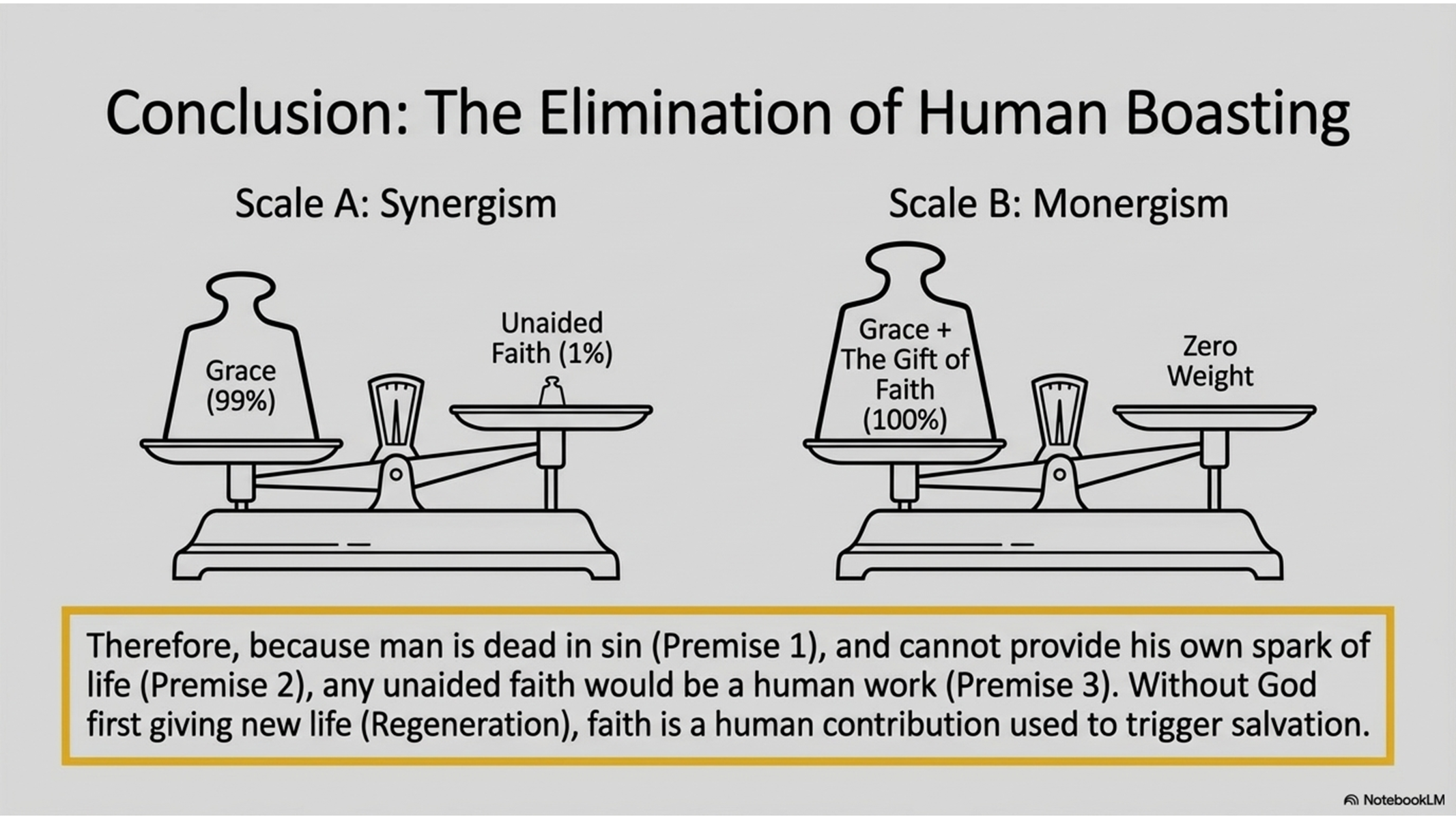
- Conclusion: Therefore, without God first giving new life (Regeneration), faith is a human work used to trigger salvation.
Refuting Premise 1: False Equivalency and Non Sequitur
- The Logical Fallacies:
- False Equivalency: This premise assumes that spiritual "deadness" is identical to a physical, corpse-like inability to respond (like Lazarus in the tomb).
- Non Sequitur: The argument assumes that because a person cannot fulfill the righteous demands of the law to earn salvation, they are therefore incapable of believing in the Savior. For example, I can not call the President on the phone, but that doesn't prove I cannot answer the phone if he calls me.
Refuting Premise 2: Conflation and False Dilemma
- The Logical Fallacies:
- Conflation: This premise improperly conflates man's responsibility to believe with God's responsibility to save. The person believing is not the one providing the life. Admitting that you have a diseased heart and need a heart transplant does not mean you are performing the surgery on yourself.
- False Dilemma: The argument forces a false choice: either God unilaterally forces life into you, or you are saving yourself. It ignores what the bible says, that God gives life through a person's faith.
Refuting Premise 3: Category Error
- The Logical Fallacy:
- Category Error: This premise takes faith and falsely places it into the category of "works of the law" or meritorious human effort. The Bible, however, treats faith and works as mutually exclusive, polar opposites.
**Refuting the Conclusion: Begging the Question
- The Logical Fallacy:
- Begging the Question: The conclusion is baked into the flawed premises. By falsely defining "dead" as unable to respond, and falsely defining "faith" as a human work, the system forces the conclusion that God must regenerate someone first. Because the premises are built on category errors and non sequiturs, the conclusion that regeneration must logically precede faith entirely collapses.
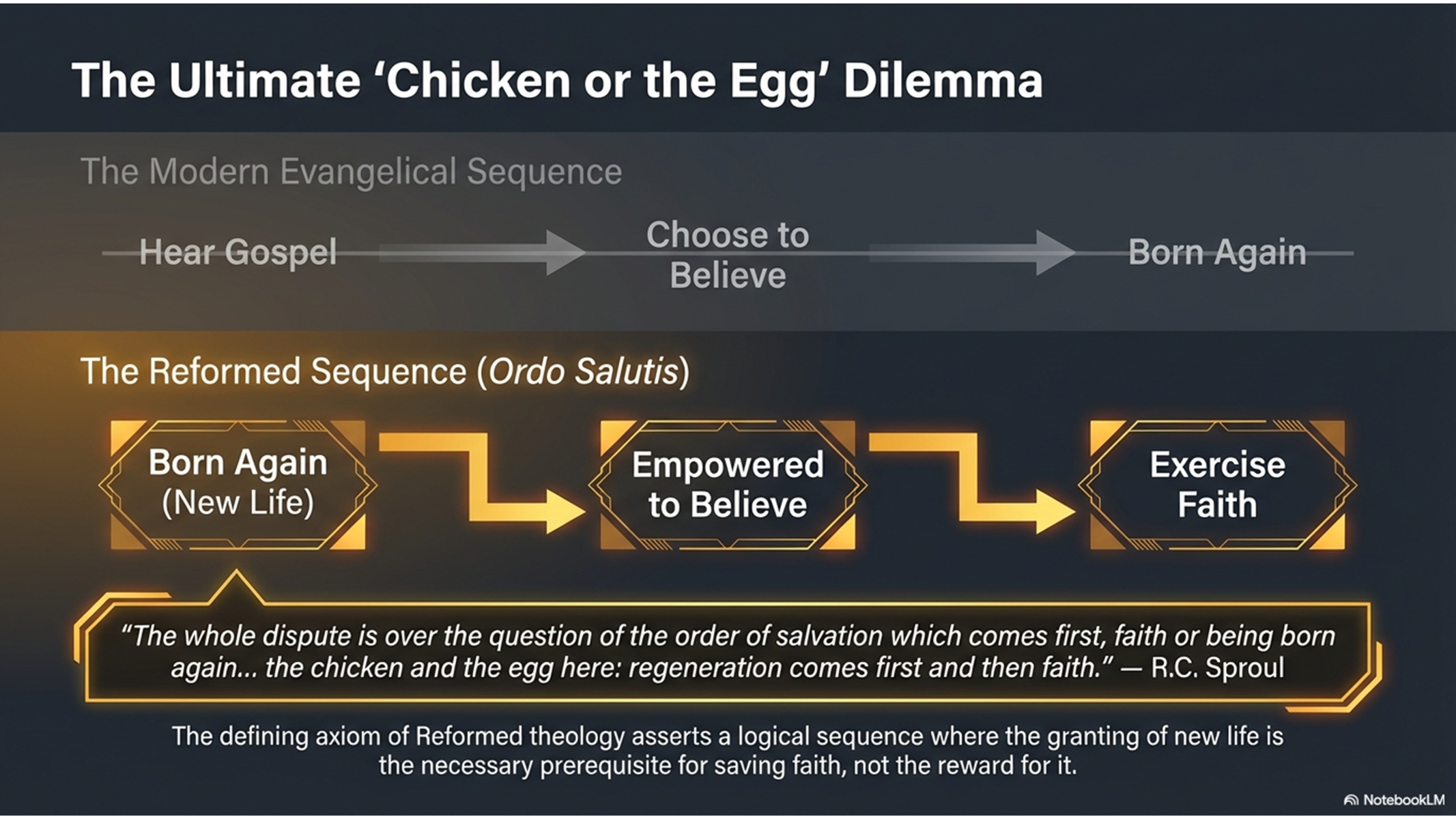
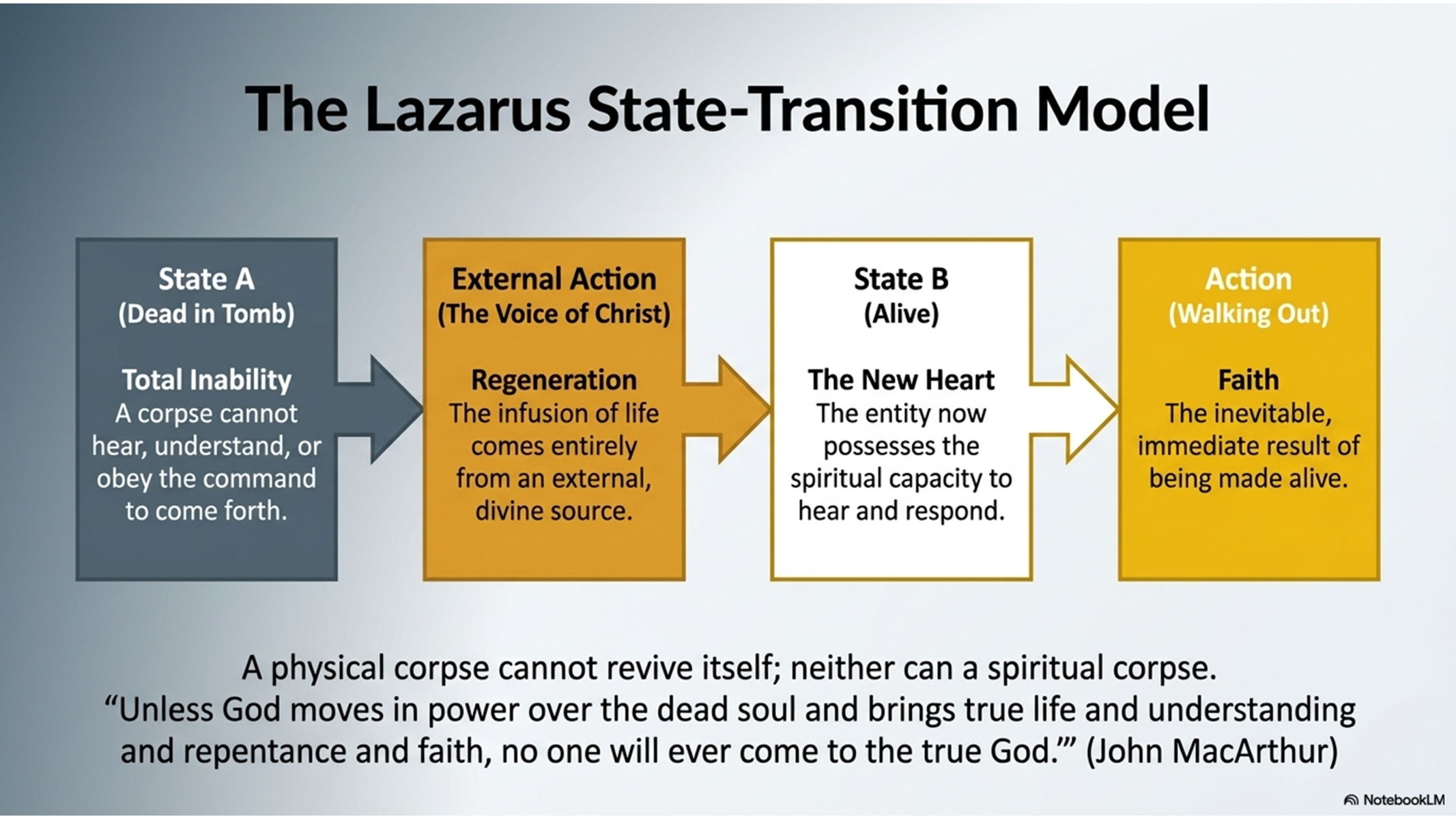
If it is defined as a total loss of ability—much like a physical corpse—then an unregenerate person is entirely passive in their salvation. The story of Lazarus supports this; as a decomposing corpse, he was incapable of participating in his own resurrection. Christ did not woo him; He commanded him. Lazarus could not respond until after he was made alive. Therefore, using this as a direct analogy, a sinner is truly "dead," unresponsive, and must be given new life before they can exercise faith.
I think the biggest problem is that when we import the scientific or medical definitions of "death" and "works" into scripture, we completely distort the biblical doctrines of human responsibility, sin, and salvation.
When the story of Lazarus is used you can see this on full display, I recommend reading John 11 to get to know the story first.
1. The Misunderstanding of "Death"
The Modern / Scientific Definition: Today, the medical and scientific definition of death is the permanent cessation of all vital functions (brain and heart activity),. When modern readers see the phrase "dead in trespasses and sins" (Ephesians 2:1), they often picture a literal corpse—like Lazarus rotting in the tomb. From this definition, Calvinistic theology concludes that a spiritually "dead" person is entirely unable to see, hear, or respond to God, just as a physical corpse cannot respond to physical stimuli.
The second problem is that the definition of "Spiritual Death" is not right.
The Biblical Definition: Death In The Bible
2. The Misunderstanding of "Works"
The Modern / Scientific Definition: In modern terms, "work" is defined by physics and science as energy expended to accomplish a task. Even mentally deciding to do something or physically reaching out your hand requires effort and brain activity. Therefore, people often assume that any human action—including the choice to believe in God—must be categorized as a "work."
The Biblical Definition: The Empty Hand-Why Faith is Not a Work
3. Even If We granted the above definitions this still does not work
When we examine the specific context of the Lazarus narrative, the Calvinistic logic quickly falls apart on several fronts:
1. Lazarus was already a born-again believer before he physically died.
Along with his sisters Mary and Martha, Lazarus was already a devoted worshiper of God long before he was ever placed in the tomb. Because Lazarus already possessed saving faith, using his physical resurrection to illustrate "pre-faith regeneration" is a massive stretching of scripture.
The narrative has absolutely nothing to do with the initial salvation of a lost sinner, effectual calling, or how an unregenerate person passes from spiritual death to life. If anything, raising an already-saved believer from the grave serves as a much better illustration of the future, physical resurrection of the saints rather than a lost person's initial conversion.
2. The True Purpose of the Lazarus Miracle The Bible never once links the physical resurrection of Lazarus to how an individual is spiritually saved. In fact, reading the full narrative reveals that Jesus's stated purpose. He explicitly told His disciples, "Lazarus is dead, and I'm glad for your sakes that I was not there, so that you may believe". Jesus used the miraculous sign as a persuasive means to help convince their wills that He was the Messiah. If God regenerates a person to cause them to believe, then using a miraculous sign to persuade them to believe not needed..
- Immediately after Lazarus came out of the grave, rather than being "regenerated" by the sight, the Pharisees and chief priests met to plot Jesus's death (John 11:46-53). By the next chapter, their hearts were so hardened that they even plotted to kill Lazarus as well, because so many people were turning to Jesus on account of him (John 12:10-11).
- Judas was right there with the disciples when Jesus said the miracle was "so that you may believe." He stood at the tomb and watched a four-day-old corpse walk out at Christ’s command. If the raising of Lazarus is a literal map for how God regenerates a soul to cause faith, then Judas should have been "made alive" in his belief. Instead, witnessing the greatest miracle of Jesus's ministry didn't change his heart; shortly after, he went and bargained to betray Him for thirty pieces of silver (Matthew 26:14-16). Jesus warned, some will not be convinced "even if someone should rise from the dead" (Luke 16:31).
- If you were to say it was just for Lazarus himself (the one being saved), not the bystanders (the disciples or Judas). Jesus explicitly states the miracle is for the onlookers.
Does Regeneration Precede Faith?
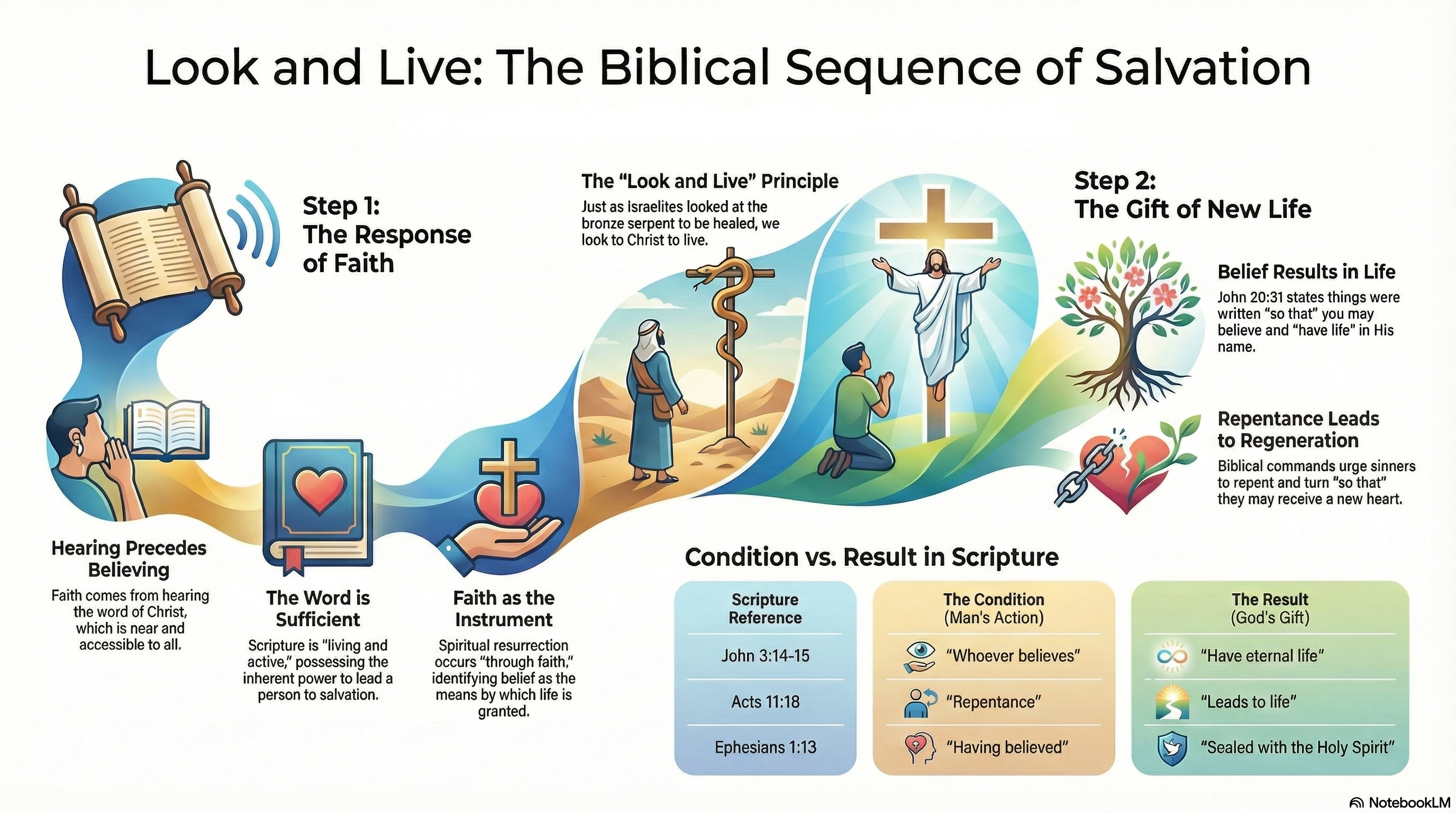
The Scriptures consistently present a specific sequence regarding salvation: A person must first believe the gospel in order to be given new spiritual life (regeneration). After all:
17 So faith [comes] from hearing, and hearing by the word of Christ.
Just three verses prior, in Romans 10:14, the Apostle Paul asks, "How will they believe in Him whom they have not heard?". The obvious answer is that you cannot believe in someone you do not know about. However, the logical implication of Paul's rhetorical question is that if a person does hear the message, they are then fully capable of believing it
To explain the accessibility of the gospel, the Apostle Paul explicitly quotes Moses from Deuteronomy 30:11-14.
11 'For this commandment which I command you today is not too difficult for you, nor is it out of reach. 12 'It is not in heaven, that you should say, 'Who will go up to heaven for us to get it for us and make us hear it, that we may observe it?' 13 'Nor is it beyond the sea, that you should say, 'Who will cross the sea for us to get it for us and make us hear it, that we may observe it?' 14 'But the word is very near you, in your mouth and in your heart, that you may observe it.
In the Old Testament, Moses told the Israelites that God's command to choose life was "not too difficult" or out of reach, nor did it require someone to ascend to heaven or descend across the sea to retrieve it. Paul applies this exact Old Testament text to the New Testament "word of faith which we are preaching". By using this text, Paul demonstrates that God's requirement of faith does not require a prior, supernatural miracle of regeneration for a person to understand and obey it. The word is already near you, in your mouth and heart, so that you may freely confess and believe in order to be saved
4 For Christ is the end of the law for righteousness to everyone who believes. 5 For Moses writes that the man who practices the righteousness which is based on law shall live by that righteousness. 6 But the righteousness based on faith speaks as follows: 'DO NOT SAY IN YOUR HEART, 'WHO WILL ASCEND INTO HEAVEN?' (that is, to bring Christ down), 7 or 'WHO WILL DESCEND INTO THE ABYSS?' (that is, to bring Christ up from the dead).' 8 But what does it say? 'THE WORD IS NEAR YOU, IN YOUR MOUTH AND IN YOUR HEART '-- that is, the word of faith which we are preaching, 9 that if you confess with your mouth Jesus [as] Lord, and believe in your heart that God raised Him from the dead, you will be saved; 10 for with the heart a person believes, resulting in righteousness, and with the mouth he confesses, resulting in salvation. 11 For the Scripture says, 'WHOEVER BELIEVES IN HIM WILL NOT BE DISAPPOINTED.' 12 For there is no distinction between Jew and Greek; for the same [Lord] is Lord of all, abounding in riches for all who call on Him; 13 for 'WHOEVER WILL CALL ON THE NAME OF THE LORD WILL BE SAVED.' 14 How then will they call on Him in whom they have not believed? How will they believe in Him whom they have not heard? And how will they hear without a preacher? 15 How will they preach unless they are sent? Just as it is written, 'HOW BEAUTIFUL ARE THE FEET OF THOSE WHO BRING GOOD NEWS OF GOOD THINGS!' 16 However, they did not all heed the good news; for Isaiah says, 'LORD, WHO HAS BELIEVED OUR REPORT?' 17 So faith [comes] from hearing, and hearing by the word of Christ.
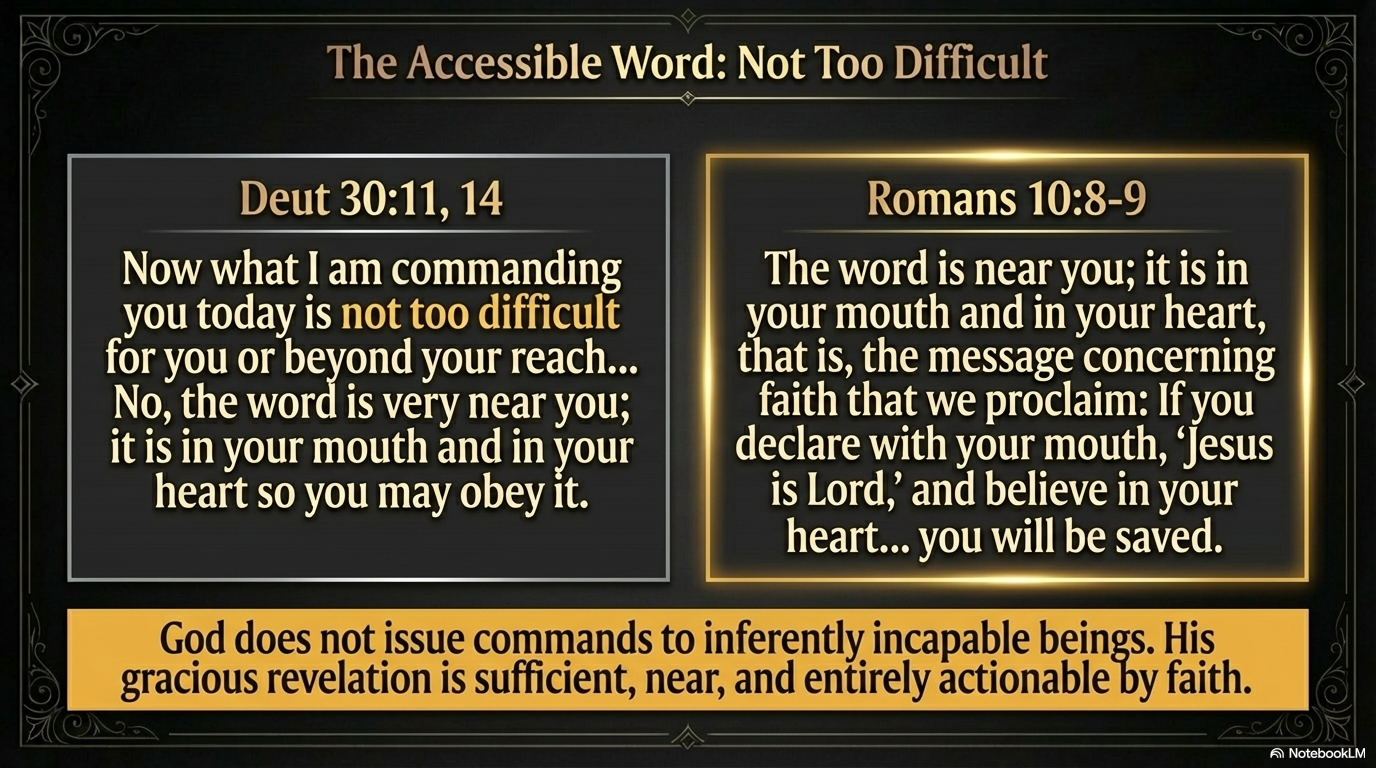
However, Moses and Paul both say that God’s Word is "not too difficult" and "not out of reach." This proves that faith is a choice you can actually make when you hear the Gospel, rather than a gift given only to a few through a process they can't control.
Gods Word Is Enough
The Bible teaches that the Word itself is the supernatural, spiritual weapon that impacts the inner person.
12 For the word of God is living and active and sharper than any two-edged sword, and piercing as far as the division of soul and spirit, of both joints and marrow, and able to judge the thoughts and intentions of the heart.
The biblical authors repeatedly testify that the written and spoken word is all that is necessary to lead a person to faith.
23 for you have been born again not of seed which is perishable but imperishable, [that is], through the living and enduring word of God.
- The Apostle John states his explicit purpose for writing his gospel: "But these are written that you may believe that Jesus is the Messiah, the Son of God, and that by believing you may have life in his name"; it was written specifically so that they could believe and thereby receive new life.
- The Apostle Paul tells Timothy that the holy Scriptures "are able to make you wise for salvation through faith in Christ Jesus".
- Jesus Himself declares, "The words I have spoken to you—they are full of the Spirit and life".
God holds humanity accountable precisely because He has graciously provided the light of His truth, and we possess the God-given capacity to either accept it or suppress it. The Holy Spirit actively brings conviction to the world by means of the gospel, ensuring that the word proclaimed is entirely sufficient to call a sinner to repentance and faith. You do not need a separate, mystical infusion of grace to make the Word work; God's grace does not need "more grace" to be effective.
Believing Results in Life
The Apostle John explicitly outlines the purpose of his gospel and the order in which life is received in John 20:31: "
31 but these have been written so that you may believe that Jesus is the Christ, the Son of God; and that believing you may have life in His name.
The text establishes that life is the result of believing. Similarly, in John 5:40
40 and you are unwilling to come to Me so that you may have life.
The grammatical structure shows that coming to Christ (faith) is the prerequisite for receiving life. Furthermore, Jesus teaches in John 6:53 that unless you eat the flesh of the Son of Man and drink his blood, you have no life in you, demonstrating that partaking in faith must happen in order to possess life.
53 So Jesus said to them, 'Truly, truly, I say to you, unless you eat the flesh of the Son of Man and drink His blood, you have no life in yourselves.
Old Testament Examples
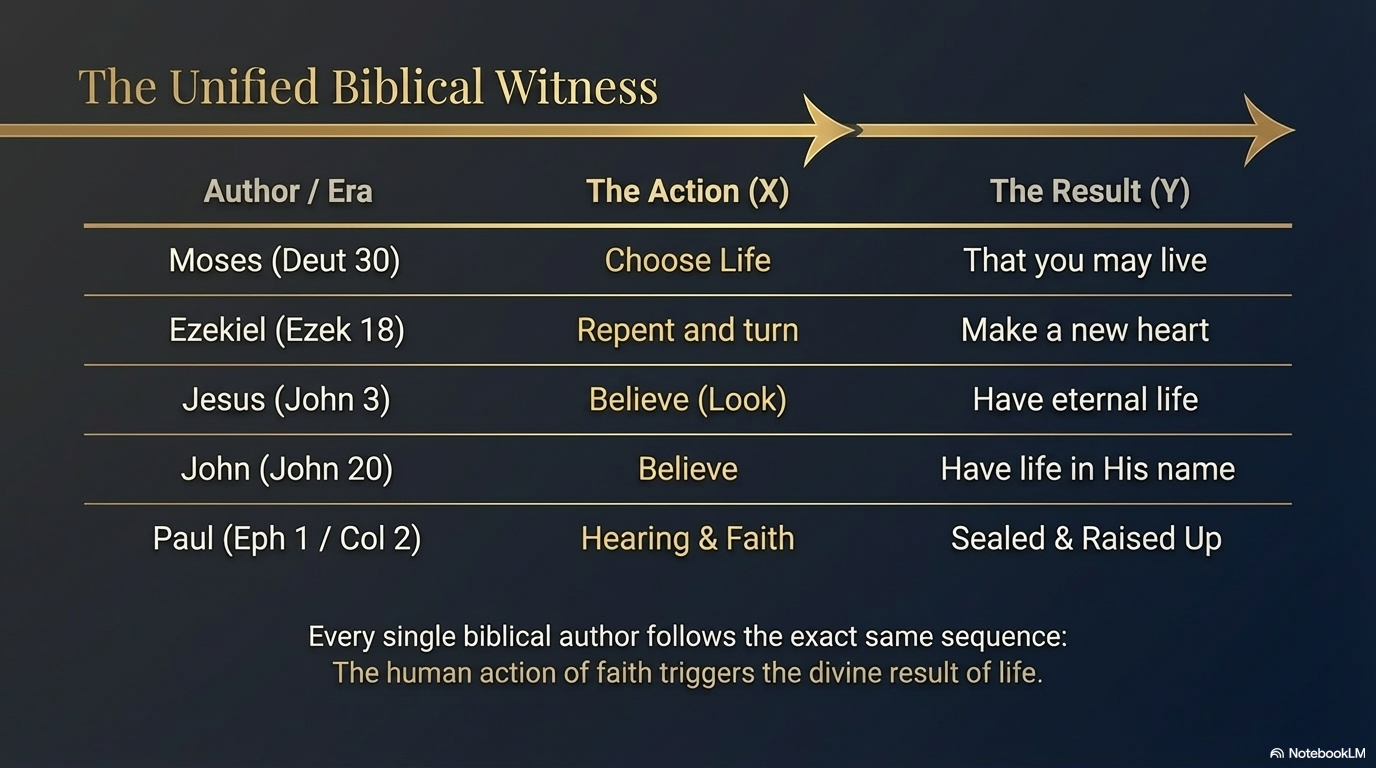
As I have already shown in Deuteronomy 30:19-20, Moses sets the conditions of the covenant before the Israelites, stating:
19 'I call heaven and earth to witness against you today, that I have set before you life and death, the blessing and the curse. So choose life in order that you may live, you and your descendants, 20 by loving the LORD your God, by obeying His voice, and by holding fast to Him; for this is your life and the length of your days, that you may live in the land which the LORD swore to your fathers, to Abraham, Isaac, and Jacob, to give them.'
God provides the options, but He places the responsibility on the people to actively trust and follow Him. Throughout the historical books of the Old Testament, God's restorative work is always contingent upon the people first humbling themselves in faith.
- 2 Chronicles 7:14 sets the sequence: "If my people who are called by my name humble themselves, and pray and seek my face and turn from their wicked ways, then I will hear from heaven and will forgive their sin and heal their land".
- 2 Kings 22:19 records God speaking to King Josiah, affirming this order: "Because your heart was responsive and you humbled yourself before the Lord when you heard what I have spoken... I also have heard you, declares the Lord".
A great example is in Ezekiel where God explicitly outlines the order of how a spiritually rebellious person receives a new heart and new spirit. In Ezekiel 18:30-31, the Sovereign Lord declares:
30 'Therefore I will judge you, O house of Israel, each according to his conduct,' declares the Lord GOD. 'Repent and turn away from all your transgressions, so that iniquity may not become a stumbling block to you. 31 'Cast away from you all your transgressions which you have committed and make yourselves a new heart and a new spirit! For why will you die, O house of Israel? 32 'For I have no pleasure in the death of anyone who dies,' declares the Lord GOD. 'Therefore, repent and live.'
The text does not say God will force a person to be made alive so that they will repent; rather, it commands the individual to humbly repent so as to receive a new heart and live. In Isaiah 55:2-3, God appeals to the people to turn to Him for spiritual nourishment and life. He commands:
2 'Why do you spend money for what is not bread, And your wages for what does not satisfy? Listen carefully to Me, and eat what is good, And delight yourself in abundance. 3 'Incline your ear and come to Me. Listen, that you may live; And I will make an everlasting covenant with you, [According to] the faithful mercies shown to David.
The prophet parallels the act of listening, coming, and inclining the ear with receiving life for the soul. A person must come and hear so that their soul may live, perfectly establishing the condition of a faithful response prior to the granting of spiritual life.
!Pasted image 20260330163705.png
New Testament Examples
Acts 11:18 - "...God has granted to the Gentiles also the repentance that leads to life",. Repentance is what leads to life; life does not lead to repentance.
In Colossians 2:12, the Apostle Paul explains how a spiritually dead person is brought to new life.
12 having been buried with Him in baptism, in which you were also raised up with Him through faith in the working of God, who raised Him from the dead.
The syntax of the verse identifies faith as the instrumental means through which a person is raised up. Because a person is raised to new life through faith, faith must logically precede the raising.
In Ephesians 1:13, he writes:
13 In Him, you also, after listening to the message of truth, the gospel of your salvation-- having also believed, you were sealed in Him with the Holy Spirit of promise,
The biblical order is hearing, then believing, and finally being sealed with the Spirit.
Paul reinforces this exact order in Galatians 3:2, asking rhetorically, "Did you receive the Spirit by the works of the law, or by hearing with faith?".
2 This is the only thing I want to find out from you: did you receive the Spirit by the works of the Law, or by hearing with faith?
He answers this a few verses later in Galatians 3:14
14 in order that in Christ Jesus the blessing of Abraham might come to the Gentiles, so that we would receive the promise of the Spirit through faith.
Jesus Told Us Plainly
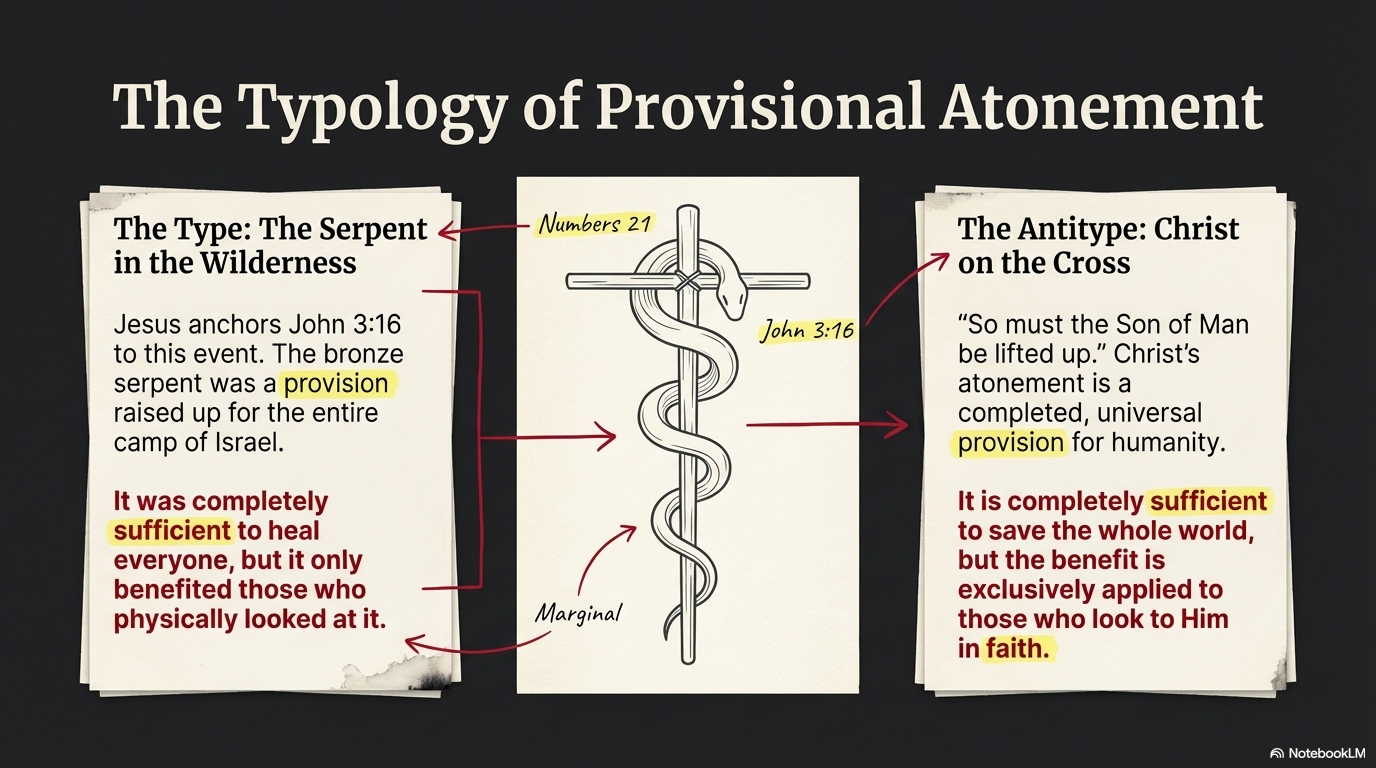
Jesus Himself uses the Old Testament narrative of Moses lifting the bronze serpent in the wilderness to explain the order of salvation. When the Israelites were bitten by venomous snakes, God provided a single means of healing for the whole camp. The people were dying and could not heal themselves, yet God provided a means: look and live. Those who looked were healed; those who refused perished. The condition (being bitten) did not prevent the response—it made the response necessary. Some died because they refused. The Old Testament illustration mandates that the faithful look (faith) must logically precede the healing (new life/regeneration).
!Pasted image 20260330163730.png
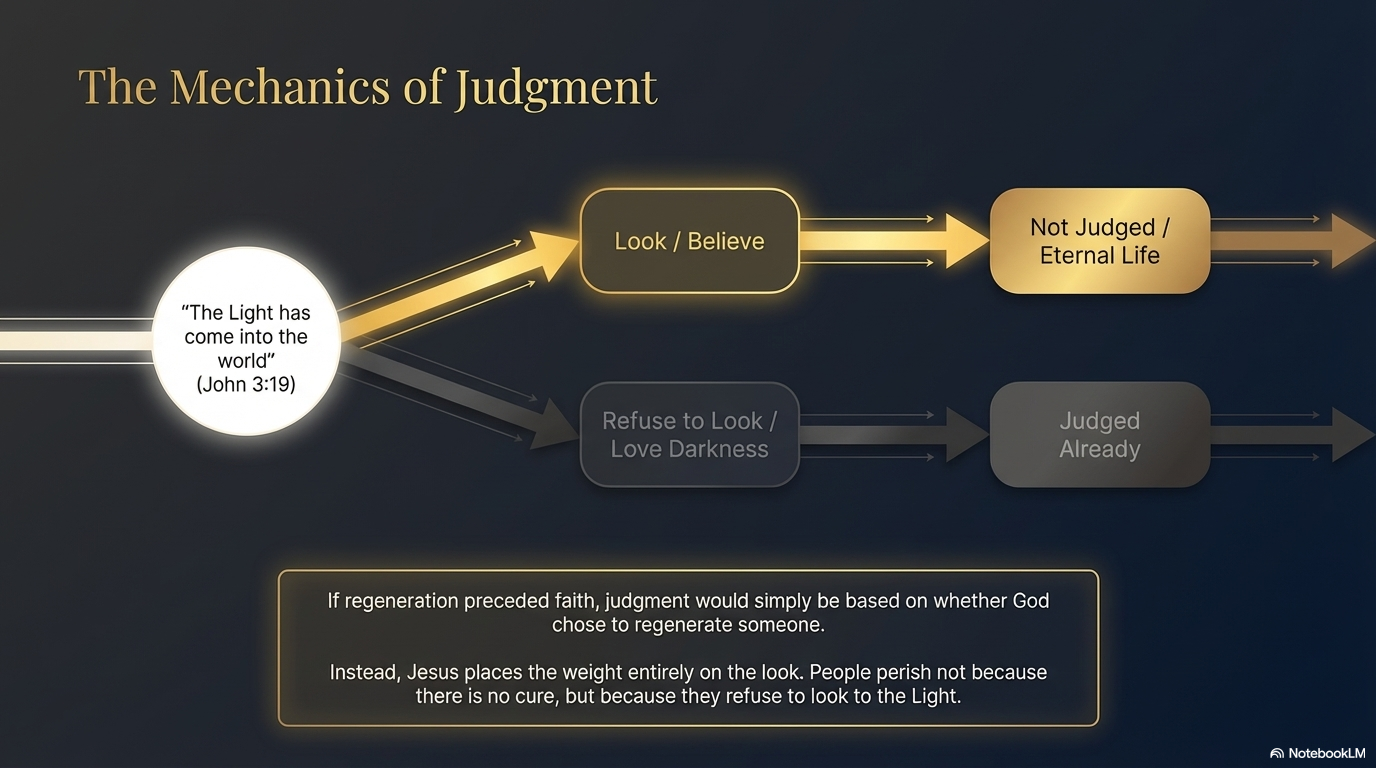
14 'As Moses lifted up the serpent in the wilderness, even so must the Son of Man be lifted up; 15 so that whoever believes will in Him have eternal life. 16 'For God so loved the world, that He gave His only begotten Son, that whoever believes in Him shall not perish, but have eternal life. 17 'For God did not send the Son into the world to judge the world, but that the world might be saved through Him. 18 'He who believes in Him is not judged; he who does not believe has been judged already, because he has not believed in the name of the only begotten Son of God. 19 'This is the judgment, that the Light has come into the world, and men loved the darkness rather than the Light, for their deeds were evil. 20 'For everyone who does evil hates the Light, and does not come to the Light for fear that his deeds will be exposed. 21 'But he who practices the truth comes to the Light, so that his deeds may be manifested as having been wrought in God.'
- Jesus explicitly links His mission to the grammar of Numbers 21. He uses the Greek word dei ("it is necessary") to connect the two events.
- The participle for "believes" (pisteuōn) is the condition, and the verb "have" (echē) is the result.
- In the Greek text, the act of believing is the means through which the "having of life" occurs. Jesus does not say "whoever has been given life will believe," but rather that the belief is the look that leads to the life.
!Pasted image 20260330155830.png
Jesus continues this logic by explaining the mechanics of salvation for the "whole world."
- The Offer: "For God so loved the world, that He gave His only begotten Son, that whoever believes in Him shall not perish, but have eternal life" (v. 16).
- The Verdict: "He who believes in Him is not judged; he who does not believe has been judged already" (v. 18).
- If regeneration preceded faith, the "judgment" would essentially be based on whether God chose to regenerate someone or not.
- However, Jesus places the weight on the look. The judgment is based on the refusal to look at the Light that has come into the world. Just as some Israelites died in the desert because they refused to look at the bronze serpent, people "perish" not because there was no cure, but because they did not believe (look) in the name of the Son of God.
8 For by grace you have been saved through faith; and that not of yourselves, [it is] the gift of God; 9 not as a result of works, so that no one may boast.
Just like the bronze serpent was the "gift" from God, the healing was the result of the look. The "look" (faith) isn't the gift—the remedy is. Just as the Israelites had to look at the serpent in order to be healed, humanity must look to the Son in faith in order to receive eternal life.
Below I present argument defending against some of the objections I have heard. Or you could just read your Bible, here is a list of verse used in debates
![[TULIP_VERSE_SUPPORT.csv]]
Total Depravity/Inability) Moral Responsibility
Definition: Total depravity claims that humanity is born spiritually dead and morally incapable of responding positively to the gospel without a prior, irresistible regeneration by God de.
Counter-Definition: Mankind is fallen and sinful, but possesses the God-given moral capacity to humbly respond in faith to God's gracious, life-giving truth and His appeals for reconciliation.
This all comes down to one question.
The Bible never defines "deadness" as a lack of moral capacity to respond to truth. If humans were born with a literal moral incapacity to respond to God's appeals, it would be "unjust" for God to hold them accountable for their failure to respond. It would make no sense to get angry at a corpse in a casket for not getting out and then punishing it for its "disobedience". The Bible never says we have the inability to choose God. See Death In The Bible
The Bible repeatedly commands humans to “seek the Lord” (Isaiah 55:6) and to “choose life” (Deuteronomy 30:19). These commands presuppose a genuine ability to respond. Responsibility entails capability: God’s moral expectations of humans would be meaningless if humans could not act upon them. God’s omniscience allows Him to know outcomes without coercing them. For example, Jesus knew Peter would deny Him (John 13:38), yet Peter’s fear and denial were his own choices. God’s knowledge guarantees certainty, not necessity.
l Passages such as Genesis 15:13, Deuteronomy 31, Isaiah 41–46, and 1 Kings 13, show God is "in control" but not "controlling" every movement. He sovereignly permits evil agents to work and then overrules that evil for His wise and holy ends (Genesis 50:20). Jesus knew from the beginning who would betray Him (John 6:64). God utilized Judas’s free, rebellious intent to fulfill the "predetermined plan" of the cross (Acts 4:28). However, identifying a plan does not mean God authored Judas’s sin; rather, He redeemed a bad determination for a good purpose.
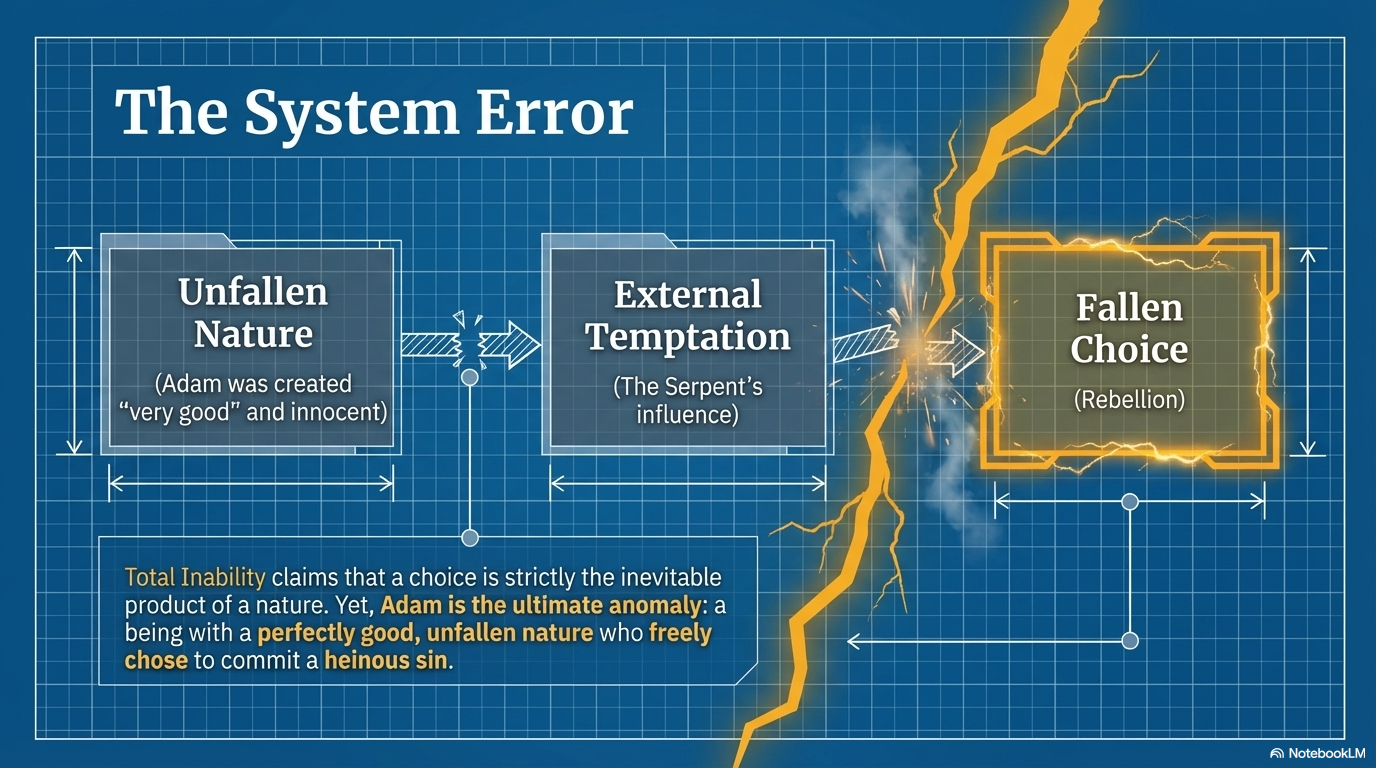
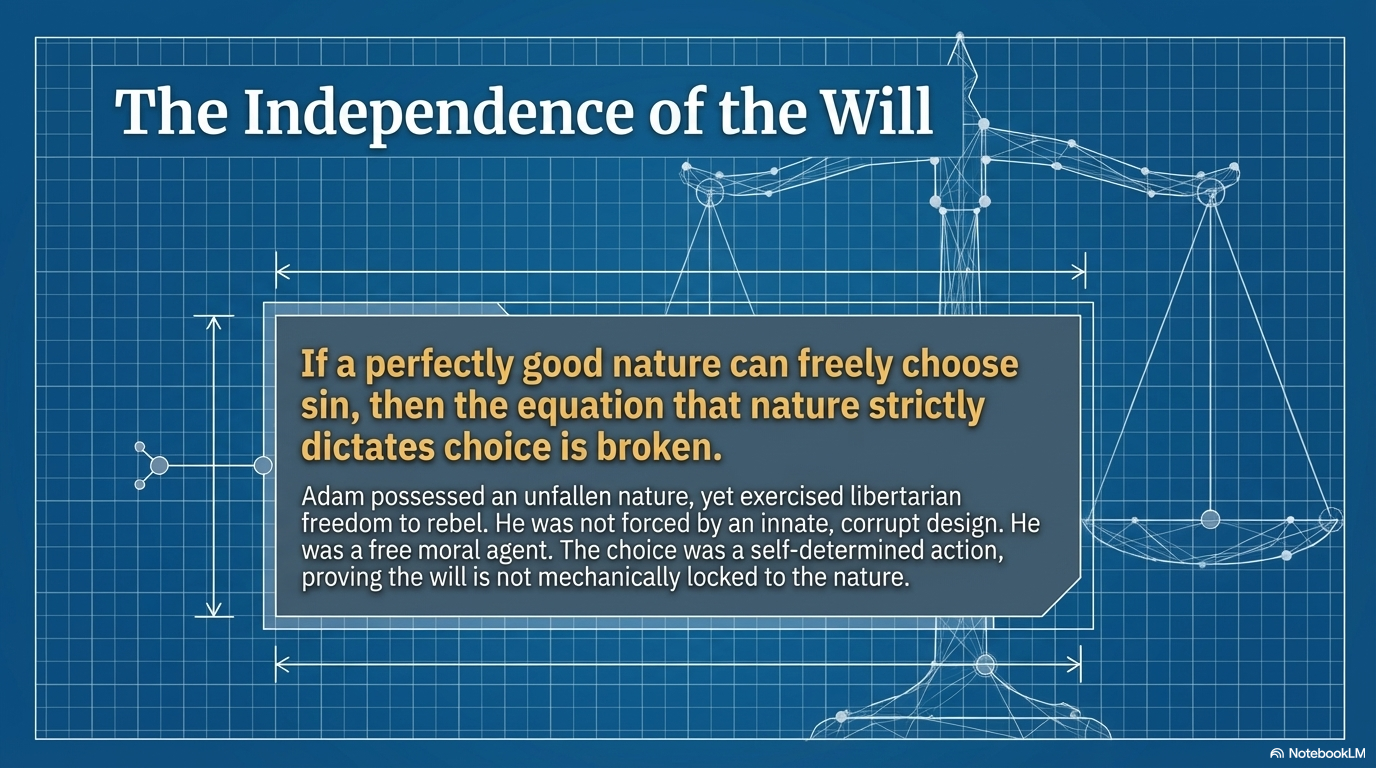
What About Adam?
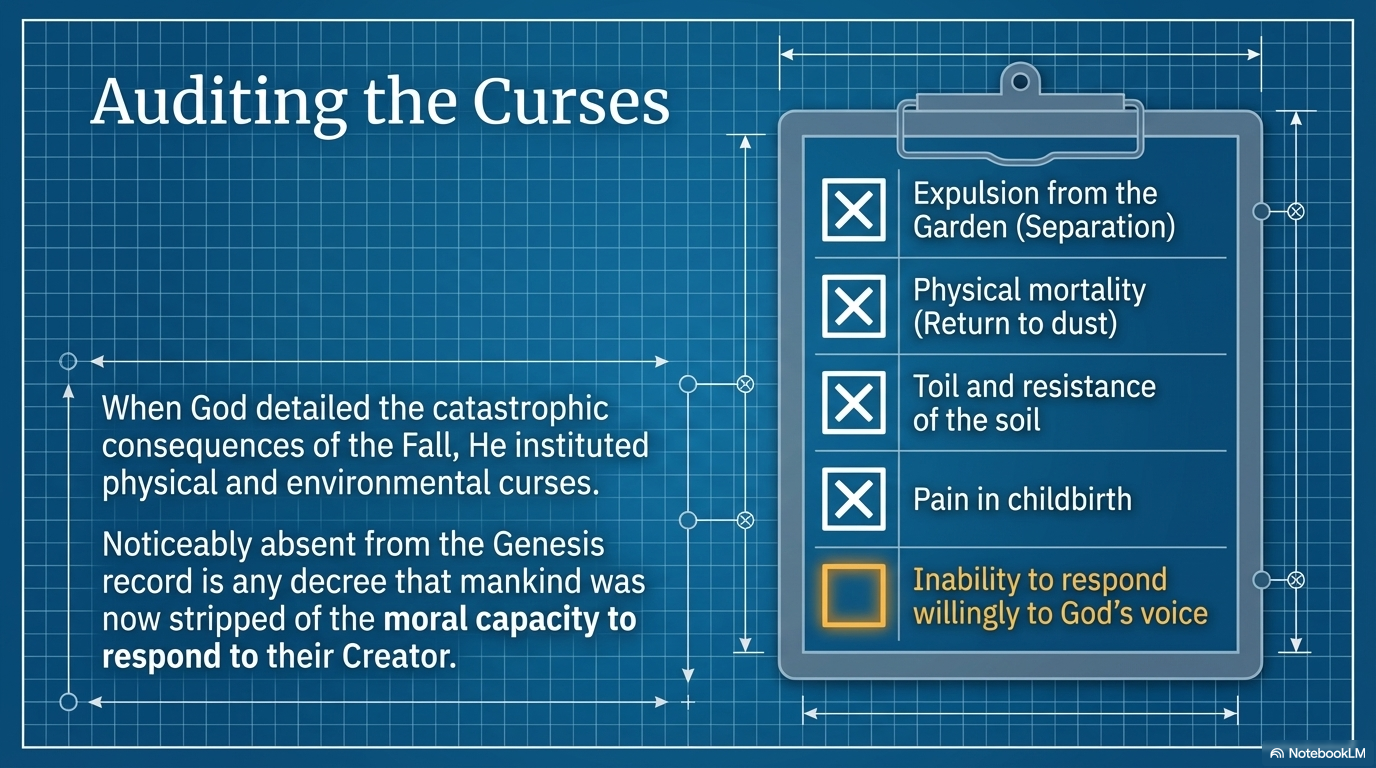
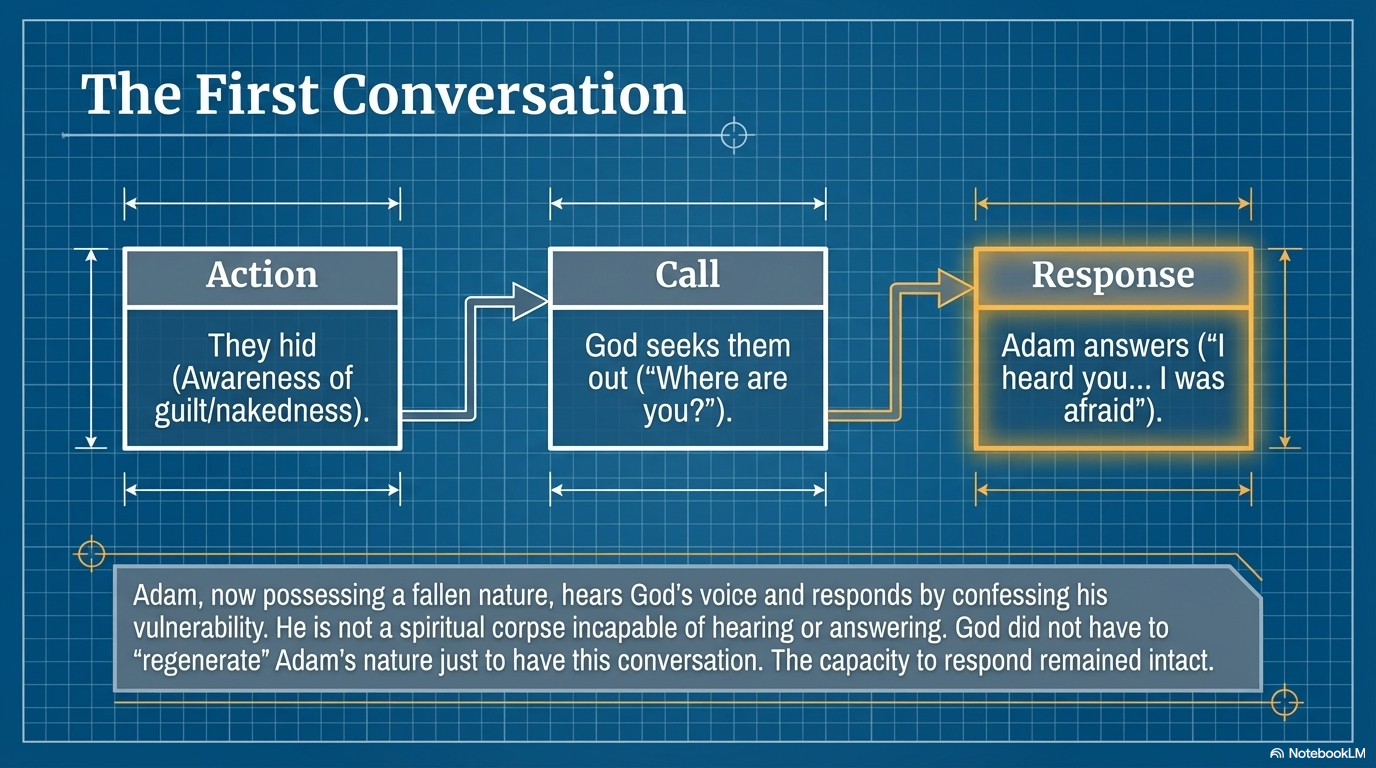
- Genesis 4:7: "If you do well, will you not be accepted? And if you do not do well, sin is crouching at the door. Its desire is contrary to you, but you must rule over it.". (Context: God speaks directly to fallen Cain, warning him that he possesses the responsibility and ability to choose to resist sin, rather than declaring him innately incapable of doing so),.
- Isaiah 1:18: "Come now, let us reason together, says the LORD: though your sins are like scarlet, they shall be as white as snow...". (Context: God appeals directly to the intellect and moral reasoning of fallen humanity, assuming their God-given capacity to reason with Him and accept His cleansing).
- Isaiah 65:2: "All day long I have held out my hands to an obstinate people, who walk in ways not good, pursuing their own imaginations.". (Context: God genuinely and patiently appeals to those who ultimately refuse Him, proving they have the capacity to respond but are freely choosing to suppress His truth),.
- Deuteronomy 30:11, 19: "Now what I am commanding you today is not too difficult for you or beyond your reach... I have set before you life and death, blessings and curses. Now choose life, so that you and your children may live..." (Context: A direct appeal placing the responsibility to respond positively on the hearer).
-
John 5:40: "Yet you refuse to come to me to have life.",. (Context: Jesus places the blame entirely on the Pharisees' willful refusal to come to Him. He does not say, "I refused to give you life so that you would come"),.
-
John 20:31: "But these are written that you may believe that Jesus is the Messiah, the Son of God, and that by believing you may have life in his name." (Context: Spiritual life comes as a result of believing the revealed Word, contradicting the premise that one must be made alive before they can believe).
-
Acts 28:27: "For this people’s heart has become calloused; they hardly hear with their ears, and they have closed their eyes. Otherwise they might see with their eyes, hear with their ears, understand with their hearts and turn, and I would heal them." (Context: Spiritual blindness and inability is a result of continued human rebellion and self-hardening over time, not an inescapable, innate condition decreed from birth).
-
Romans 10:14, 17: "How, then, can they call on the one they have not believed in? And how can they believe in the one of whom they have not heard?... Consequently, faith comes from hearing the message, and the message is heard through the word about Christ.",. (Context: Proves that the God-given provision of the gospel is the powerful, sufficient means that enables humanity to hear, believe, and respond),.
-
Romans 1:18-21: "The wrath of God is being revealed from heaven against all the godlessness and wickedness of people, who suppress the truth by their wickedness, since what may be known about God is plain to them, because God has made it plain to them... so that people are without excuse. For although they knew God, they neither glorified him as God nor gave thanks to him, but their thinking became futile and their foolish hearts were darkened.",. (Context: Humanity is not born innately blind and ignorant of God; they "knew God" but "became" darkened because they willfully and actively suppressed the clearly revealed truth),,.
-
Colossians 2:12: "...having been buried with him in baptism, in which you were also raised with him through your faith in the working of God, who raised him from the dead.",. (Context: Spiritual resurrection (new life) is brought about through the instrumental means of faith, proving one is not raised in order to have faith, but is raised through faith),.
-
2 Corinthians 5:20: "We are therefore Christ’s ambassadors, as though God were making his appeal through us. We implore you on Christ’s behalf: Be reconciled to God.",. (Context: God sends a genuine appeal specifically to His enemies calling them to reconciliation, completely refuting the assumption that being an "enemy of God" renders a person morally incapable of accepting the offer of peace),.
-
Hebrews 3:15: "As has just been said: 'Today, if you hear his voice, do not harden your hearts as you did in the rebellion.'" (Context: A conditional warning against resisting God, demonstrating humans have control over whether they harden their hearts).
Arguments
The Bible No One Seeks God in Passages like Psalm 14:2-3
Ezekiel 36:26-27 proves that you have to be regenerated by God.
30 'Therefore I will judge you, O house of Israel, each according to his conduct,' declares the Lord GOD. 'Repent and turn away from all your transgressions, so that iniquity may not become a stumbling block to you. 31 'Cast away from you all your transgressions which you have committed and make yourselves a new heart and a new spirit! For why will you die, O house of Israel? 32 'For I have no pleasure in the death of anyone who dies,' declares the Lord GOD. 'Therefore, repent and live.'
26 'Moreover, I will give you a new heart and put a new spirit within you; and I will remove the heart of stone from your flesh and give you a heart of flesh. 27 'I will put My Spirit within you and cause you to walk in My statutes, and you will be careful to observe My ordinances.
- The text is a corporate prophecy to the nation of Israel. In the original Hebrew text, God tells the people that He will give "you" (plural) a "new heart" (singular) and a "new spirit" (singular). You would be better trying to use this as your proof text instead Ezekiel 11:19: *And I will give them one heart, and put a new spirit within them. And I will take the heart of stone out of their flesh and give them a heart of flesh,
Context
- People often stop reading at verse 28. Look at the very next sentence: 'You will live in the land that I gave to your forefathers; so you will be My people, and I will be your God. This is a prophecy about the return from Babylon.
- Ezekiel was part of that "Good Fig" group (the first wave of exiles- Ezekiel 1:1). When he delivers the promise of the "New Heart" in Ezekiel 36 and 37, he is speaking to the very people who obeyed the command to submit to God’s judgment via exile in the land of the Chaldeans. The promise of the new heart wasn't for the rebels who stayed in Jerusalem to fight; it was a reward for the remnant that humbled themselves and went into captivity.
The "stony heart" is the result of a long process of resisting God, often described by Moses and the prophets as being "stiff-necked" (This is a farming metaphor—an ox that tenses its neck muscles so the farmer can't lead it.).
Zechariah 7:11–12 "But they refused to pay attention; they stubbornly turned their backs and stopped up their ears. They made their hearts as hard as flint [stone] and would not listen to the law or to the words that the Lord Almighty had sent by his Spirit through the earlier prophets."
Deuteronomy 10:16 "Circumcise your hearts, therefore, and do not be stiff-necked any longer."
Exodus 33:3 Go up to a land flowing with milk and honey; for I will not go up in your midst, because you are an obstinate people, and I might destroy you on the way.”
e an obstinate people, and I might destroy you on the way.”Moses and Ezekiel both show that the promise of a "new heart" is the result of returning to God.
Deuteronomy 30:2, 6 "2 And when you return to the Lord your God and obey him... 6 The Lord your God will circumcise your hearts and the hearts of your descendants, so that you may love him with all your heart and with all your soul and live."
Ezekiel 18:30–31 "Repent! Turn away from all your offenses; then iniquity will not be your ruin. Rid yourselves of all the offenses you have committed, and get a new heart and a new spirit."
Ezekiel 36:26 "I will give you a new heart and put a new spirit in you; I will remove from you your heart of stone and give you a heart of flesh."
Jesus used the same logic to explain why people did not understand Him. In the Parable of the Sower, the "hard ground" isn't bad soil by nature. It's hard because it's a path that has been walked on and packed down over time. When He explains why He speaks in parables. It wasn't because they were born unable to, but because they had closed themselves off.
Matthew 13:15 "For this people’s heart has become calloused; they hardly hear with their ears, and they have closed their eyes. Otherwise they might see with their eyes, hear with their ears, understand with their hearts and turn, and I would heal them."
Mark 10:5 "It was because your hearts were hard that Moses wrote you this law," Jesus replied.
2 Chronicles 7:14 "If my people, who are called by my name, will humble themselves and pray and seek my face and turn from their wicked ways, then I will hear from heaven, and I will forgive their sin and will heal their land."
James 4:7, 10 "Submit yourselves, then, to God. Resist the devil, and he will flee from you. ... Humble yourselves before the Lord, and he will lift you up."
Jeremiah 24:7 "I will give them a heart to know me, that I am the Lord. They will be my people, and I will be their God, for they will return to me with all their heart."
Unconditional Election Faith-Based Election
Definition: Unconditional election is the belief that God unilaterally chose certain individuals for salvation before the foundation of the world without any regard to their future faith or moral choices.
Counter-Definition: Biblical election is conditional upon faith; God chooses to save and grant entrance to those who humbly trust in Christ.
- Historians admit that the doctrine of total moral inability and individual unconditional election was not the view of the church for its first 400 years; it was introduced by **Augustine in the 5th century
The Bible says God loves or hates people before they were born. Look at Jacob and Esau
Old Testament Support
- Isaiah 66:2: "These are the ones I look on with favor: those who are humble and contrite in spirit, and who tremble at my word". (Context: God explicitly states the condition for receiving His favor and election—humility and a reverent response to His revealed truth, rather than a secret, unconditional decree).
- Psalm 25:9, 14: "He guides the humble in what is right and teaches them his way... The secret of the Lord is for those who fear him, and he makes his covenant known to them". (Context: God reserves His intimate covenant knowledge and guidance for those who meet the condition of fearing Him).
- 2 Kings 22:19: "Because your heart was responsive and you humbled yourself before the Lord when you heard what I have spoken... I also have heard you, declares the Lord". (Context: God's positive response and deliverance are a direct result of human responsiveness and humility, demonstrating a conditional relationship).
- Psalm 18:27: "You save the humble but bring low those whose eyes are haughty". (Context: God’s saving action is intentionally directed toward the humble, entirely refuting the idea that He elects individuals to salvation without regard to their posture toward Him).
New Testament Support
- Luke 18:14: "I tell you that this man, rather than the other, went home justified before God. For all those who exalt themselves will be humbled, and those who humble themselves will be exalted". (Context: In the parable of the Pharisee and the tax collector, Jesus teaches that justification is granted conditionally to the one who humbly confesses their unworthiness, not unilaterally bestowed).
- John 1:12: "Yet to all who did receive him, to those who believed in his name, he gave the right to become children of God". (Context: The right to adoption and becoming a child of God is not an eternal, unconditional status, but is granted conditionally to those who receive and believe in Christ).
- 1 Peter 5:5-6: "God opposes the proud but shows favor [grace] to the humble. Humble yourselves, therefore, under God’s mighty hand, that he may lift you up in due time". (Context: God’s saving grace and favor are explicitly reserved for the humble, placing the responsibility on humanity to humble themselves in order to be exalted).
- 1 Corinthians 1:27: "But God chose the foolish things of the world to shame the wise; God chose the weak things of the world to shame the strong". (Context: God's election is not an arbitrary, unconditional decree for no apparent reason, but a purposeful choice of those who meet the condition of being weak and lowly to demonstrate His own power and glory).
- Ephesians 1:4, 13: "For he chose us in him before the creation of the world to be holy and blameless in his sight... And you also were included in Christ when you heard the message of truth, the gospel of your salvation. When you believed, you were marked in him with a seal, the promised Holy Spirit." (Context: God corporately chose that all who are "in Him" through faith will be saved, sealing them only after they hear and believe).
- Matthew 22:14: "For many are called, but few are chosen." (Context: In the parable of the wedding banquet, the "chosen" or elect are those who accept the universal invitation and come clothed in the proper wedding garments of faith in Christ, not those arbitrarily picked).
- 1 Peter 1:1-2: "To God’s elect... who have been chosen according to the foreknowledge of God the Father..." (Context: Election is tied to God's foreknowledge, not a unilateral, unconditional decree).
- James 4:10: "Humble yourselves before the Lord, and he will lift you up." (Context: God continually promises to save and exalt those who meet the condition of humility).
Limited Atonement
Definition: Limited atonement asserts that Jesus Christ died on the cross to intentionally pay for the sins of the unconditionally elect alone, explicitly excluding the rest of humanity.
From Others
- The doctrine of limited atonement teaches that while Christ’s death was sufficient for all, it was intentionally designed to effectively redeem only the "elect" chosen by God from eternity.
- "Particular redemption" is the preferred term because it emphasizes that Jesus died for a specific group—his "sheep," "the church," and his "bride"—rather than for every individual sinner indiscriminately.
- At its heart, the doctrine asks whether the cross made humanity "save-able" or if it actually "saved" them; it concludes that Christ’s work truly reconciled sinners to God rather than just making reconciliation a possibility.
- It argues that if Christ died in the place of every person but not everyone is saved, then the atonement is less than a full substitution; therefore, Christ must have specifically secured the salvation of a multitude that cannot be lost.
- Rather than Christ doing "his part" and waiting for a human response, the text asserts that his sacrifice was a finished act that personally bore the sins of his people and effectively healed them.
- The doctrine celebrates Christ as a Good Shepherd who did not merely make salvation possible, but actually shouldered the curse and sustained God's anger to guarantee the redemption of those given to him.
- Christ actually bore the punishment for every single person, then everyone must go to heaven (Universalism). If one denies Universalism but says Christ died for everyone, they diminish the cross by claiming Christ's death does not infallibly secure anyone's salvation.
The doctrine of limited atonement—the L in TULIP—teaches that Christ effectively redeems from every people “only those who were chosen from eternity to salvation” (Canons of Dort, II.8). As Ursinus explains in his commentary on the Heidelberg Catechism, Christ’s death was for everyone “as it respects the sufficiency of satisfaction which he made, but not as it respects the application thereof.” In other words, the death of Christ was sufficient to atone for the sins of the whole world, but it was God’s will that it should effectively redeem those and only those who were chosen from eternity and given to Christ by the Father.
Particular redemption is often considered a more favorable term, because the point of the doctrine is not to limit the mercy of God, but to make clear that Jesus did not die in the place of every sinner on the earth, but for his particular people. The good shepherd lays his life down, not for the goats, but for the sheep (John 10:11). This is why John 6 says Jesus came to save those the Father had given to him, and why Matthew 1:21 says he died for his people, and John 15:13 says for his friends, and Acts 20:28 says for the church, and Ephesians 5:25 says for his bride, and Ephesians 1:4 says for those chosen in Christ Jesus.
The doctrine of particular redemption is worth defining and defending because it gets to the heart of the gospel. Should we say “Christ died so that sinners might come to him”? Or, “Christ died for sinners”? Did Christ’s work on the cross make it possible for sinners to come to God? Or did Christ’s work on the cross actually reconcile sinners to God? In other words, does the death of Jesus Christ make us save-able or does it make us saved?
If the atonement is not particularly and only for the sheep, then either we have universalism—Christ died in everyone’s place and therefore everyone is saved—or we have something less than full substitution. “We are often told that we limit the atonement of Christ,” Spurgeon observed, “because we say that Christ has not made a satisfaction for all men, or all men would be saved.” But, Spurgeon argued, it is the view of the atonement that says no one in particular was saved at the cross that actually limits Christ’s death. “We say Christ so died that he infallibly secured the salvation of a multitude that no man can number, who through Christ’s death not only may be saved, but are saved, must be saved, and cannot by any possibility run the hazard of being anything but saved.”
Christ does not come to us merely saying, “I’ve done my part. I laid down my life for everyone because I have saving love for everyone in the whole world. Now, if you would only believe and come to me I can save you.” Instead he says to us, I was pierced for your transgressions. I was crushed for your iniquities (Isa. 53:5). I have purchased with my blood men for God from every tribe and language and people and nation (Rev. 5:9). I myself bore your sins in my body on the tree, so that you might infallibly die to sins and assuredly live for righteousness. For my wounds did not merely make healing available. They healed you (1 Pet. 2:24).
“Amazing love!” a great Arminian once wrote. “How can it be that you, my God, should die for me?!” Praise be to our Good Shepherd who didn’t just make our salvation possible, but sustained the anger of God in body and soul, shouldered the curse, and laid down his life for the sheep.
Sproul acknowledges the historic formula that Christ's death is "sufficient for all, but efficient only for some." He argues that Reformed theology accepts this only in terms of the infinite value or merit of Christ's sacrifice, but restricts the actual design and intent of the atonement exclusively to the elect.
- The Arminian view suggests that Christ’s death did not guarantee salvation for anyone specifically, but rather created a "possibility" of salvation for everyone contingent upon their belief.
- The central question of the doctrine is whether Christ is a "real" Savior who actually saves or a "potential" Savior who merely makes salvation possible.
- If the atonement is viewed as absolutely unlimited for every person, faith becomes a decisive "work with a vengeance. because its presence or absence determines whether Christ’s sacrifice is actually effective for an individual.
- Both Reformed and Arminian theologians agree that the value of Christ’s death is "sufficient" for all humanity due to its infinite merit, but they differ on how that merit is applied.
- Reformed theology argues that if Christ’s work only makes salvation possible, it remains a mere potentiality that saves no one in and of itself.
- Sproul theorizes that if the atonement requires faith, we must ask: "What if nobody believed?" In that case, Christ would have died in vain, saving no one.
In the same essay Packer says the Arminian concept, as debated at the Synod of Dort in 1618, declares that “Christ’s death did not ensure the salvation of anyone, for it did not secure the gift of faith to anyone (there is no such gift); what it did was rather to create a possibility of
salvation for everyone if they believe.”? The question answered by the doctrine of limited atonement is this: Is Christ a real Savior or merely a “potential” Savior? The doctrine of limited atonement, the L of TULIP, is probably the most disputed term of the five. The idea
that the atonement is “limited” provides the crux of the controversy. To state the question in another way: Did Christ die to atone for the sins of every human being, or did he die to atone for the sins of the elect only?
The atonement of Christ was clearly limited or un limited. There is no alternative, no tertium quid. If it is unlimited in an absolute sense, then an atonement has been made for every person’s sins. Christ has then made propitiation for all persons’ sins and expiated them as well. Here faith becomes a work with a vengeance because its presence or absence in a sinner determines the efficacy of Christ’s work of satisfaction for this person.
....
I can hear the howls of protest from the Arminian camp. They steadfastly abhor the idea that human faith adds any “value” to the finished work of Christ or to the efficacy of Christ’s work of satisfaction. The formula they normally use is that Christ’s atonement is sufficient for all, but efficient only for some. Reformed theologians do not question that the value of Christ’s atonement is sufficient to cover the sins of the whole fallen race. The value of his sacrifice is unlimited. His erit is sufficient to cover the demerits of all who sin. We also agree that the atonement is efficient only for some, an idea that is integral to the doctrine of limited atonement. If faith is necessary to the atonement, then Christ’s work was indeed a mere potentiality. In itself it saves no one. It merely makes salvation possible. Theoretically we must ask the obvious question, What would have happened to the work of Christ if nobody believed in it? That had to be a theoretical possibility. In this case Christ would have died in vain. He would have been a potential Savior of all but an actual Savior of none.
Counter-Definition: Christ’s atoning sacrifice was provisionally made for the sins of every single human being, becoming effective only for those who believe.
Christ actually provided atonement for the whole world, and He actually saves all who humbly trust in Him.
They get this idea that Jesus only died for a specific group because of verses like
11 'I am the good shepherd; the good shepherd lays down His life for the sheep.
25 Husbands, love your wives, just as Christ also loved the church and gave Himself up for her,
21 'She will bear a Son; and you shall call His name Jesus, for He will save His people from their sins.'
9 'I ask on their behalf; I do not ask on behalf of the world, but of those whom You have given Me; for they are Yours;
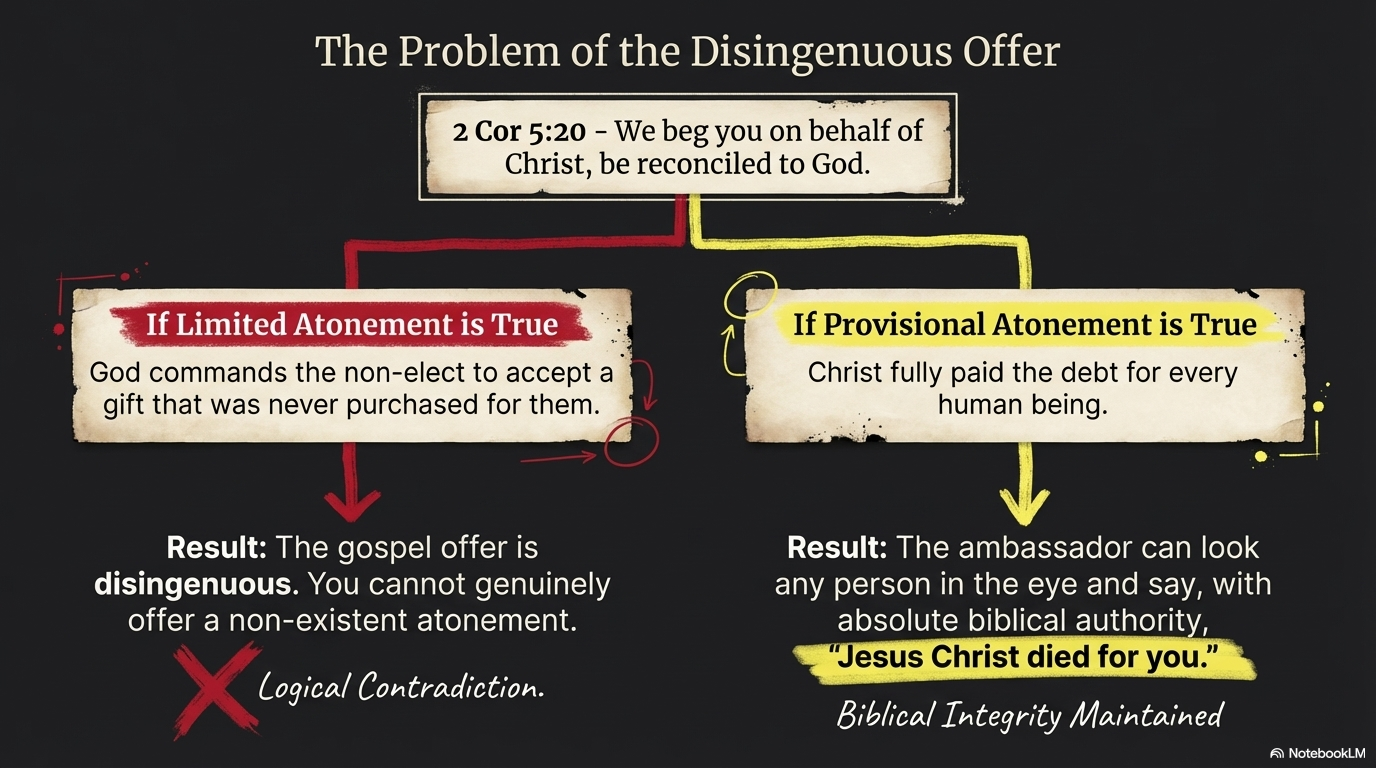
All of theses verse are True! We don't need to go into the context of everyone. What is happening when these verses are used to prove LA, is what’s called a negative inference fallacy. To see why, look at Galatians 2:20, where Paul says Christ "gave Himself up for me." If we used that same logic, we’d have to assume Jesus died only for Paul and nobody else.
It’s the same thing with the Apostles. Just because Jesus has a specialized prayer for them doesn't negate verses like 1 John 2:2, which says he is the propitiation for the "whole world." You can have a specific prayer for one group without it canceling out a sacrifice meant for everyone.
This shows up clearly in 2 Peter 2:1. It describes false teachers who bring about "swift destruction," yet it says the "Master who bought them" is Jesus. This is key because it shows Christ’s "purchase" or ransom actually extends even to those who ultimately reject him.
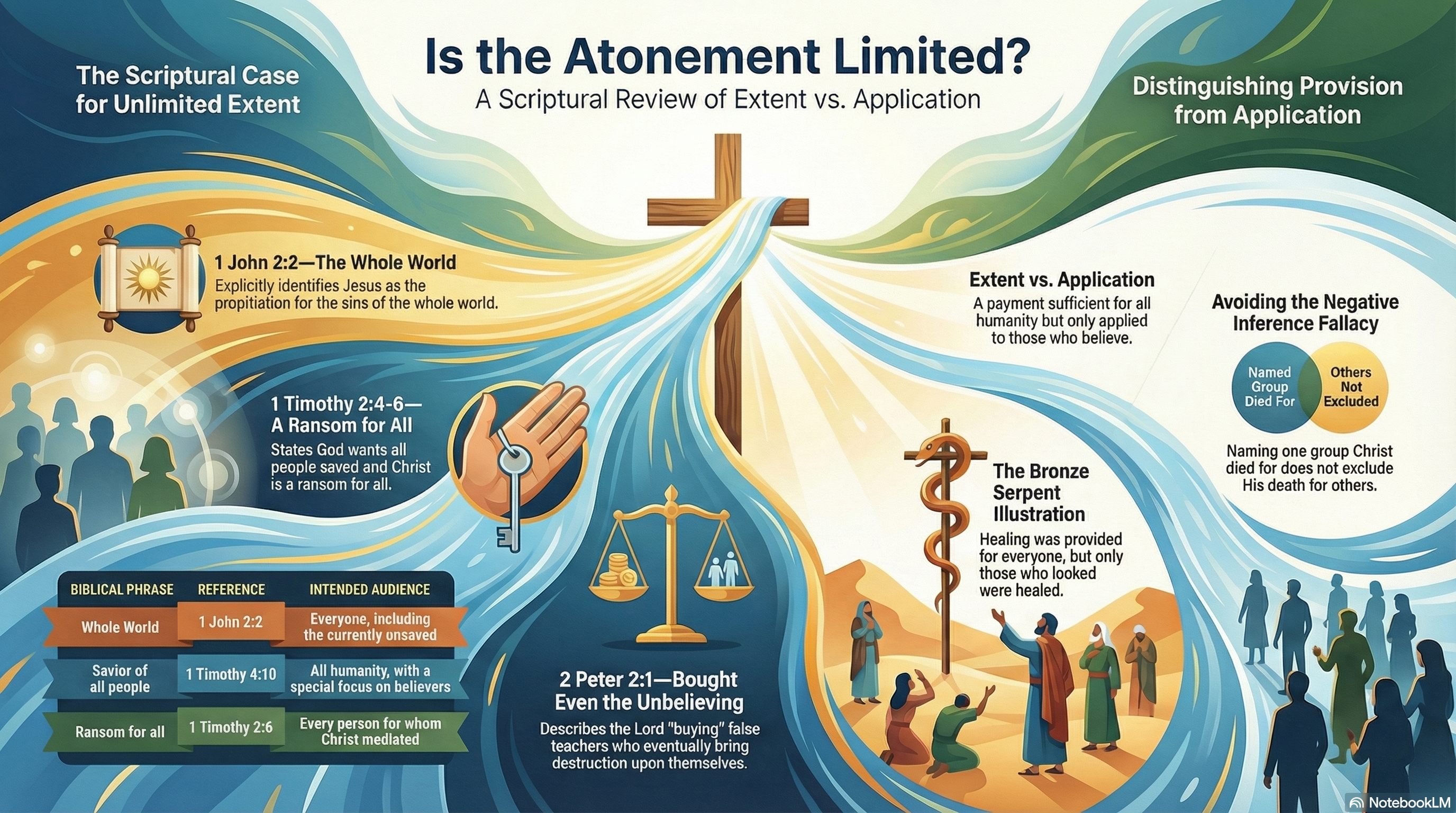
Some Verses on the scope Of Christs Death
- Isaiah 53:6 – “All of us like sheep have gone astray… But the LORD has caused the iniquity of us all to fall on Him.”
- John 1:29 – John the Baptist identifies Jesus as “the Lamb of God who takes away the sin of the world.”
- John 3:16 – “For God so loved the world that He gave His only begotten Son, that whoever believes in Him should not perish.”
- John 6:32‑33 – Jesus: “It is my Father who gives you the true bread out of heaven… which comes down out of heaven and gives life to the world.”
- John 12:32 – Jesus says He will draw all people to Himself when lifted up.
- 2 Corinthians 5:14‑15 – “He died for all… therefore all died; and those who live should no longer live for themselves but for Him.”
- 2 Corinthians 5:19 – God was reconciling the world to Himself in Christ.
- Romans 5:18‑19 – “As one trespass led to condemnation for all men, so one act of righteousness leads to justification and life for all men.”
- 1 John 2:2 – “…not for ours only but also for the sins of the whole world.”
- Hebrews 2:9 – Jesus tasted death for everyone.
- 1 Timothy 2:4 – God “desires all people to be saved…”
- 1 Timothy 2:5‑6 – Christ “gave Himself as a ransom for all people.”
- 1 Timothy 4:10 – God is “the Savior of all people, especially of those who believe.”
- 2 Peter 2:1 – False teachers “deny the Master who bought them,” implying Christ’s purchase extends even to those who perish.
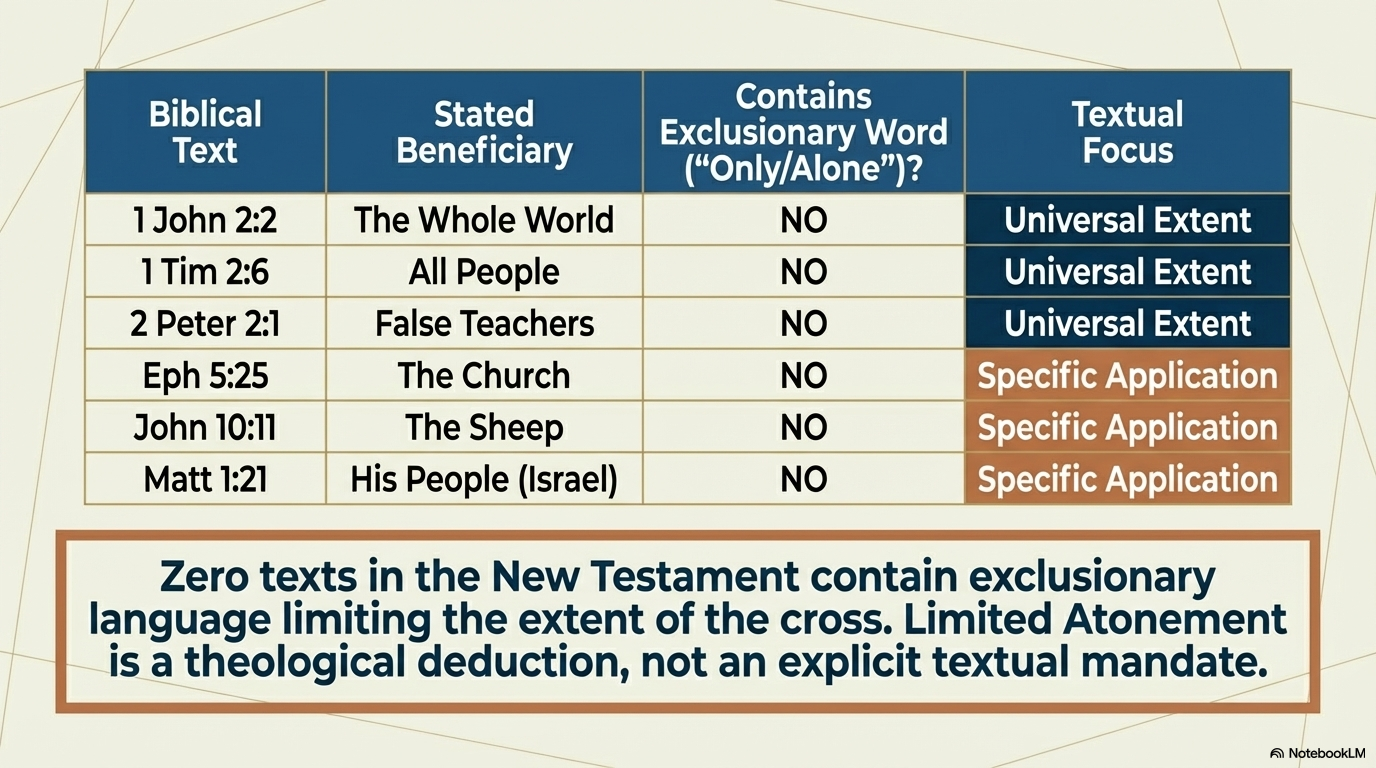
John 3:16-18, 12:32-48, 1 John 2:2, 4:14, 2 Corinthians 5:14–15, 1 Peter 3:18, Romans 5:18–19, Isaiah 49:6,53:6–11, Colossians 1:19–22, 1 Timothy 2:3-6,4:10, 2 Peter 2:1, 3:9, Ezekiel 18:23, Ezekiel 33:11, Mark 10:45, Matthew 20:28, 28:18-20, Romans 3:23–26, 5:12, 11:32, Hebrews 2:9, 9:28, 1 Corinthians -31,15:22, Galatians 3:28–29, Psalm 22:27–28, Titus 2:11, Revelation 5:9, Luke 24:46-47;
Addressing Arguments
Christ is either a "potential Savior" of everyone or an "actual Savior" of the elect.
10 For it is for this we labor and strive, because we have fixed our hope on the living God, who is the Savior of all men, especially of believers.
The adverb "especially" (
2 and He Himself is the propitiation for our sins; and not for ours only, but also for [those of] the whole world.
To definitively prove that "the whole world" cannot grammatically mean "the world of the elect," one only needs to look at 1 John 5:19, which defines the exact same phrase by contrasting it directly against believers: "We know that we are of God, and the whole world lies in the power of the evil one". It is contextually and exegetically impossible to apply the phrase "the whole world" to the elect here. If you do, it is a Logical Fallacy of Equivocation
The Greek construction uses
14 We have seen and testify that the Father has sent the Son [to be] the Savior of the world.
This identifies Christ as the "Savior of the world" (
Grammatically, the Greek word for world (cosmos) is used 28 times in the epistle of 1 John, with 26 of those occurrences referring comprehensively to the unsaved world. Whenever the concept of "world" appears in passages relating to God's saving intent or the atonement (such as 1 John 4:14, 1 John 2:2, John 1:29, and John 3:16), it is always inclusive of the whole world and is never restricted to the elect.
What if nobody believed? In that case, Christ would have died in vain, saving no one.
To suggest that Christ might have died for no one is to ignore the fact that many have already believed and, according to God’s own Word, a "multitude that no one can count" certainly will
16 For I am not ashamed of the gospel, for it is the power of God for salvation to everyone who believes, to the Jew first and also to the Greek.
It also incorrectly measures the success of the Cross by human response rather than by the perfection of Christ’s obedience and the sufficiency of His sacrifice. The biblical sacrificial system, a sacrifice is "successful" if the offering is spotless and the priest performs the ritual correctly. Lets look to what Jesus said:
14 'As Moses lifted up the serpent in the wilderness, even so must the Son of Man be lifted up; 15 so that whoever believes will in Him have eternal life.
Jesus compares Himself to the serpent Moses lifted in the wilderness. If every Israelite had refused to look at the serpent and died, would the serpent have been "lifted in vain"? No. The way out was made, the command was given, and the healing was available. The "waste" lies with the person who refuses to look, not with the God who provided the cure.
Jesus did not go to the cross wondering if His sacrifice would take effect; He went knowing that His being "lifted up" would exert a universal, magnetic pull on all of humanity.
31 'Now judgment is upon this world; now the ruler of this world will be cast out. 32 'And I, if I am lifted up from the earth, will draw all men to Myself.'
God only intended to save the elect.
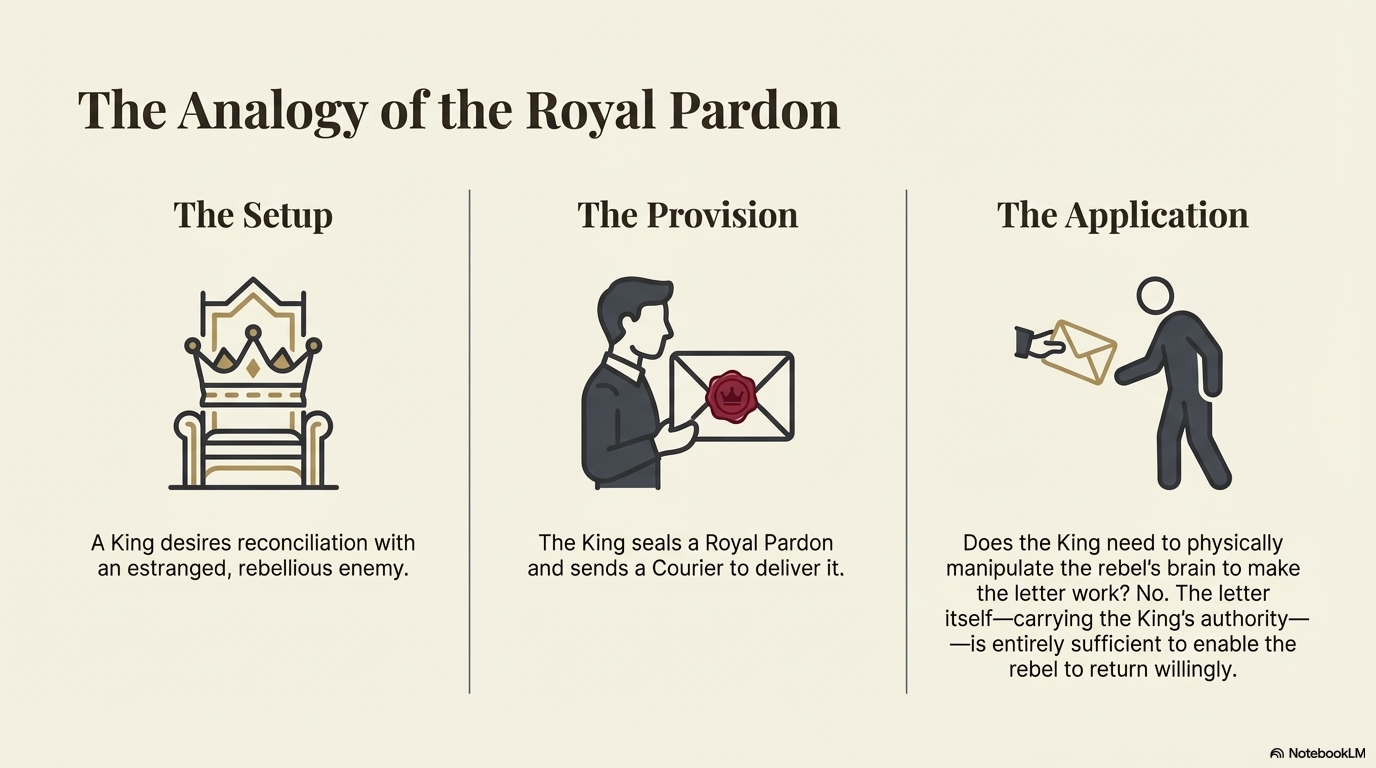
Just because a gift is rejected doesn't mean the giver didn't intend for the recipient to have it. A governor may issue a general pardon (intent) that a prisoner refuses to sign (result). The refusal of the prisoner doesn't retroactively delete the governor's original intent to free them.
The claim that God only intended to save a pre-selected group (the elect) creates friction with the rest of the biblical narrative.
t creates a "divine insincerity." If God commands "all people everywhere to repent" (Acts 17:30) but has withheld the only means of doing so from the majority, the command is a logical impossibility.
3 This is good and acceptable in the sight of God our Savior, 4 who desires all men to be saved and to come to the knowledge of the truth.
This verse explicitly identifies God’s desire (theléma) as universal. If God only "intended" to save the elect, Paul would have to qualify this as "all kinds of men" or "all the elect." Instead, the context of the passage (praying for all people, including pagan kings) demands a literal, universal application.
9 The Lord is not slow about His promise, as some count slowness, but is patient toward you, not wishing for any to perish but for all to come to repentance.
If His intent were strictly limited to a small group, His "patience" toward the world would be meaningless; there would be no reason to delay judgment if the "non-elect" have no possibility of repentance. His delay is proof of a sincere intent for "all" to turn to Him. The "Limited Intent" view forces a redefinition of the word "all" every time it appears in a salvific context. However, when these verses are read naturally, they reveal a God whose provision is as wide as the Fall. While the application of salvation is limited to those who believe, the intent and availability of the cross are as universal as the "all" who went astray in Isaiah 53:6.
This Makes Faith a work
In logic, this happens when a single word is used with two different meanings to force a conclusion.
-
The "Science" Definition: Work is any action or effort (e.g., "It takes work to believe," or "Your brain is working").
-
The Biblical Definition: Work (ergon) specifically refers to deeds done to achieve a legal standing or earn a reward from God.
By applying the "science" definition to faith, one can technically call faith a "work." The idea that faith is a "work" is a human invention used to support the idea that Christ must have only died for those who would believe. However, God's Word tells us that faith is the surrender of all work.
27 Where then is boasting? It is excluded. By what kind of law? Of works? No, but by a law of faith. 28 For we maintain that a man is justified by faith apart from works of the Law.
God defines faith as the end of legal striving. It is the opposite of the "Works of the Law" that Paul constantly warns against. Paul continually places faith and works at odds with one another; faith is never presented as just another work of the law,.
4 Now to the one who works, his wage is not credited as a favor, but as what is due. 5 But to the one who does not work, but believes in Him who justifies the ungodly, his faith is credited as righteousness,
Paul defines the believer as the one who "does not work." Therefore, logically, faith cannot be a "work." If God says faith is the absence of work, then calling faith a "work with a vengeance" is a direct contradiction of Scripture.
16 For this reason [it is] by faith, in order that [it may be] in accordance with grace, so that the promise will be guaranteed to all the descendants, not only to those who are of the Law, but also to those who are of the faith of Abraham, who is the father of us all,
God chose faith as the "conduit" specifically because it is the only thing that is "in accordance with grace." If faith were a work of any kind, it would be in accordance with debt, not grace. Faith is the only response that allows God to do 100% of the saving while man simply receives 100% of the benefit.
16 nevertheless knowing that a man is not justified by the works of the Law but through faith in Christ Jesus, even we have believed in Christ Jesus, so that we may be justified by faith in Christ and not by the works of the Law; since by the works of the Law no flesh will be justified.
8 For by grace you have been saved through faith; and that not of yourselves, [it is] the gift of God; 9 not as a result of works, so that no one may boast.
Both of these verses separates the "gift" (salvation/grace) from "works." Faith is the "through" (the channel), not the "result." You cannot boast about being saved through faith any more than a drowning man can boast about "working" because he grabbed the life ring thrown to him.
Irresistible Grace
Definition: Irresistible grace dictates that God effectually and irresistibly changes the heart of the pre-selected elect, causing them to inevitably desire and accept salvation.
Counter-Definition: God graciously enables all humanity to respond to His life-giving gospel, but appeal can be—and often is—freely resisted and suppressed by rebellious individuals.
!Pasted image 20260330160727.png
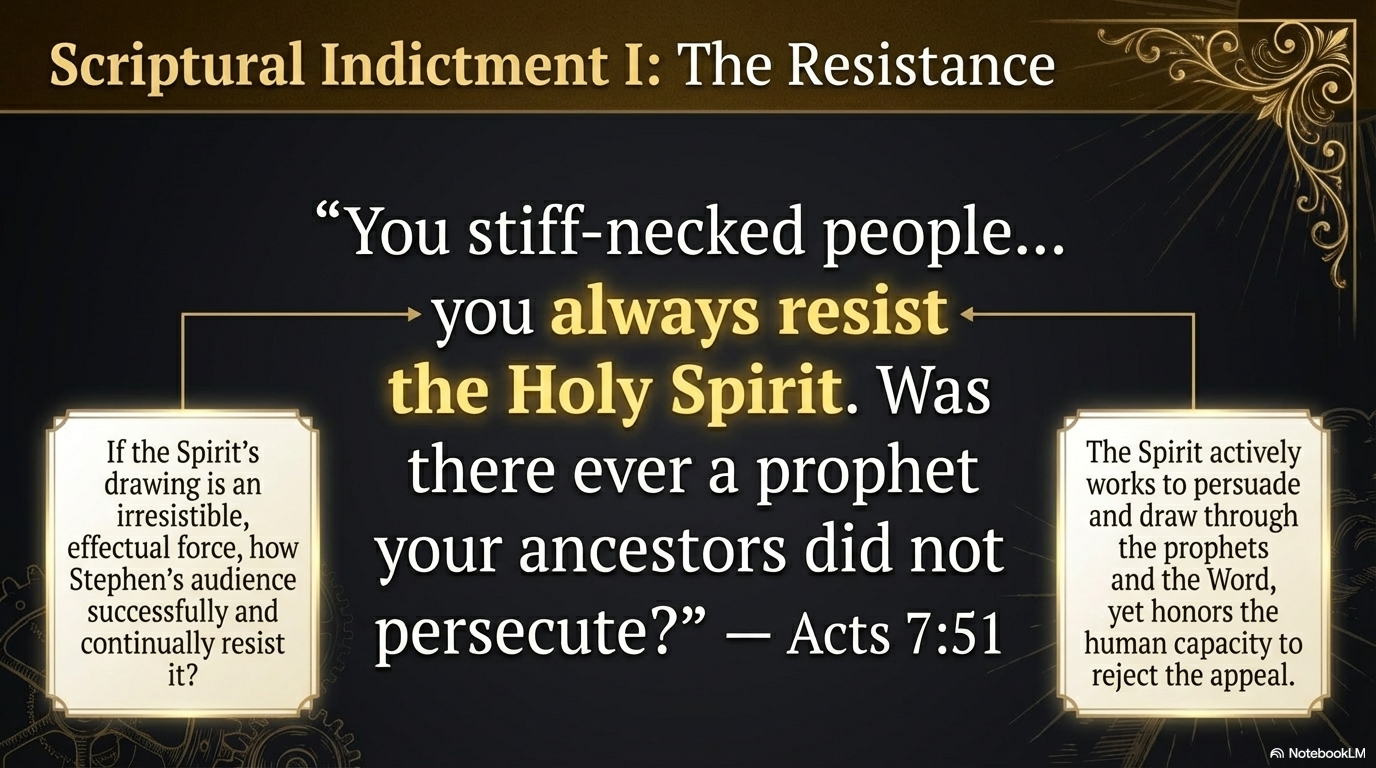
- Acts 7:51: "You stiff-necked people! Your hearts and ears are still uncircumcised. You are just like your ancestors: You always resist the Holy Spirit!" (Context: Stephen’s rebuke proves that the Holy Spirit's drawing and conviction can be successfully resisted).
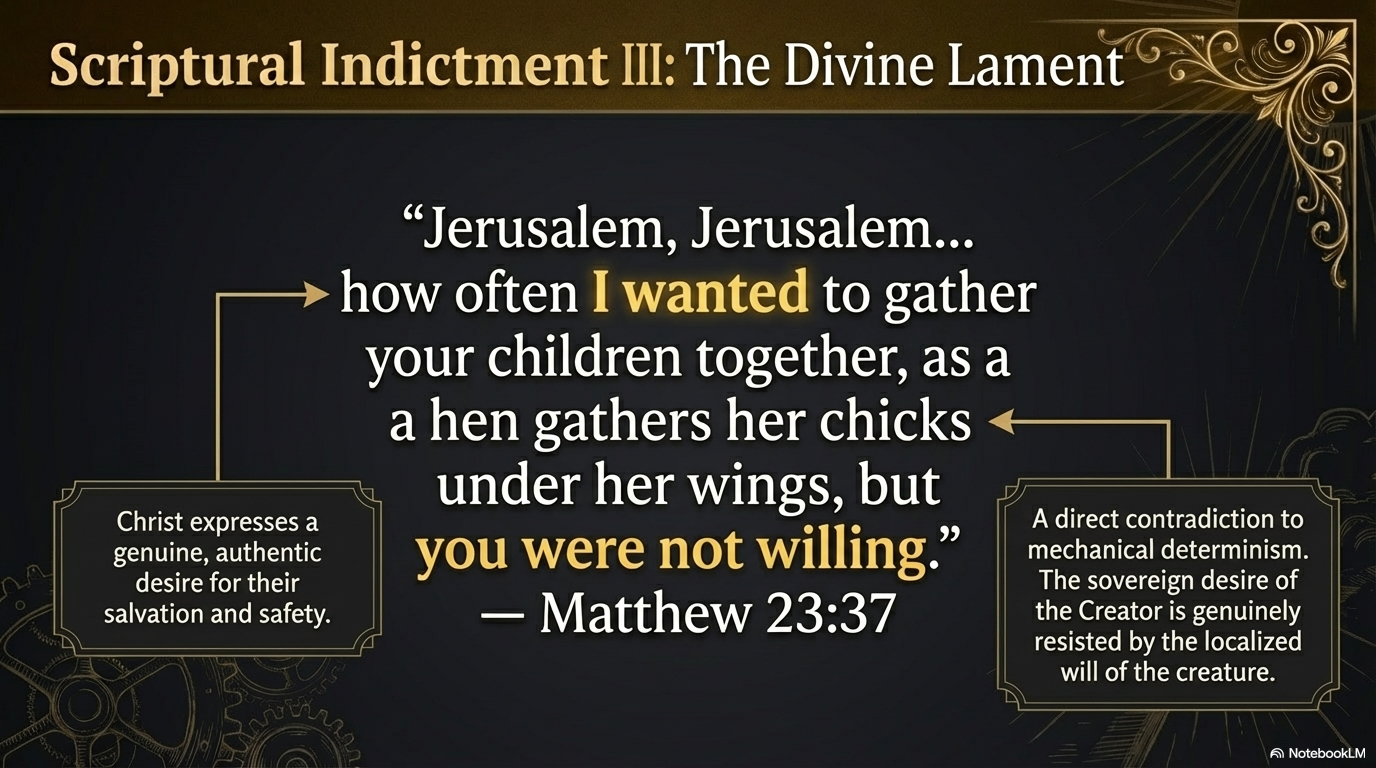
- Matthew 23:37: "Jerusalem, Jerusalem, you who kill the prophets and stone those sent to you, how often I have longed to gather your children together, as a hen gathers her chicks under her wings, and you were not willing." (Context: Christ's genuine desire to save is thwarted by human unwillingness, refuting the concept of an irresistible calling).
- Romans 10:21: "But concerning Israel he says, 'All day long I have held out my hands to a disobedient and obstinate people.'" (Context: God sincerely pleads with and holds out His hands to those who continually reject Him).
- John 12:48: "There is a judge for the one who rejects me and does not accept my words; the very words I have spoken will condemn them at the last day." (Context: Judgment is entirely based on the human responsibility to accept or reject God's clearly spoken Word, negating the idea that God dictates belief).
Addressing Arguments
Jesus said they did not choose him
16 'You did not choose Me but I chose you, and appointed you that you would go and bear fruit, and [that] your fruit would remain, so that whatever you ask of the Father in My name He may give to you.
- Jesus didn’t say “I predestined you to salvation before the foundation of the world.”
- He said, “You did not choose me, but I chose you, and I appointed you…” — which in context means He picked them for a purpose: to go and bear fruit. He is choosing the apostles for their offices and tasks. This would be just like God chose Israel in the OT.
Jesus is telling the Twelve that He picked them to be Apostles, For most people, salvation happens by hearing the message the apostles wrote and choosing to believe it. Take a look at Election
Perseverance of the Saints Conditional Security
Definition: Perseverance of the saints teaches that those who are unconditionally elected will be irresistibly preserved by God to inevitably persevere in faith until the end.
Counter-Definition: God guarantees the final glorification and eternal security of everyone placed in Christ through faith, but predestination speaks to the ultimate destination of believers, not the unilateral pre-selection of their faith.
- Romans 8:29-30: "For those God foreknew he also predestined to be conformed to the image of his Son... And those he predestined, he also called; those he called, he also justified; those he justified, he also glorified." (Context: Predestination describes the final guaranteed benefits—glorification and being conformed to Christ's image—for those who are already believers).
- Romans 11:20-23: "Granted. But they were broken off because of unbelief, and you stand by faith. Do not be arrogant, but tremble. For if God did not spare the natural branches, he will not spare you either... And if they do not persist in unbelief, they will be grafted in, for God is able to graft them in again." (Context: A severe conditional warning demonstrating that individuals are cut off for unbelief, and even the hardened can be restored if they leave their rebellion).
- Colossians 1:22-23: "But now he has reconciled you by Christ’s physical body through death to present you holy in his sight... if you continue in your faith, established and firm, and do not move from the hope held out in the gospel." (Note: This text is a general biblical reference supporting conditional perseverance and the necessity of remaining in the faith, complementing the Romans 11 mandate).
- Ephesians 1:13-14: "And you also were included in Christ when you heard the message of truth, the gospel of your salvation. When you believed, you were marked in him with a seal, the promised Holy Spirit, who is a deposit guaranteeing our inheritance...",. (Context: Eternal security and the guarantee of our final inheritance are secured only after a person hears and believes. Predestination is the guaranteed destination for those who are already located "in Him" through faith),.
- Philippians 1:6: "For I am confident of this very thing, that He who began a good work in you will perfect it until the day of Christ Jesus.",. (Context: God's preserving power is directed specifically toward existing believers, guaranteeing their final destination and glorification, but it does not suggest they were irresistibly caused to believe in the first place),.
- 2 Timothy 2:20-21: "Now in a great house there are not only vessels of gold and silver but also of wood and clay, some for honorable use, some for dishonorable. Therefore, if anyone cleanses himself from what is dishonorable, he will be a vessel for honorable use, set apart as holy, useful to the master...",. (Context: Being preserved and used as a noble vessel is conditional upon the believer's active cooperation in cleansing themselves from sin and departing from iniquity),.
- Hebrews 3:15: "As has just been said: 'Today, if you hear his voice, do not harden your hearts as you did in the rebellion.'",. (Context: Addressed directly to New Testament believers as a severe warning that perseverance requires not hardening one's heart against God's voice, indicating a genuine, conditional responsibility to remain faithful),.
The scriptures consistently emphasize that God guarantees the eternal security of those who are in Christ, but this relationship is maintained conditionally through continued faith, requiring believers to take responsibility for their own spiritual condition. If a person continually suppresses the truth or listens to worldly wisdom, their conscience can become seared and their heart calloused.
Here are the biblical warnings discussed in the sources instructing believers not to fall away, harden their hearts, or return to rebellion:
- Hebrews 3 and 4: The author issues a severe warning, stating, "Today, if you hear his voice, do not harden your hearts as you did in the rebellion". This warning demonstrates that individuals have control over whether they close their eyes to God's truth, and if they continually resist Him, they can grow into a hardened, calloused state.
- Romans 11:20-22: Paul explicitly warns Gentile believers not to become arrogant about the Israelites who were cut off. He states that the natural branches were broken off because of unbelief, and warns believers: "Do not be arrogant, but tremble. For if God did not spare the natural branches, he will not spare you either". He adds that believers must continue in God's kindness, "otherwise you too will be cut off".
- Revelation 3: Jesus addresses the church in Sardis, which consists of believers, warning them, "You have a reputation of being alive, but you are dead. Wake up and strengthen what remains". This "deadness" is not an innate inability to respond, but a severe warning to Christians to separate themselves from their carnal rebellion and draw near to God once again.
- Galatians 1 and 3: The Apostle Paul warns genuine, born-again believers in Galatia about being "bewitched" and led astray by false teachers, proving that even those who possess the Holy Spirit must be continually on guard against deceptive words that could choke off their faith.
- Romans 8:13: Paul gives a severe warning to believers regarding their fleshly choices, stating: "For if you live according to the flesh you will die, but if by the Spirit you put to death the misdeeds of the body, you will live". It is the believer's absolute responsibility to respond to the Spirit's call rather than returning to carnal, worldly behaviors.
- The Parable of the Soils (Matthew 13 / Mark 4): Jesus warns that Satan is actively working to snatch the word away from people's hearts lest they believe, and that believers must actively cultivate the word of God implanted in them so that their faith is not choked out by the cares of the world.
**