Definitions of Terms
• Sovereignty: For many, sovereignty means God is ultimately and decisively in control of all human decisions, including evil thoughts, desires, and actions. Under this definition, God meticulously controls all things that come to pass through a divine decree to ensure His own self-glorification.
- This definition is illogical because it makes God the author of the very sins He condemns. If God meticulously scripts every word, the debates between Christians would imply God is essentially arguing with Himself through different human puppets. Furthermore, it renders the command to pray for God’s will to be done on earth as superfluous, as His will would already be perfectly and meticulously accomplished in every event.
• Regeneration: In the some "order of salvation," regeneration (being made alive or born again) must precede faith. Because man is dead in sin- A spiritual corpse with total moral inability- he must be made spiritually alive before he has the capacity to understand or believe the gospel.
- The "corpse" analogy for deadness is a category error. Biblically, "deadness" refers to separation due to rebellion, not a lack of moral capacity to hear an appeal. The other order is illogical because it requires a person to have New Life before they come to the Lifegiver.
• Compatibilism: This is the philosophical position that exhaustive divine sovereignty is compatible with human responsibility. It suggests that while God determines every action and desire, human decisions are still meaningful because they are not coerced by external agents but are acts of the will.
- This is logically equivalent to hard determinism. It is irrational to hold a character like Frodo in the novel Lord of the Rings responsible for his choices if his every move was pre-written by an author. If God is the decisive cause of a man’s preference for sin, then the man has a perfect excuse for his unbelief: "I was born this way by divine decree".
• Reprobation: The necessary counterpart to election, reprobation is the decree by which God passes over specific individuals, choosing not to give them saving grace and leaving them to the just consequences of their sins to demonstrate His justice and power.
- This view contradicts God's repeated oaths that He takes "no pleasure in the death of the wicked" (Ezekiel 18:23, 33:11). If God created people specifically for destruction, His weeping over Jerusalem (Luke 19:41) would be disingenuous or "crocodile tears".
Biblically, what is mistaken for an unconditional decree of damnation is actually judicial hardening.
Which is as follows:
In Scripture, hardening is a judicial act where God gives a person over to the consequences of their own persistent, self-chosen rebellion. It is not an arbitrary decision made before a person is born; it is a "judgment in kind" against those who have consciously suppressed the truth.
The Pottery Analogy
Paul’s use of the Potter and Clay imagery in Romans 9:21-22 is often used to argue for some form of determinism. But it's based in a OT picture.
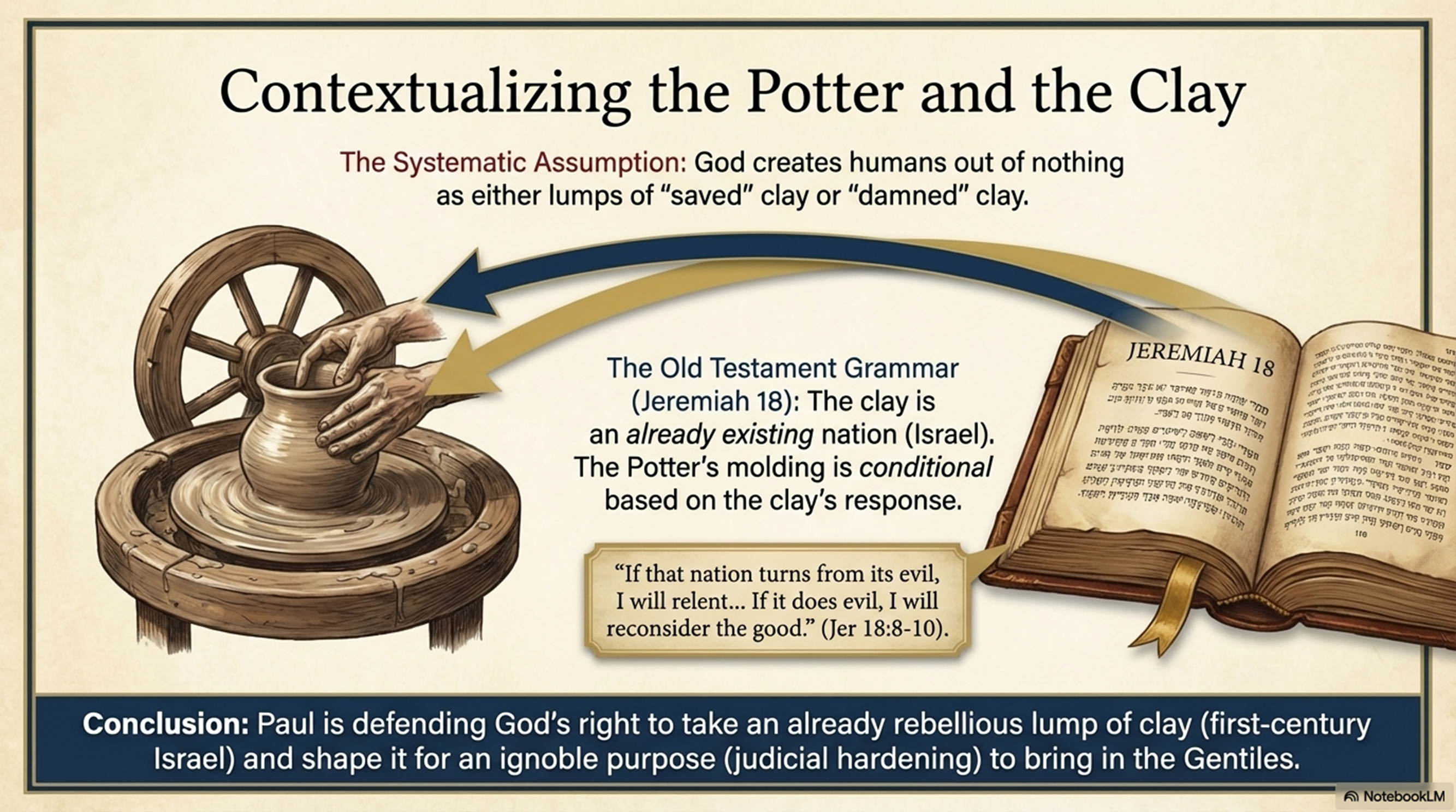
**In Jeremiah 18:1-10, God sends the prophet to the potter’s house to see a "national" lesson.
1 The word which came to Jeremiah from the LORD saying, 2 'Arise and go down to the potter's house, and there I will announce My words to you.' 3 Then I went down to the potter's house, and there he was, making something on the wheel. 4 But the vessel that he was making of clay was spoiled in the hand of the potter; so he remade it into another vessel, as it pleased the potter to make. 5 Then the word of the LORD came to me saying, 6 'Can I not, O house of Israel, deal with you as this potter [does]?' declares the LORD. 'Behold, like the clay in the potter's hand, so are you in My hand, O house of Israel. 7 'At one moment I might speak concerning a nation or concerning a kingdom to uproot, to pull down, or to destroy [it]; 8 if that nation against which I have spoken turns from its evil, I will relent concerning the calamity I planned to bring on it. 9 'Or at another moment I might speak concerning a nation or concerning a kingdom to build up or to plant [it]; 10 if it does evil in My sight by not obeying My voice, then I will think better of the good with which I had promised to bless it.
The clay becomes "marred" in the potter’s hand. This represents Israel’s persistent rebellion to God. The potter doesn't throw the clay away; he remolds it into "another vessel, as it seemed good to the potter to make." God explicitly says, "O house of Israel, can I not do with you as this potter does?... If that nation against whom I have spoken turns from its evil, I will relent of the disaster that I thought to bring upon it" (v. 6-8). The "shaping" of the vessel is not a pre-determined decree but a response to the clay’s pliability
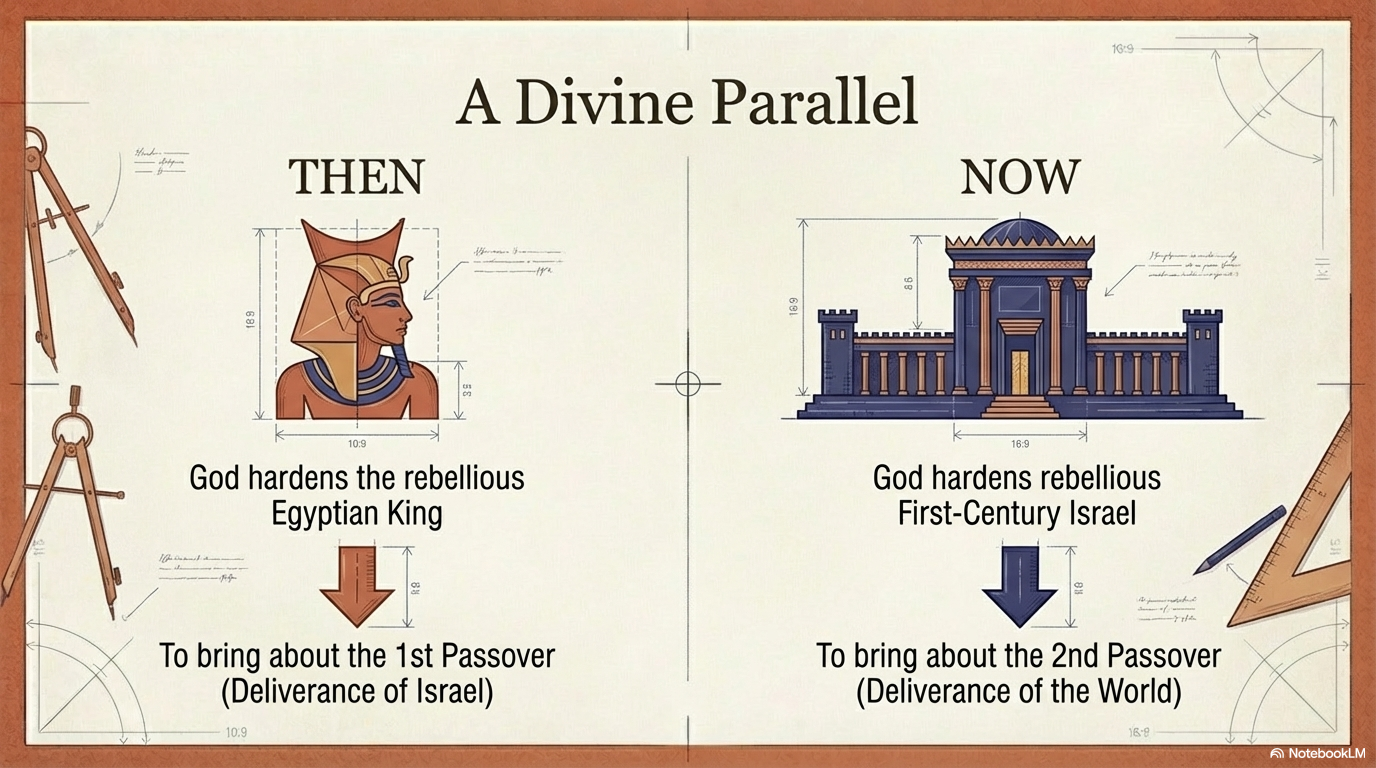
The hardening of individuals in scripture is often a temporary means to achieve a greater redemptive goal, such as the first Passover in Egypt or the crucifixion of Christ through the hardening of Israel.
1. The Trigger: Persistent Resistance
Before God hardens a heart, the individual first hardens themselves.
-
Romans 1:24-28: Paul explains that God "gave them up" to a debased mind after they traded the truth of God for a lie. The "handing over" is the response to their active suppression of the truth.
-
Acts 28:27: This verse describes the sequence perfectly: "For the heart of this people has become dull... and their eyes they have closed; otherwise they might see with their eyes." God’s hardening is the judicial "sealing" of the eyes that the people had already fought to close.
2. The Method: Strengthening a Chosen Resolve
God doesn't inject new evil into a heart; He often uses revelation (signs, wonders, or parables) to strengthen a person in the direction they are already determined to go.
-
Pharaoh: Pharaoh hardened his own heart through the first five plagues. God then "strengthened" (hardened) Pharaoh's heart so that he would stay the course long enough for God’s power to be fully displayed through the Red Sea.
-
Israel: During the time of Jesus, God used parables to hide the truth from those who had already rejected the Light. This "judicially blinded" them so they would proceed with the crucifixion—a temporary evil that God used to achieve the ultimate redemptive goal of the Cross.
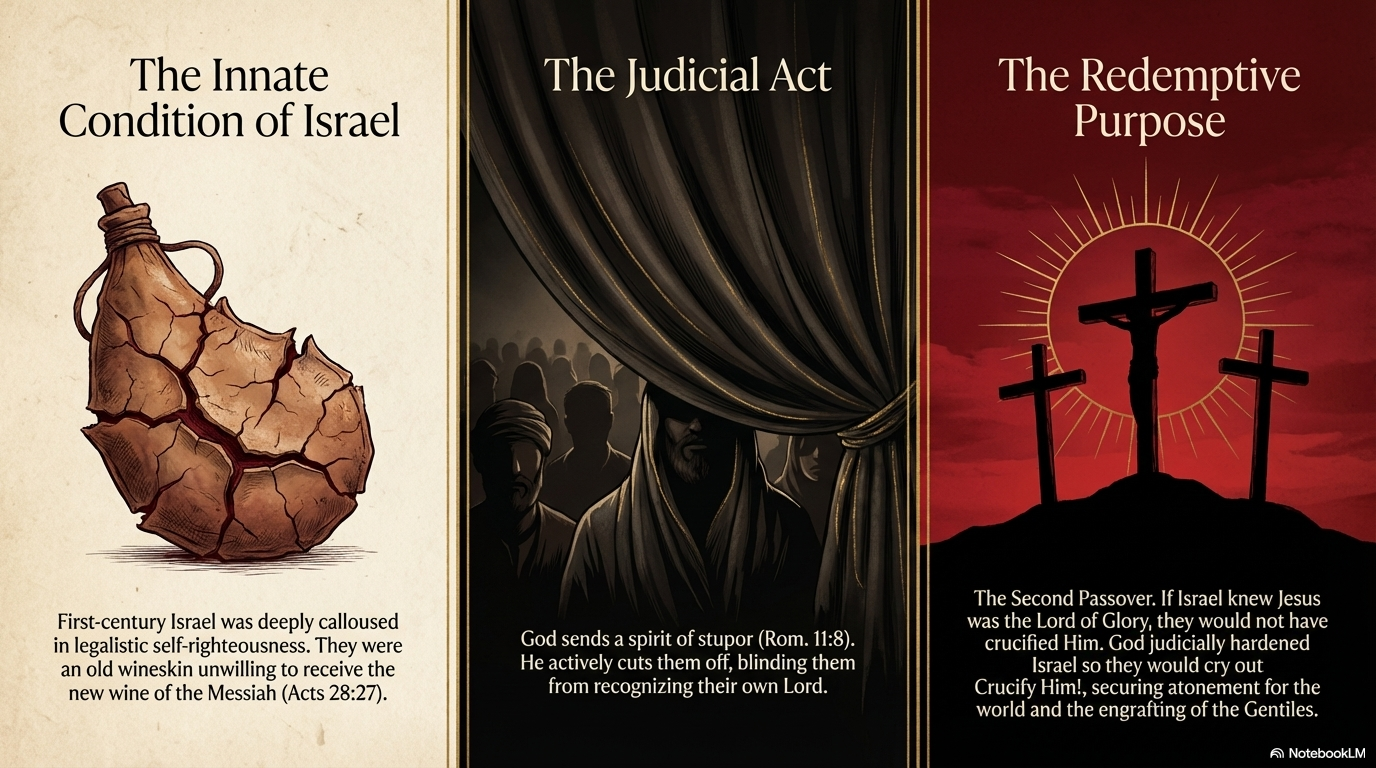
3. The Goal: A Strategic Redemptive Purpose
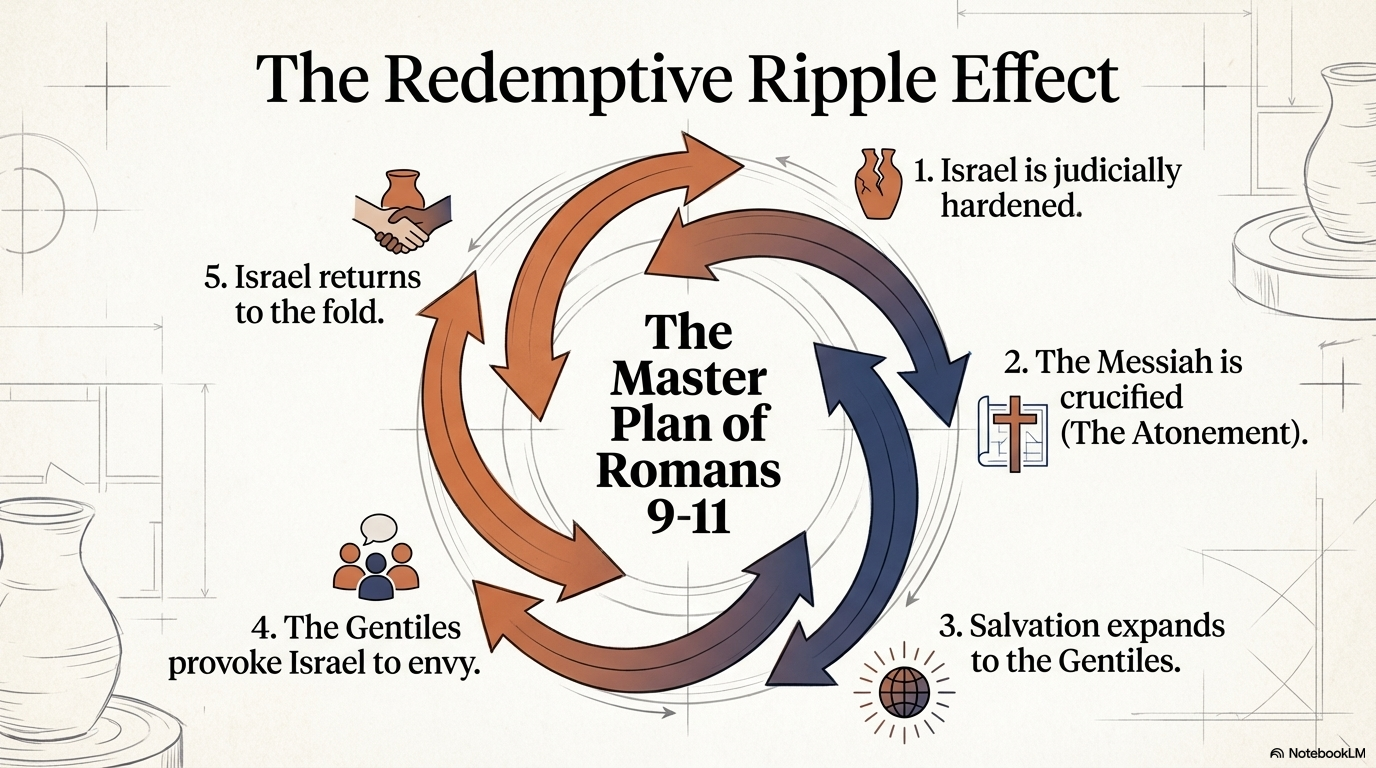
Hardening is almost always temporal and strategic. God uses the "hardness" of a group to force history toward a specific redemptive goal.
- The "Vessels of Wrath": When Paul speaks of "vessels of wrath" in Romans he is referring to the nation of Israel in their current state of rebellion. In Romans 9:22, Paul says God "endured with much longsuffering the vessels of wrath prepared for destruction." You do not need "longsuffering" or patience for a condition you created yourself. Patience implies that God is waiting for repentance (2 Peter 3:9) while simultaneously utilizing their current rebellion for His glory—like the salvation of the Gentiles.
- The Greek grammar is vital here. In verse 23, God actively prepared the vessels of mercy for glory. However, in verse 22, the vessels of wrath are "prepared for destruction" using a passive participle (katērtismena). They "fit themselves" for destruction through their own stubbornness;
During His earthly ministry, Jesus used parables to keep the Jewish crowds from perceiving His identity too early (Matthew 13:10-15). This "judicial blinding" ensured they would proceed with the crucifixion according to the "predetermined plan" of God (Acts 2:23). If they had understood, they might not have crucified the Lord of Glory (1 Corinthians 2:8).
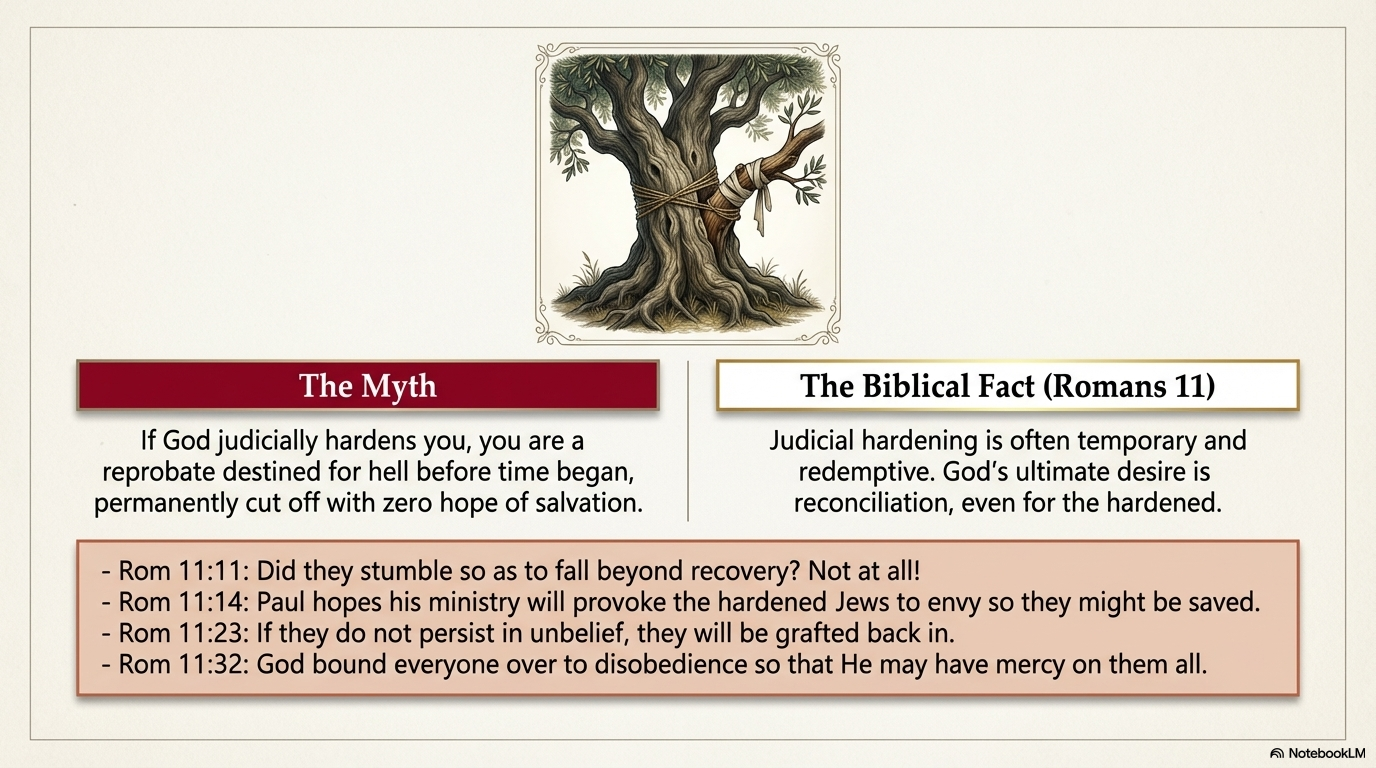
- The "Fall" is Not Final: Paul asks, "Did they stumble so as to fall beyond recovery? Not at all!" (Romans 11:11). God used the "stumble" of Israel to bring the Gospel to the Gentiles. The hardening of the "vessels of wrath" (Israel) was intended to "provoke them to envy*" so that they might eventually seek the mercy they rejected.
Other Examples
Jacob And Esau
The claim that God chose to love Jacob and hate Esau before time began for salvation is a misreading of the text's intent and chronology.
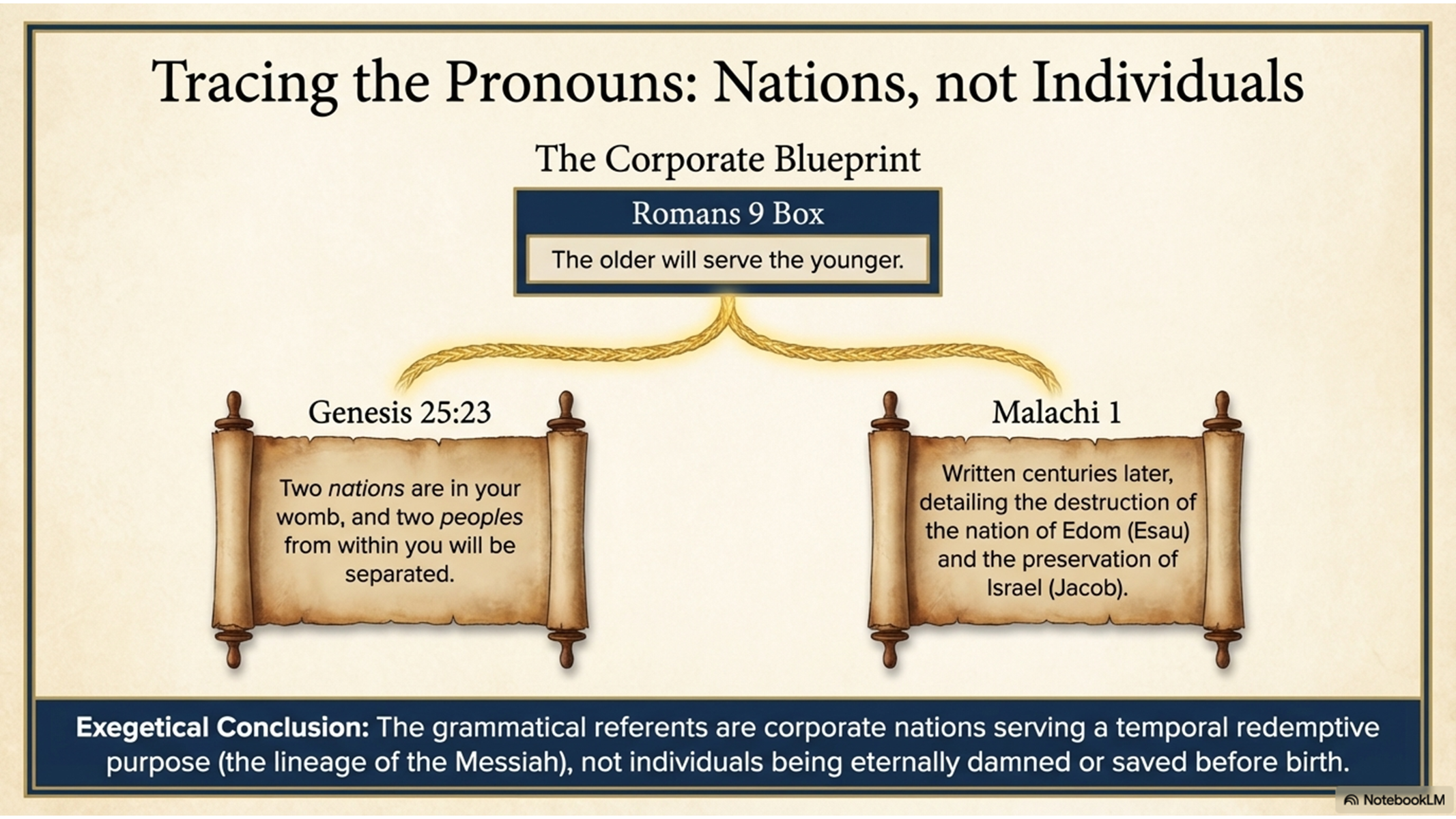
While the preceding verse (v. 12) quotes Genesis 25:23 regarding the unborn twins, verse 13 is actually a quotation from Malachi 1:2–3, the final book of the Old Testament, which was written 1,500 years after the brothers lived. In Genesis 29:30-31, Jacob is said to have "loved Rachel more than Leah," and the very next verse describes Leah as "hated" or "unloved," demonstrating that the term meant "loved less" or "not preferred" in context.
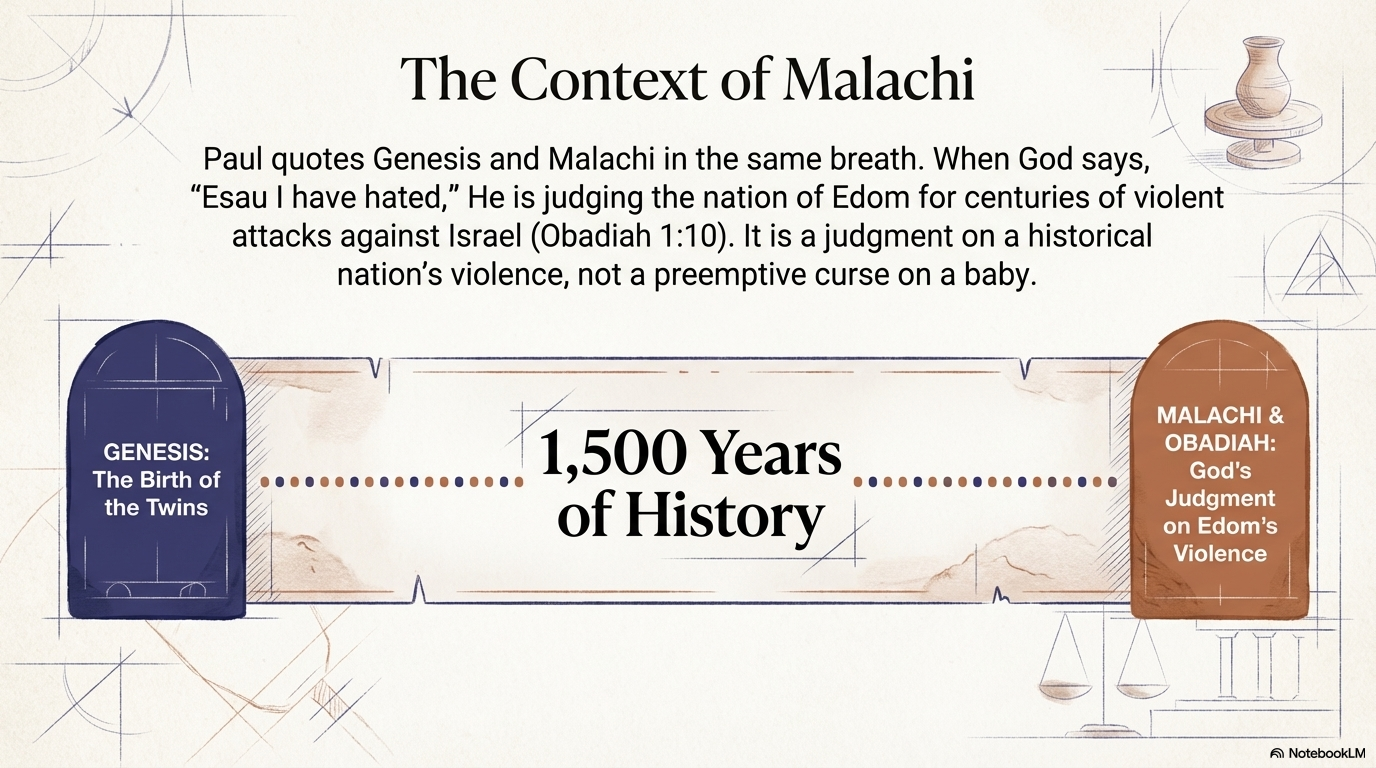
• Idioms of Preference: "Love" and "hate" are first-century Semitic idioms for preference. Similar to Jesus’ command to "hate" one's family to follow Him (Luke 14:26), it refers to choosing one role or path over another.
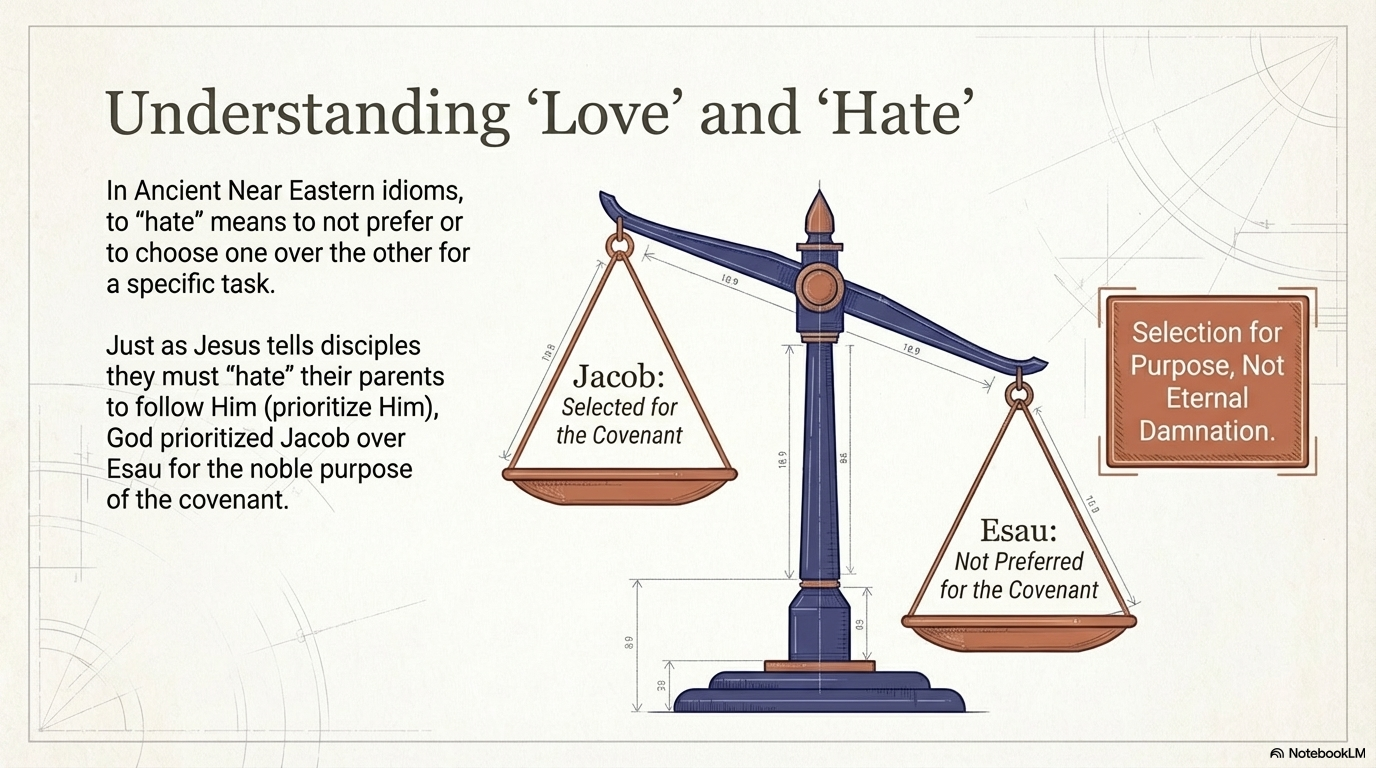
In Malachi, God is addressing the nations of Israel and Edom (represented by their patriarchal heads), not unborn individuals. Jacob was chosen for the noble use of bringing the Messiah to the world, while Esau was chosen for a common purpose. God's "hatred" toward Edom was not unconditional; it was a judicial response to the Edomites' historical violence and rebellion against Israel.
By quoting Malachi, Paul is providing a "before and after" picture: While the choice of Jacob’s line to carry the promise was not based on the works of the twins (v. 11), the eventual "hatred" or wrath toward the nation of Edom was conditioned on their behavior. Which we know from Obadiah 1:10, stating Edom would be destroyed "because of the violence against your brother Jacob"
The Hardening of Pharaoh
The primary Hebrew word used for hardening in the account of Pharaoh is hazaq, which literally means "to strengthen," "to firm up," or "to stiffen". "Hardening does not change your mind; it prevents you from changing your mind" by locking the individual into the rebellious path they have already chosen.
Pharaoh hardened his own heart multiple times before God judicially hardened him, essentially locking him into a rebellious position he had already chosen. God "raised up" Pharaoh not by creating him for destruction, but by placing him in power during a specific time to demonstrate His authority through Pharaoh's existing rebellion
- Initial Defiance: When Moses first approached Pharaoh, the king resisted naturally and immediately, asking, "Who is Yahweh that I should listen to him?". Before God is ever shown actively hardening Pharaoh, the text records several times that "Pharaoh's heart grew hard" or that "Pharaoh hardened his own heart" in response to seeing relief from the plagues.
- Divine Judicial Hardening: It is only after Pharaoh has repeatedly and willfully hardened himself that the scripture says "the Lord hardened the heart of Pharaoh"* (Exodus 9:12).
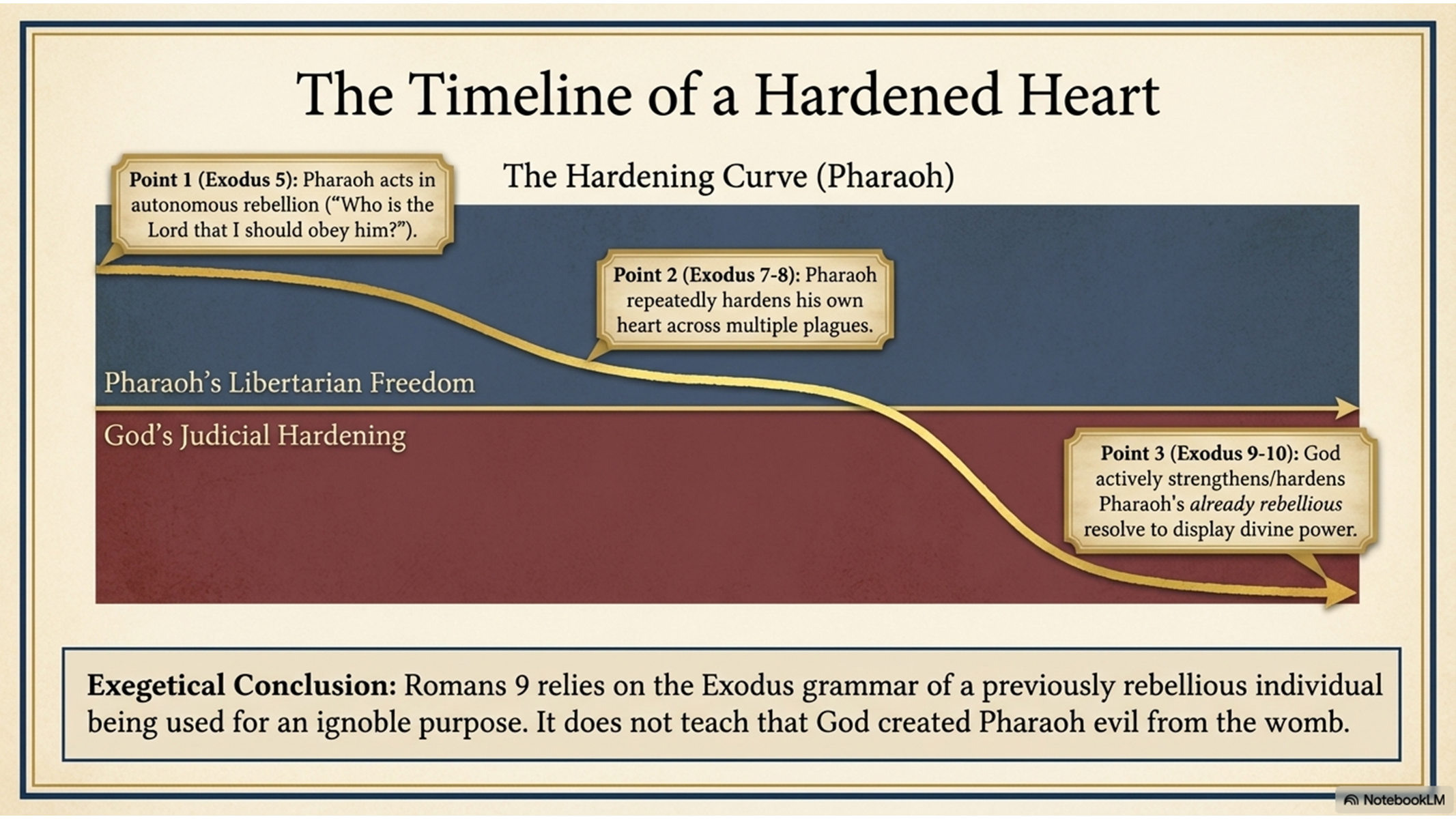
In Romans 9:17, Paul quotes God saying to Pharaoh, "For this very purpose I have raised you up, that I might show my power in you". God could have "struck him dead" for his prior sins, but He instead "endured with much long-suffering" this vessel of wrath in order to use Pharaoh's stubbornness to provide the occasion for the signs, wonders, and the first Passover. He is placing a specific rebellious man into a position of power at a specific time.
• Monergism: This term describes salvation—specifically regeneration—as a work of God alone, where the sinner is the passive recipient of divine action.
-
This definition wrongly assumes that faith is a "work" that would rob God of glory if performed by the human will. To call faith a "work" contradicts Romans 3:27, which states that boasting is excluded specifically "by the law of faith". By labeling any human response as "work of the law," Calvinists make faith and grace mutually exclusive, whereas the Bible says the promise "depends on faith in order that the promise may rest on grace" (Romans 4:16).
-
Deadness: Calvinists frequently describe the unregenerate person as a "spiritual corpse". This analogy is intended to illustrate that just as a physically dead man cannot respond to an invitation, a spiritually dead person is morally unable to see, hear, or understand the gospel until God intervenes. Because of this, Calvinists argue that lost people cannot willingly accept the gospel as true unless God performs a miracle of regeneration first. One of the primary biblical narratives Calvinists use to support this view is the raising of Lazarus from the dead in John 11. They argue that just as Lazarus could not obey Jesus' command to "come forth" while still dead, a sinner cannot hear or respond to the call of the gospel until they are first made alive by God. Because man is seen as totally dead, Calvinists believe that regeneration (new birth) must precede faith. In their view, God must infuse spiritual life into a dead soul so that the sinner can recognize the value of salvation and willingly come to Christ. They argue that if faith were a choice made by a "dead" person, it would constitute a meritorious work, which would rob God of His glory .n this system, deadness means the human will is enslaved to sin. Calvinists maintain that while man acts according to his desires, his fallen nature is "pre-programmed to believe lies". Therefore, an unbeliever will inevitably reject the gospel as "foolishness" unless the Holy Spirit irresistibly changes their heart of stone into a heart of flesh.