| OT | Genesis 1:26 | Genesis | 1:26 | | Elohim states that Adam will be made “in our image,” yet in the next verse Adam is made “in the image of Elohim.” This could indicate plurality of Persons within Elohim, but could also be a majestic plural or (less likely) speaking to divine council (cf. Job 38:7). | Nouns, Pronoun |
| OT | Genesis 3:22 | Genesis | 3:22 | | Yahweh Elohim states that “the man has become like one of us.” This could indicate plurality of Persons within Yahweh Elohim, but could also be a majestic plural or speaking to divine council. | Nouns, Pronoun |
| OT | Genesis 11:7 | Genesis | 11:7 | | Yahweh says, “Let us go down and confuse their language.” However, in the next verse it is Yahweh alone who scatters the people. This could indicate a plurality of Persons within Yahweh, but could also be a majestic plural or (less likely) speaking to divine council. | Nouns, Pronoun |
| OT | Genesis 19:24 | Genesis | 19:24 | | Yahweh rains down fire and sulfur on Sodom and Gomorrah from (?) Yahweh out of the heavens. This could indicate two Persons called “Yahweh,” but could also be an example of Hebraic agency or parallelism. It could also be a Hebraism meaning “from Himself.” | Nouns |
| OT | Genesis 20:13 | Genesis | 20:13 | | Elohim “caused [plural] me to wander.” Whereas Elohim (plural) is occasionally used in reference to lesser gods, it is always with a singular verb; here, (plural) Elohim is used together with a plural verb, unprecedented in Hebrew except where multiple persons are in view. This appears to be strong evidence for the plurality of Persons within Elohim. | Verb |
| OT | Genesis 35:7 | Genesis | 35:7 | | Elohim “appeared [plural].” Whereas Elohim (plural) is occasionally used in reference to lesser gods, it is always with a singular verb; here, (plural) Elohim is used together with a plural verb, unprecedented in Hebrew except where multiple persons are in view. This appears to be strong evidence for the plurality of Persons within Elohim. | Verb |
| OT | 2 Samuel 7:23 | 2 Samuel | 7:23 | | Elohim “went [plural].” Whereas Elohim (plural) is occasionally used in reference to lesser gods, it is always with a singular verb; here, (plural) Elohim is used together with a plural verb, unprecedented in Hebrew except where multiple persons are in view. This appears to be strong evidence for the plurality of Persons within Elohim. | Verb |
| OT | Psalm 45:6-7 | Psalm | 45:6-7 | | A Davidic king, addressed as Elohim, is anointed by Elohim His Elohim. This shows that Elohim is not, in itself, an indication of numerical plurality; however, it also demonstrates that there are at least two Persons who can be called Elohim, one of Whom is inferior to and anointed by the other. | Nouns, Verb |
| OT | Psalm 58:11 | Psalm | 58:11 | | The Psalmist states that “there is a God Who judges [plural, lit. ‘they judge’] the earth.” Whereas Elohim (plural) is occasionally used in reference to lesser gods, it is always with a singular verb; here, (plural) Elohim is used together with a plural verb, unprecedented in Hebrew except where multiple persons are in view. This appears to be strong evidence for the plurality of Persons within Elohim. | Verb |
| OT | Proverbs 30:4 | Proverbs | 30:4 | | Yahweh has a Son whose name is not expected to be known by the writer’s audience. This could be a point in favor of trinitarianism. However, it is also possible that the son in question is Solomon himself (see 1 Chron. 28:5-6). | Nouns |
| OT | Isaiah 9:6 | Isaiah | 9:6 | | The prophet prophesies the future arrival of a Son, a descendant of David, who will be called “El-Gibbor” (lit. “God of Might”). The very same title is applied in the next chapter to Yahweh, to Whom Israel is exhorted to return (Isa. 10:20-21). This is evidence that the coming Messiah will be Yahweh Himself, Who will be born as a child, a descendant of David. | Nouns |
| OT | Isaiah 61:1 | Isaiah | 61:1 | | Yahweh, Who is contextually the One speaking throughout the entirety of this passage (see 60:22, 61:8), states that “the Spirit of Adonai Yahweh is upon Me, for Yahweh has anointed Me.” The same Yahweh Who is speaking then goes on to state that He will rejoice in Yahweh His God (v. 10)! The grammar appears to indicate three Persons, all of Whom are called Yahweh directly: Yahweh Who anoints and sends to Israel, Yahweh Who is anointed and sent to Israel, and the Spirit of Adonai Yahweh. | Nouns |
| OT | Isaiah 63:8-10 | Isaiah | 63:8-10 | | Yahweh saved Israel by the instrumentality of the Angel of His Presence (Who has the very name of Yahweh; Exod. 23:20-21). However, they rebelled and His Holy Spirit grieved. The grammar indicates three separate Persons, all of Whom are identified with Yahweh (either in this passage or elsewhere) yet distinguished from one another. | Nouns |
| OT | Jeremiah 23:5-6 | Jeremiah | 23:5-6 | | The name of the Davidic king and Messiah Who will come to restore Israel will be “Yahweh our righteousness.” | Nouns |
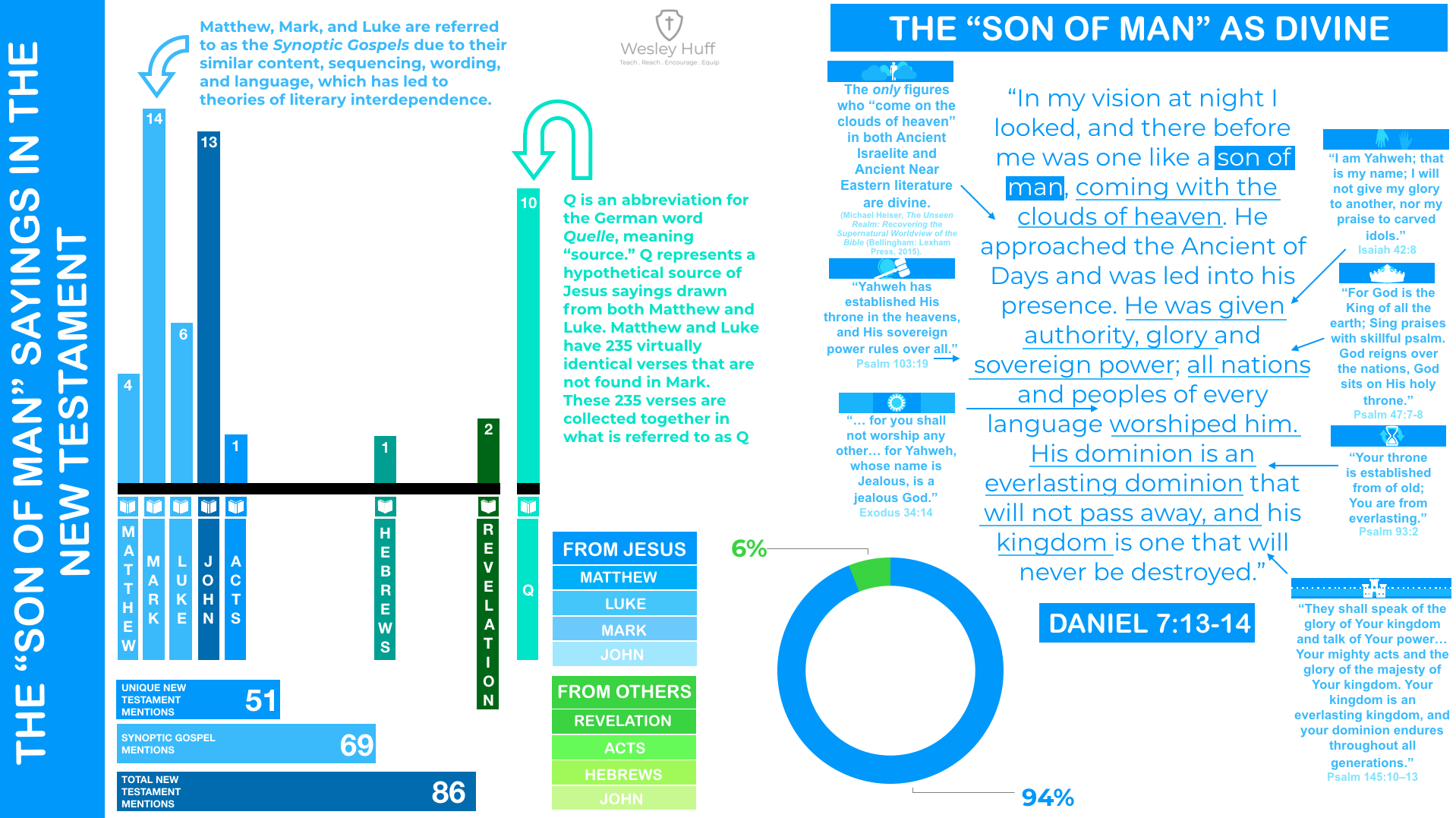
| OT | Daniel 7:13-14 | Daniel | 7:13-14 | | One “like a son of man” is presented before the Ancient of Days, riding on the clouds of heaven, and is religiously served (pelach) by all people. Both riding on the clouds of heaven and being religiously served are deeds elsewhere reserved for Yahweh alone. This implicitly indicates that the “One like a son of man” is Himself Yahweh, despite being distinguished from the One on the throne. | Nouns, Verb |
| OT | Hosea 1:6-7 | Hosea | 1:6-7 | | Yahweh states that He will save Israel “by Yahweh their Elohim.” This could be evidence of two Persons called Yahweh, one of Whom sends the other to save Israel (esp. in light of Zech. 2:8-11), but could also merely be a Hebraism meaning “by Myself.” | Nouns |
| OT | Zechariah 2:8-11 | Zechariah | 2:8-11 | | Yahweh of Hosts insists no less than three times that He has been sent by Yahweh, and that He Himself will come to dwell in the midst of Israel. This indicates the existence of at least two different Persons called Yahweh, one of Whom will send the other to dwell in Israel. | Nouns |
| OT | Zechariah 14:9 | Zechariah | 14:9 | | Yahweh, Who is one and Whose name is one, will Himself come to rule over the whole earth from Jerusalem. This indicates that the coming Messiah will indeed be Yahweh Himself. | Nouns |
| NT | Matthew 3:3 | Matthew | 3:3 | | Here it is stated that John the Baptist came to “prepare the way of the Lord.” In this context, the Lord refers to Jesus, yet in the original context “the LORD” is Yahweh (isaiah 40:3Isa. 40:3). This could be taken to show that Jesus is Yahweh; however, it could also be a mere example of Hebraic agency, considering that the original passage also states that “the Messenger [lit. “angel/agent”] of the Covenant” is the One Who is coming. | Nouns |
| NT | Matthew 5:21-22, 5:27-28, 5:31-32, 5:33-34, 5:38-39, 5:43-44 | Matthew | 5:21-22, 27-28, 31-32, 33-34, 38-39, 43-44 | | Jesus repeatedly alters the OT Testament teachings, even in some cases reversing them. But rather than appealing to the authority of God, as would be necessary when altering/reversing a previous teaching of God, He appeals to His own authority: “I say to you”! This implies that He Himself carries the authority of God, and His audience certainly would not have missed this implication. | Verb |
| NT | Matthew 9:2 | Matthew | 9:2 | | Jesus claims the authority to forgive sins, something properly belonging to God alone. However, the author immediately goes on to state that “God… had given such authority to a man,” which renders this passage equivocal on the issue of Christ’s deity. | Verb |
| NT | Matthew 12:6, 8 | Matthew | 12:6, 8 | | Jesus not only claims authority over the Sabbath, a day consecrated by Yahweh Himself (Exod. 20:8-11), but claims to be greater than the temple itself (which was considered to be the earthly presence of God Most High)! His Pharisaic audience clearly recognized the ‘blasphemy,’ resulting in a conspiracy to murder Him (v. 14). | Nouns |
| NT | Matthew 12:32 | Matthew | 12:32 | | The blasphemy of the Holy Spirit is considered far greater than all other sins, which is inconceivable unless the Holy Spirit is both personal and on the level of God Himself. However, this doesn’t prove that He is a ‘third Person,’ for Holy Spirit could simply be another name for the Father. | Nouns |
| NT | Matthew 14:27 | Matthew | 14:27 | | Jesus tells His disciples not to fear the tumultuous sea, because “I am He” (ego eimi). This is a strong parallel with Isaiah 43, in which Yahweh tells Israel, “do not fear when you pass through the waters” because “I am He” (ego eimi) is with them (vv. 1-3, 10). However, the parallel between the two is possibly unintentional. (cf. Job 9:8). | Verb |
| NT | Matthew 16:27 | Matthew | 16:27 | | Jesus claims authority over the angels of God and states that He will come to “repay each one according to his deeds.” This is a quotation of several OT Testament passages which state that Yahweh Himself will repay according to each person’s deeds (Ps. 62:12; Prov. 24:12; Jer. 17:10; 32:19; Ezek. 33:20 cf. Rom. 2:6). However, this could also be understood in light of other passages which state that God gave judgment over to Jesus (Jn. 5:22; Acts 17:31). | Nouns, Verb |
| NT | Matthew 19:17-21 | Matthew | 19:17-21 | | Jesus quotes all of the Ten Commandments except those dealing with following God, and then sums up the rest by exhorting the rich young ruler to “follow Me”! This is an implicit claim to being the same as Yahweh God, Who the first four commandments deal with. However, it could also be understood in light of the principle of Hebraic agency by which following Jesus, the agent of God, is the same as following God Himself (cf. Jn. 12:44). | Verb |
| NT | Matthew 21:9 | Matthew | 21:9 | | Jesus is identified as “the One Who comes in the name of the Lord” (Ps. 119:26), Who in the original OT context is in fact Yahweh Himself. | Nouns |
| NT | Matthew 23:9-10 | Matthew | 23:9-10 | | Jesus puts Himself on the same level as the Father in heaven, stating that He, the Christ, is their “one-and-only Leader.” | Nouns |
| NT | Matthew 23:37-39 | Matthew | 23:37-39 | | Jesus states that He, in the past, willed to gather the inhabitants of Jerusalem “as a hen gathers her chicks under her wings.” This is an action attributed to Yahweh alone in the OT (Deut 32:11; Ruth 2:12; Ps 17:8; 36:7; 57:1; 61:4; 63:7; 91:4). Furthermore, He again identifies Himself as “the One Who comes in the name of the Lord,” Who in the original OT context is Yahweh Himself (Ps. 119:26). | Nouns, Verb |
| NT | Matthew 25:31-32 | Matthew | 25:31-32 | | Jesus Himself will enter into judgment with the nations in the eschatological Day of the Lord, an action which in the OT is attributed to Yahweh (Joel 3:2). However, this can be understood in light of other passages which state that God gave all judgment over to Jesus (Jn. 5:22; Acts 17:31). | Nouns, Verb |
| NT | Matthew 26:64 | Matthew | 26:64 | | Jesus claims to be the “one like a son of man” of Daniel 7:13-14, Who as noted above is described using actions (like riding on the clouds and being religiously served) that belong to Yahweh alone. In the very next verse, the high priest identifies this claim as blasphemous and deserving of death. However, this could also be merely a Messianic claim, which some early sources imply was also considered blasphemous in the 1st-2nd centuries. | Nouns |
| NT | Matthew 28:19 | Matthew | 28:19 | | The Father, Son, and Holy Spirit all appear to share a singular “name” into which Christians are to be baptized. However, this could also be a Hebraism in which multiple individuals with different names are attributed a singular “name” (cf. Gen. 48:16; 1 Sam. 17:13). | Nouns |
| NT | Mark 1:2-3 | Mark | 1:2-3 | | See note on Matthew 3:3. | Nouns |
| NT | Mark 2:5 | Mark | 2:5 | | See note on Matthew 9:2. | Verb |
| NT | Mark 2:28 | Mark | 2:28 | | See note on Matthew 12:8. | Nouns |
| NT | Mark 3:29 | Mark | 3:29 | | See note on Matthew 12:32. | Nouns |
| NT | Mark 6:50 | Mark | 6:50 | | See note on Matthew 14:27. | Verb |
| NT | Mark 10:18-21 | Mark | 10:18-21 | | See note on Matthew 19:17-21. | Verb |
| NT | Mark 11:9 | Mark | 11:9 | | See note on Matthew 21:9. | Nouns |
| NT | Mark 14:62 | Mark | 14:62 | | See note on Matthew 26:64. | Nouns |
| NT | John 1:1-14 | John | 1:1-14 | | John states that the Word of God, which was with God in the beginning and which was God, became flesh in Jesus Christ. This could reflect early Targums or Hebrew wisdom literature, suggesting Jesus is either Yahweh Himself or the manifestation of Yahweh’s Word. | |
| NT | John 1:18 | John | 1:18 | | The textual tradition states the Son, in the bosom of the Father, is the “only-begotten God” who reveals the Father. Some patristic evidence favors the alternate reading of "only-begotten Son." | |
| NT | John 4:14, 26 | John | 4:14, 26 | | Jesus claims to be the One from whom living water flows, which is always associated with Yahweh in the OT (Isa. 12:2-3, Jer. 2:13), and identifies Himself with “I am He,” echoing Isaiah 52:6 (LXX). | |
| NT | John 5:18-30 | John | 5:18-30 | | Jesus’ claim that “God was [His] Father” was viewed as making Himself identical to God. He also claimed that all should honor the Son as they honor the Father, indicating equality of worship between the Father and Son. | |
| NT | John 6:20 | John | 6:20 | | See note on Matthew 14:27. | |
| NT | John 7:37-38 | John | 7:37-38 | | Jesus claims to be the One from whom living water flows, which is always a reference to Yahweh in the OT (Isa. 12:2-3, Jer. 2:13). | |
| NT | John 8:24, 28 | John | 8:24, 28 | | Jesus twice states, “I am He,” mirroring Isaiah 43:24-25 and 43:10, indicating a claim to deity, as these are Yahweh's words in the OT. | |
| NT | John 8:58 | John | 8:58 | | Jesus states, “Before Abraham became, I am,” a claim to exist before Abraham and implicitly a claim to deity, causing the Jews to accuse Him of blasphemy. | |
| NT | John 10:1-16 | John | 10:1-16 | | Jesus claims to be the exclusive Shepherd of Israel, a role attributed to Yahweh alone in the OT (Ps. 23:1, Isa. 40:11), suggesting He is Yahweh. | |
| NT | John 10:25-29 | John | 10:25-29 | | Jesus claims to be the Shepherd of Israel, and that both He and the Father hOT Israel as their sheep, which implies that both the Father and the Son are Yahweh. | |
| NT | John 10:30 | John | 10:30 | | Jesus affirms unity with the Father, asserting that "I and the Father are one," implying ontological unity with Yahweh. | |
| NT | John 10:31-36 | John | 10:31-36 | | The Jews accuse Jesus of blasphemy for claiming to be God. Jesus uses Psalm 82 to rebuke the Pharisees, positioning Himself as Elohim, not a lesser god. | |
| NT | John 10:37-39 | John | 10:37-39 | | Jesus appeals to His works as proof of His unity with the Father. Despite this, the Jews still attempt to seize Him, viewing His claims as blasphemy. | |
| NT | John 11:25 | John | 11:25 | | Jesus claims to be the Resurrection and the Life, a title reserved for Yahweh, suggesting His deity. | |
| NT | John 12:13 | John | 12:13 | | See note on Matthew 21:9. | |
| NT | John 12:38-41 | John | 12:38-41 | | John states that Isaiah spoke of Jesus' glory, which may refer to Yahweh's glory (Isa. 6:3), but it could also refer to the Messiah's glory, leaving some ambiguity on the deity of Christ. | |
| NT | John 13:18-19 | John | 13:18-19 | | Jesus quotes Psalm 41:9, linking it to Himself, and uses the phrase “I am He,” a reference to Isaiah 43:10, which is an implicit claim to deity. | |
| NT | John 14:6 | John | 14:6 | | Jesus claims to be the Way, the Truth, and the Life, titles that belong to Yahweh, indicating His divine nature. | |
| NT | John 14:9-11 | John | 14:9-11 | | Jesus says that anyone who has seen Him has seen the Father, emphasizing their unity, but not necessarily claiming to be the Father Himself. | |
| NT | John 14:16-17, 14:26 | John | 14:16-17, 26 | | Jesus distinguishes the Helper (Holy Spirit) from Himself and the Father, describing Him as a separate Person with masculine pronouns, but does not declare Him to be God. | |
| NT | John 15:26 | John | 15:26 | | The Helper (Holy Spirit) proceeds from the Father, suggesting a distinction between the Persons of the Trinity. | |
| NT | John 16:7, 16:13 | John | 16:7, 13 | | The Spirit of Truth will be sent by Jesus, again emphasizing the distinction between the Son and the Spirit while describing the Spirit as a Person with masculine pronouns. | |
| NT | John 17:5 | John | 17:5 | | Jesus prays to the Father to be glorified with the glory He had before the world existed, suggesting pre-existence and sharing the same glory as Yahweh. | |
| NT | John 20:22 | John | 20:22 | | Jesus breathes on the disciples and gives them the Holy Spirit. The word “spirit” (ruach in Hebrew and pneuma in Greek) also means "breath," indicating that Jesus' breath is the Holy Spirit, implying that Jesus possesses the same Spirit as Yahweh. | |
| NT | John 20:28 | John | 20:28 | | Thomas exclaims, “My Lord and my God!” (ho kurios mou kai ho theos mou). This is a rare vocative address that is typically reserved for Yahweh in the Bible, found in both the LXX (e.g., Ps. 35:24) and the NT(e.g., Rev. 4:11). If understood vocatively, this is one of the few instances in the NTwhere Jesus is explicitly referred to as “the God” (ho theos). However, alternative interpretations exist within unitarian views, suggesting that this phrase may not be a direct vocative address. | |
| NT | Acts 1:11-12 | Acts | 1:11-12 | | Jesus is taken up bodily from the Mount of Olives, and it is prophesied that He will return in the same way. However, in the OT, it is Yahweh Himself Who returns bodily to the Mount of Olives in the Day of the Lord (Zech. 14:3-4). | |
| NT | Acts 2:17-18, 2:33 | Acts | 2:17-18, 33 | | Peter quotes Joel 2:28-29 in which “Yahweh your God” promises that He Himself will pour out the Spirit. However, he then goes on to state that it is Jesus who is pouring out the Spirit. | |
| NT | Acts 3:14 | Acts | 3:14 | | Peter refers to Jesus as “the HOLY and Righteous One,” a name which belongs to Yahweh alone in the OT (see esp. Isa. 17:7; 24:16; 43:15; 57:15). | |
| NT | Acts 5:3-4, 5:9 | Acts | 5:3-4, 9 | | By parallelism the Holy Spirit is both “God” and “the Spirit of the Lord.” | |
| NT | Acts 7:52 | Acts | 7:52 | | Jesus is referred to as the Righteous One, a title only properly belonging to Yahweh in the OT (see note on Acts 3:14). | |
| NT | Acts 7:59 | Acts | 7:59 | | It is Jesus Who receives the spirit of Stephen upon his death. However, according to the OT, the spirit of a man returns to God at death, because it is He Who first gave it (Ecc. 12:7). | |
| NT | Acts 10:43 | Acts | 10:43 | | “All the prophets testify of [Jesus], that through His name everyone who believes in Him receives forgiveness of sins.” The OT prophets never say such a thing about any human or derivative god, but only about Yahweh alone. | |
| NT | Acts 20:28 | Acts | 20:28 | | Paul exhorts the elders at Ephesus to “shepherd the church of God which He purchased with His own blood.” Since it is, of course, Jesus Who purchased the church with His blood, this is likely another instance in which Jesus is referred to as “the God” (ho theos). However, it is possible to translate it alternately as “…which He purchased with the blood of His own [Son],” although this has the problem that “His own” (ho idios autou) is never elsewhere used on its own to describe Jesus. | |
| NT | Acts 22:14 | Acts | 22:14 | | See note on Acts 8:52. | |
| NT | Acts 28:25-27 | Acts | 28:25-27 | | According to Paul, it was the Holy Spirit Who spoke in Isa. 6:8-10. In the original context of the passage, it is the Lord Yahweh who speaks. | |
| NT | Romans 1:3-4 | Romans | 1:3-4 | | Jesus is both the Son of David according to the flesh, and the Lord and Son of God according to the Spirit of holiness. This confirms the distinction between the Son and the Spirit, and affirms the ‘two natures’ of Jesus. | |
| NT | Romans 8:9-17, 8:26-29 | Romans | 8:9-17, 26-29 | | The Father, Son, and Spirit are distinguished from one another. The Spirit has a mind, testifies, and intercedes, demonstrating His personality. | |
| NT | Romans 8:35-39 | Romans | 8:35-39 | | “The love of Christ” is equated with “the love of God.” | |
| NT | Romans 9:1 | Romans | 9:1 | | Paul undertakes the Oath of Testimony, swearing by Christ and the Holy Spirit, which was traditionally done only by swearing by God Himself. | |
| NT | Romans 9:5 | Romans | 9:5 | | Christ is referred to as “the One being God over all, blessed to the ages.” The grammar is unambiguous, with no contextual reason to switch from Christ to the Father. | |
| NT | Romans 9:32-33 | Romans | 9:32-33 | | Christ has become a stumbling stone and rock of offense, in accordance with the OT prophecy about Yahweh becoming a stone of stumbling to Israel. | |
| NT | Romans 10:13 | Romans | 10:13 | | Paul quotes Joel 2:32, where “the Lord” for salvation is Yahweh in the OT, but here it is Jesus. | |
| NT | Romans 10:20 | Romans | 10:20 | | Paul applies Isaiah 65:1, in which Yahweh is found by those who did not seek Him, now fulfilled in Jesus being found by the Gentiles. | |
| NT | Romans 14:6-9 | Romans | 14:6-9 | | Paul states that actions are done “with regard to the Lord,” identified as Jesus in v. 9, possibly another instance where Jesus is called “the God” (ho theos). | |
| NT | Romans 15:30 | Romans | 15:30 | | The Father, Son, and Spirit are distinguished personally. The Spirit is said to love, implying His personality. | |
| NT | 1 Corinthians 2:10 | 1 Corinthians | 2:10 | | The Spirit is omniscient, searching out “the depths of God,” something only God can do. | |
| NT | 1 Corinthians 2:16 | 1 Corinthians | 2:16 | | Paul equates Yahweh with Christ, quoting Isaiah 40:13: “Who has known the mind of Yahweh?” followed by “we have the mind of Christ.” | |
| NT | 1 Corinthians 8:4-6 | 1 Corinthians | 8:4-6 | | Jesus Christ is placed on the same level as the Father, as the one Lord. Paul places Jesus on equal footing with the Father, breaking up the traditional doxology. | |
| NT | 1 Corinthians 12:4-11 | 1 Corinthians | 12:4-11 | | The Spirit, Lord (Jesus), and God (Father) are distinguished personally. The Spirit has a “will,” affirming His personality. | |
| NT | 2 Corinthians 1:21-22 | 2 Corinthians | 1:21-22 | | God (Father), Christ, and the Spirit are personally distinguished from one another. | |
| NT | 2 Corinthians 3:17-18 | 2 Corinthians | 3:17-18 | | The Spirit is said to be “the Spirit of the Lord” as well as “the Lord” Himself. | |
| NT | 2 Corinthians 5:10 | 2 Corinthians | 5:10 | | “We must all appear before the judgment seat of Christ,” showing that the throne of God and the throne of Christ are the same. | |
| NT | 2 Corinthians 10:17 | 2 Corinthians | 10:17 | | Paul quotes Jeremiah 9:24 about boasting in the Lord Yahweh, but applies it to Jesus Christ. | |
| NT | 2 Corinthians 13:14 | 2 Corinthians | 13:14 | | The Spirit, Lord Jesus, and God (Father) are distinguished personally, with the Spirit having “fellowship,” affirming His personality. | |
| NT | Galatians 4:4-6 | Galatians | 4:4-6 | | The Father, Son, and Spirit are personally distinguished, with the Spirit crying out, “Abba Father!” within our hearts. | |
| NT | Galatians 6:14 | Galatians | 6:14 | | See note on 2 Corinthians 10:17. | |
| NT | Ephesians 1:3-14; 3:14-17; 4:4-6; | Ephesians | 1:3-14 | | The Father, Son, and Spirit are personally distinguished and praised for their respective roles in salvation. | |
| NT | Ephesians 2:18, 2:21-22; 5:18-20 | Ephesians | 2:18, 21-22; 3:14-17; 4:4-6; 5:18-20 | | God the Father, Lord Jesus, and Spirit are distinguished personally five separate times. | |
| NT | Ephesians 4:8 | Ephesians | 4:8 | | Quoting Psalm 68:18, Paul states that when Christ ascended, He led captivity and gave gifts, but in the original OT context, it is Yahweh who does this. | |
| NT | Philippians 2:5-8 | Philippians | 2:5-8 | | This passage describes the ‘two natures’ of Jesus or alternatively His life on earth as the Second Adam. | |
| NT | Philippians 2:10-11 | Philippians | 2:10-11 | | Paul re-applies Isaiah 45:23 about Yahweh to Jesus, emphasizing the uniqueness of Yahweh compared to other gods. | |
| NT | Philippians 3:3 | Philippians | 3:3 | | The Father, Son, and Spirit are personally distinguished from one another. | |
| NT | Colossians 1:15 | Colossians | 1:15 | | Jesus reveals the Father perfectly and is the Firstborn, inheriting creation from the Father, consistent with trinitarianism. | |
| NT | Colossians 1:16 | Colossians | 1:16 | | All things were created in, through, and for Jesus, emphasizing His role in creation. | |
| NT | Colossians 2:2 | Colossians | 2:2 | | Paul speaks of the “mystery of God Christ,” possibly calling Christ “the God.” | |
| NT | Colossians 2:9 | Colossians | 2:9 | | “In Him [Jesus], all the fullness of the God-ness dwells bodily,” affirming the absolute deity of Christ. | |
| NT | 1 Thessalonians 1:3-6 | 1 Thessalonians | 1:3-6 | | God the Father, the Lord Jesus, and the Spirit are again personally distinguished from one another. The Spirit is said to have "joy," once again affirming His personality. | |
| NT | 2 Thessalonians 1:12 | 2 Thessalonians | 1:12 | | Paul speaks of “the grace of our God and Lord Jesus Christ,” calling Jesus “the God” (ho theos) in a grammatically unambiguous fashion. Unitarians deny that this verse is actually calling Jesus “our God.” | |
| NT | 2 Thessalonians 2:13-14 | 2 Thessalonians | 2:13-14 | | God the Father, the Lord Jesus, and the Spirit are personally distinguished from one another. | |
| NT | 2 Thessalonians 3:5 | 2 Thessalonians | 3:5 | | “May the Lord direct your hearts to the love of God and to the perseverance of Christ.” | |
| NT | 1 Timothy 2:5-6 | 1 Timothy | 2:5-6 | | The grammar of this passage is somewhat ambiguous, but could refer to Jesus as both the “one God” and “a man,” affirming the ‘two natures’ doctrine of Christ. | |
| NT | 1 Timothy 3:16 | 1 Timothy | 3:16 | | “He was revealed in the flesh, was vindicated in the Spirit, seen by angels, proclaimed among the nations, believed on in the world, taken up in glory.” Likely refers to Jesus indirectly as “the Living God.” | |
| NT | 2 Timothy 4:18 | 2 Timothy | 4:18 | | Paul gives a doxology to the Lord Jesus, despite condemning worship of any created being apart from the Creator in another doxology (Romans 1:25). | |
| NT | Titus 2:13 | Titus | 2:13 | | Paul speaks of “the glory of our great God and Savior, Christ Jesus,” calling Jesus “the great God.” | |
| NT | Titus 3:5-6 | Titus | 3:5-6 | | God the Father, our Savior Jesus, and the Holy Spirit are again personally distinguished from one another. | |
| NT | Hebrews 1:2 | Hebrews | 1:2 | | God the Father “established the ages” through His Son. This could describe either the original creation event or the future ages during which Christ will reign. | |
| NT | Hebrews 1:6 | Hebrews | 1:6 | | The Father says, “Let all the angels of God worship Him [the Son].” The application to Jesus indicates He is fully Yahweh, not a derivative god. | |
| NT | Hebrews 1:8-9 | Hebrews | 1:8-9 | | The Father speaks to the Son, calling His throne eternal. This verse shows Jesus called “the God” at least once in the NT Testament. | |
| NT | Hebrews 1:10-12 | Hebrews | 1:10-12 | | The Father speaks to the Son about His eternal nature and work of creation. The passage supports the view that the Son is Yahweh. | |
| NT | Hebrews 3:1-4 | Hebrews | 3:1-4 | | Jesus is compared to Moses, with the builder of all things (likely Jesus) being God. Ambiguities may suggest the Father is referenced instead. | |
| NT | Hebrews 3:7-11 | Hebrews | 3:7-11 | | The Holy Spirit speaks the words of Psalm 95:7-11, indicating that the Spirit is Yahweh. | |
| NT | Hebrews 9:14;10:29-30 | Hebrews | 9:14; 10:29-30 | | God the Father, the Christ, and the eonian Spirit are personally distinguished. | |
| NT | Hebrews 13:20 | Hebrews | 13:20 | | Jesus is called “the great Shepherd of the sheep,” a title that belongs to Yahweh. | |
| NT | Hebrews 13:21 | Hebrews | 13:21 | | A doxology is given to Jesus, affirming His divinity despite the prohibition of worshipping created beings. | |
| NT | 1 Peter 1:2 | 1 Peter | 1:2 | | God the Father, Jesus Christ, and the Spirit are personally distinguished from one another. | |
| NT | 1 Peter 2:8 | 1 Peter | 2:8 | | See note on Romans 9:32-33. | |
| NT | 1 Peter 3:14-16 | 1 Peter | 3:14-16 | | Peter quotes Isaiah 8:12 but applies the sanctification of Christ as Lord in hearts, an implicit statement of Christ’s identity as Yahweh. | |
| NT | 1 Peter 4:11 | 1 Peter | 4:11 | | Peter gives a doxology to Jesus Christ, despite the prohibition against worshiping non-God beings. | |
| NT | 1 Peter 4:14 | 1 Peter | 4:14 | | God the Father, the Christ, and the Spirit of glory are personally distinguished. | |
| NT | 1 Peter 5:4 | 1 Peter | 5:4 | | Jesus is called the “Chief Shepherd,” a title reserved for Yahweh in the OT Testament. | |
| NT | 2 Peter 1:1 | 2 Peter | 1:1 | | Peter calls Jesus “the God” (ho theos) in a grammatically unambiguous way, affirming His divinity. | |
| NT | 2 Peter 3:18 | 2 Peter | 3:18 | | See note on 1 Peter 4:11. | |
| NT | 1 John 5:20 | 1 John | 5:20 | | “We are in Him Who is TRUE, in His Son Jesus Christ; this One is the TRUE God and eonian life.” Based on the grammar of this verse, John could be referring to either the Father or Jesus (or even… both!) as “the TRUE God.” However, contextual indications demonstrate virtually beyond a doubt that it is, in fact, Jesus Who is being referred to in this way. This is because John never refers to the Father as “eonian life,” but makes a habit of referring to Jesus as “the Life” (Jn. 11:25; 14:6) and “the Truth” (Jn. 14:6) or even “the TRUE” (Rev. 3:7)! Furthermore, at the start of this epistle and even earlier in the same chapter, John calls Jesus the “eonian life” (1 Jn. 1:1-2; 5:11-12). So then, it is very likely that John is referring to Jesus (or else, both the Father and Jesus) as “the TRUE God.” This also solves another ‘problem’ for trinitarianism. At Jn. 17:3, Jesus refers to His Father as “the only TRUE God,” which unitarians take to mean that Jesus cannot Himself be God. However, according to 1 Jn. 5:20, the “eonian life” (Jesus) is also the TRUE God. | |
| NT | Jude 4 | Jude | 4 | | Jude refers to Jesus as “our only Master and Lord Jesus Christ.” Although unitarians often argue that Jesus could be “our only Lord” in the sense of being our only human lord, the same cannot be true of “our only Master.” The title “the Master/Owner” (ho despotes, lit. ‘the Despot’) emphasizes total authority, and is typically applied to Yahweh alone, the One Who created the heavens and the earth (Lk. 2:29; Acts 4:24; Rev. 6:10). If Jesus is “our only Master,” then (unless Yahweh is somehow demoted to a lesser position than Jesus) Jesus must be Yahweh, creator of heaven and earth. | |
| NT | Jude 5 | Jude | 5 | | After stating that Jesus is avowedly our only Master and Lord, Jude goes on to state “that Jesus/the Lord, after saving a people out of Egypt, then destroyed those who did not believe.” The textual evidence is split fairly evenly between the two readings “Jesus” and “the Lord,” although leaning slightly toward “Jesus.” However, even if the original reading is “the Lord,” Jude just stated that Jesus is “our only Lord”! This early Christian tradition that Jesus is the One who led the exodus from Egypt parallels the Old Testament teaching that it was ‘the Angel of the Presence’ Who saved Israel, and Who, though being sent by Yahweh, nevertheless carries the name of Yahweh (Exod. 23:20-21, Isa. 63:8-10). | |
| NT | Jude 25 | Jude | 25 | | “To the only God our Savior be glory, majesty, power, and authority, through Jesus Christ our Lord, before all ages, now, and for the ages, verily!” A straightforward reading of this passage indicates that God had glory through Jesus Christ before all ages, which of course requires Jesus to have existed before all ages. (See also 2 Tim. 1:9 which implies that Christ Jesus existed “before times eonian.”) | |
| NT | Revelation 1:17-18 | Revelation | 1:17-18 | | Jesus declares, “I am the First and the Last, and the Living One.” Elsewhere in RevJohn, the statement that “I am the First and the Last” is attributed to the One sitting on the throne, Who is unambiguously the Father (Rev. 1:11). However, even if “the First and the Last” is a title that can be applied to Jesus as a non-God being, as unitarians argue (despite the fact that this title in Isa. 44:6 is a claim to being the absolute one and only God), the title of “the Living One” is absolutely unique to Yahweh alone, the Living God in Whom is all life. This is the climax of the “Life” statements throughout the Johannine literature (cf. Jn. 11:25; 14:6; 1 Jn. 1:1-2; 5:11-12; 5:20). | |
| NT | Revelation 2:8 | Revelation | 2:8 | | Jesus once again claims to be “the First and the Last.” | |
| NT | Revelation 2:23 | Revelation | 2:23 | | Jesus declares that all of the churches will come to know that “I am the One Who searches minds and hearts, and I will give to each of you according to your works.” This brings together two frequent OT statements about Yahweh’s role in judgment (for which see 1 Chron. 28:9; Ps. 7:9; Jer. 17:10 cf. Acts 1:24; Rom. 8:27; along with Ps. 28:4; 62:12; Prov. 24:12; Ezek. 33:20 cf. Rom. 2:6). Even if unitarians argue that this refers to the fact that God has given all judgment to Jesus (Jn. 5:22; Acts 17:31) this still would not warrant Jesus’ declaration of Himself as “ the One Who searches minds and hearts, and gives to each according to their works”; only Yahweh could refer to Himself as such. | |
| NT | Revelation 3:7 | Revelation | 3:7 | | Jesus is said to be “the One Who is Holy and TRUE,” both of which are titles applicable to Yahweh God alone | |
| NT | Revelation 5:6 | Revelation | 5:6 | | The Lamb (Jesus), despite being distinguished from the One sitting on the throne (the Father), is nevertheless said to stand “in the center of the throne.” This shows that He is personally distinguished from the Father, while also deserving the same divine honor and prerogatives as the Father Himself.
Furthermore, the Lamb is said to have seven eyes, a characteristic of Yahweh in the OT (Zech. 4:10) which symbolically expressed “fullness of seeing” (in Latin, omni-scienta, literal ‘omniscience’). This shows that the Lamb has omniscience, a characteristic which belongs to God Most High alone (cf. Jn. 16:30; 21:17). | |
| NT | Revelation 5:9 | Revelation | 5:9 | | The elders “sing a new song” to the Lamb Who was slain, to praise Him for His salvation. In the OT, the exhortation to “sing a new song” is only ever directed at Yahweh Elohim Himself, and always in the context of His lovingkindness and salvation (Ps. 33:3; 96:1; 98:1; 144:9; 149:1; Isa. 42:10). (Significantly, in Psalm 33:3-4, the exhortation to “sing a new song” is directed at “the Word of Yahweh,” which is also the name of Jesus! [Jn. 1:14; Rev. 19:13] ) | |
| NT | Revelation 5:11-14 | Revelation | 5:11-14 | | The multitudes before the throne worship the Lamb, using almost the exact same song that they sang to the One on the throne (the Father) in the previous chapter. Combined with v. 6, this shows that the Lamb not only sits upon God’s throne, but is worthy of equal worship with the Father (cf. Jn. 5:23); and this despite the fact that worshipping any derivative being, even a messenger of God, is condemned (Col. 2:18 cf. Rev. 19:10; 22:9-10). | |
| NT | Revelation 7:17 | Revelation | 7:17 | | See note on Revelation 5:6. | |
| NT | Revelation 11:15 | Revelation | 11:15 | | The author uses a singular verb – “He will reign” – despite the fact that both the Father and “His Christ” are the subject of this verb. | |
| NT | Revelation 17:14; 19:16 | Revelation | 17:14; 19:16 | | “The Lamb… is Lord of lords and King of kings.” This reflects a name of God which came to be used in Judaism, Melech Malchei HaMelachim, meaning “King of kings of kings.” However, this is likely not a statement of Christ’s deity, since King of kings was also a title of some human kings during this period. | |
| NT | Revelation 20:6 | Revelation | 20:6 | | The priests of God are said to also be the priests of Christ, despite the fact that Yahweh’s priests were absolutely forbidden from acting as priest for any derivative ‘god’ or mere human. | |
| NT | Revelation 21:9 | Revelation | 21:9 | | NT Jerusalem is said to be the bride of the Lamb. Per the OT imagery of Israel and Judah as the brides of God, the marriage of Jerusalem to any not-God entity is adultery (see esp. Jer. 3:1-10; Hos. 1:2). However, in RevJohn the marriage of Jerusalem to the Lamb is presented as good and ideal. | |
| NT | Revelation 21:22 | Revelation | 21:22 | | Both “the Lord God the Almighty” and “the Lamb” are said to constitute the ‘temple’ of NT Jerusalem – i.e., the physical presence of God. It would not make sense to include the Lamb in the ‘temple’ if the Lamb were not God. | |
| NT | Revelation 22:1, 22:3 | Revelation | 22:1, 3 | | God and the Lamb are said to share a (singular) throne, reaffirming that Jesus shares the divine honor and prerogatives of the Father. | |
| NT | Revelation 22:3-5 | Revelation | 22:3-5 | | Of both God and the Lamb, it is said that “His servants will serve Him; they will see His face, and His name will be on their foreheads” (cf. Rev. 11:15). This shows that singular pronouns can be used of these two Persons together, which solves the ‘problem’ for trinitarianism of why God repeatedly uses singular pronouns in the OT. | |
| NT | Revelation 22:6-7, 22:16 | Revelation | 22:6-7, 16 | | The messenger speaking to John says that it was “the Lord God of spirits” Who sent him, yet immediately goes on to relate that this Lord God states, “Lo, I am coming quickly” (the words of Jesus according to v. 20). Furthermore, it is later said that it was Jesus Who sent the messenger (v. 16). Thus, it is Jesus Who is referred to as “the Lord God of spirits” in v. 6. | |
| NT | Revelation 22:12 | Revelation | 22:12 | | See notes on Matthew 16:27 and Revelation 2:23. | |
| NT | Revelation 22:13 | Revelation | 22:13 | | The One Who states, “I am coming quickly,” in the previous verse (i.e. Jesus) now claims, “I am the Alpha and the Omega, the First and the Last, the Beginning and the End.” In Isa. 44:6, the title “the First and the Last” is a claim to being the absolute one and only God of monotheism. Furthermore, elsewhere in RevJohn, the claim to being “the Alpha and the Omega” and “the Beginning and the End” is only made by the Father (1:8, 21:6). | |