The Gospels of Matthew, Mark, Luke, and John are foundational texts for the Christian faith, documenting the life, teachings, death, and resurrection of Jesus Christ. The question of whether the Bible has been changed over time is a common concern among skeptics and believers alike. In an age of increasing information and misinformation, understanding the integrity of the biblical texts is essential. Many critics argue that the Bible, especially the Gospels, has been altered, edited, or even fabricated to fit theological agendas.
However, a closer examination of the historical and textual evidence reveals a different story—one that reveals the reliability and preservation of the original words of the Gospel writers.
About The Gospels
The Gospels fit the genre of ancient Greco-Roman biography, which aimed to record factual histories about individuals, rather than fictional stories.
The Gospels of Matthew, Mark, and Luke are called the Synoptic Gospels because they share many of the same narratives, often arranged similarly and sometimes using identical wording, which distinguishes them from the largely unique content of the Gospel of John. The term synoptic comes from the Greek σύνοψις (synopsis), meaning "a viewing together," and refers to how these Gospels present a unified and similar perspective on Jesus’ life and ministry. This strong parallelism among the three Gospels in content, arrangement, and specific language is widely attributed to literary interdependence, though the role of orality and memorization of sources has also been explored by scholars (@Goodacre2001-fa, @Derico2017-hs). Scholars have long debated the synoptic problem, which explores their literary connections and common sources.
The Traditional View
The dating of the Gospels is a crucial aspect of understanding their historical reliability and authenticity. A common claim is that the Gospels were written decades after the life of Jesus, making them unreliable as historical accounts. Skeptics argue that the this large length of time from Jesus actual live allowed for distortions, legendary development, and theological embellishment. However, this assertion overlooks compelling evidence suggesting the Gospels were written much earlier, within the lifetime of eyewitnesses. This view, widely accepted in the past ([The Cambridge Companion to Biblical Interpretation (Cambridge Companions to Religion)]), suggests Mark was written first (around 6-70 A.D), followed by Matthew (around 80-85 A.D.) and then Luke (around 85-90 A.D.).
Evidence Based Dating Of The Gospels:
Evidence-based dating examines textual clues, historical references, and early manuscript traditions to determine when the Gospels were written. Contrary to claims of late authorship, a growing body of evidence points to their origins within the first century, during the lifetime of eyewitnesses. Internal and external evidence build a compelling case for the early dating of the Gospels, including references to historical events, linguistic patterns, and citations by early church fathers. This approach provides a solid foundation for evaluating their credibility as historical documents.
The Gospels Were Composed Early, Before 70 AD
The Absence of Temple Destruction Commentary
The destruction of Jerusalem and its temple in 70 AD is a critical event conspicuously absent from the Gospels' narratives. Given the significance of this event to Jewish and early Christian communities, its omission is striking. For example, Jesus predicts the temple’s destruction (Mark 13:2, Matthew 24:2, Luke 21:6), but these predictions are presented without commentary or fulfillment.
"The lack of references to the destruction of the temple suggests that the Gospels were written prior to 70 AD."
Unlike other fulfilled prophecies (e.g., Judas’ betrayal), the Temple's destruction is not discussed as past tense in the Gospels, a notable omission if written post-70 AD. The Gospels present the prophecy as unfulfilled, a warning rather than a retrospective account. Though the gospels they always mention if an Old Testament Prophecy was fulfilled (Matthew 21:4-5, Mark 14:78-79, Luke 4:21, Acts 11:28). In any of the passages with Judas, they always went out of their way to show that he would later betray Jesus (Matthew 10:2-4, Matthew 26:25, Mark 3:16-19, Luke 6:16)it would be strange to not mention the Temple destruction in this forward looking language as well. If the Gospels were written after 70 AD, one would expect the authors to highlight the fulfillment of Jesus’ prophecy as evidence of His authority.
"An urgent question nonetheless presents itself to those who argue that these passages were written post-70, with the destruction of the temple in view: Why warn people of an event that has already happened?"
The early dating of the Gospels strengthens the argument that Jesus accurately predicted the fall of Jerusalem and the destruction of its temple. If the Gospels were written before 70 AD, it would indicate that Jesus' prophecy was recorded prior to the event, making His foreknowledge of the destruction even more remarkable. The lack of post-70 AD commentary on the fulfillment of the prophecy suggests that the authors were more concerned with preserving the authenticity of Jesus' words as spoken, rather than retroactively aligning them with historical events. This early record further affirms the credibility of Jesus as a prophet whose predictions came true, supporting the idea that His authority was divinely inspired.
The Evidence Support The 1st Century Authorship Of The Gospels
The Gospels Align With Trends Of The 1st Century
The Gospels Were Written By There Named Authors
A Living Witness
The Gospels themselves claim to be based on eyewitness accounts (e.g., Matthew 9:9-13; John 21:24). Early Christian tradition strongly emphasizes the apostles as primary sources for information about Jesus. The Early Church would have needed written records quickly. The first generation of disciples began to age and pass away by the 60s AD. To preserve the teachings of Jesus, it was natural for the church to document his life and ministry during this period.
- The Gospels claim direct or indirect eyewitness connections. For example, the Gospel of Mark is traditionally linked to Peter's testimony.
- Early church tradition attests to the authors' identities (e.g., Matthew as an Apostle, Luke as Paul’s companion), emphasizing their proximity to events.
- The Gospels frequently reference living witnesses to Jesus’ ministry, crucifixion, and resurrection (e.g., Luke 1:1-4; John 19:35).
- Paul’s letters, some of which date to the early 50s, confirm the preservation of these traditions. In 1 Corinthians 15:3-8, Paul mentions over 500 witnesses of the resurrected Christ, many of whom were still alive.
"The existence of living eyewitnesses encouraged an early recording of the Gospels to preserve accurate accounts."
Subtle Agreements Supporting Gospel Reliability
In Christian apologetics, Undesigned Coincidences refer to subtle, incidental agreements between different accounts in the Gospels and other historical records, providing additional evidence for their authenticity. These coincidences occur when one Gospel describes a detail that another Gospel indirectly corroborates, showing a deeper narrative coherence across the texts. Examples include how Mark recounts Herod’s feast and the descriptions by Josephus align, suggesting common traditions within Herod’s family that are based in history.
Additional examples, like matching place names, local customs, and tax records, further reveal these unplanned harmonies between Gospel accounts and historical sources. These subtle interconnections imply that Gospel authors drew from authentic events and oral traditions, rather than fabrication.
Manuscript Evidence and Early Citations
Fragments of Gospel manuscripts, such as The Earliest Manuscript P52, a fragment of John’s Gospel dated to approximately 125 AD, demonstrate that the Gospels were widely circulated by the early second century. Additionally, early church fathers like Ignatius (c. 108 AD) and Clement of Rome (c. 96 AD) quote or allude to Gospel material, implying their composition decades earlier.
"The textual evidence points to a period of rapid dissemination, indicating the Gospels were written significantly earlier than some critics propose."
Roman Relations in the Gospels
Unlike later texts such as Revelation, Acts and the Gospels portray Roman officials, such as Pontius Pilate and centurions, in a neutral or even positive light (Matthew 8:10, Luke 23:4, Acts 21:32, Acts 27:3, Mark 15:39) This attitude aligns with a pre-64 AD context, prior to Nero's persecution of Christians (Christian Persecution Under Nero). The Gospel of John, which was written after 70 A.D. also lacks this positive tone with Romans.
Detailed Jewish Practices and Laws
The Gospels describe Jewish practices, such as offering sacrifices at the Temple (Matthew 5:23-24), which became irrelevant after the Temple's destruction in 70 AD. Matthew also includes accounts of the suicide of Judas and the account of the guard at the tomb that would only matter to Jews that are in Jerusalem. Their inclusion implies these texts were written while such practices remained meaningful. Furthermore, the Gospels display precise knowledge of first-century Judaism and Palestine, including customs, geography, and social norms. In contrast, later works, such as Gnostic texts, lack this cultural and historical accuracy, reflecting their distance from the events. This coherence with the first-century context suggests the Gospels were shaped by eyewitnesses or their immediate contemporaries.
"The vivid portrayal of first-century life is best explained by early authorship by those familiar with the events or their immediate aftermath."
The Unfinished Story of Acts
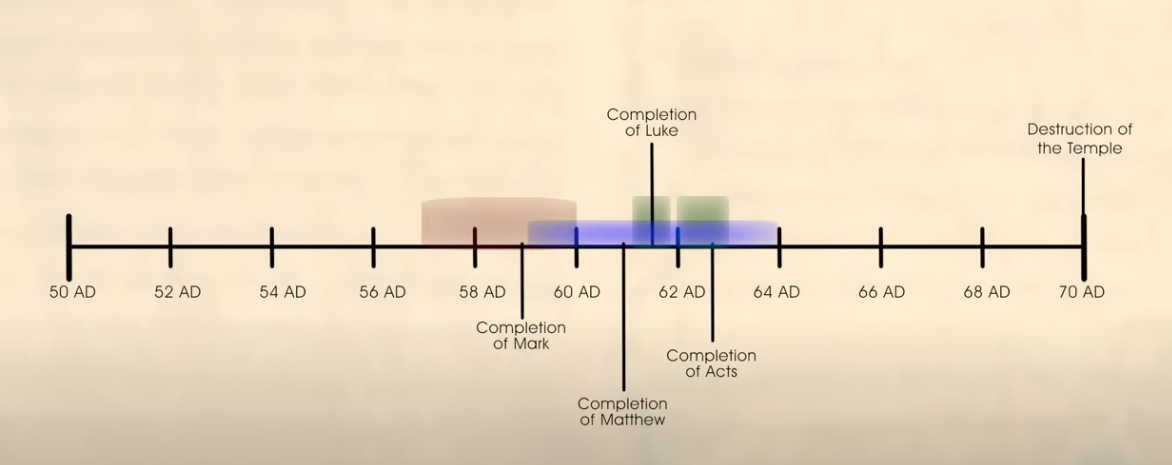
"The timeline for Acts necessitates a first-century dating for the Gospels, particularly Luke and its precursor, Mark."
Dating The Gospels In Light Of Evidence
Matthew
The Gospel of Matthew is often dated earlier than 70 A.D. due to its focus on Jewish customs and its lack of reference to the destruction of the Temple.
- Dating The Gospel Of Matthew
Matthew's detailed emphasis on Jesus as the fulfillment of Jewish prophecy aligns with an audience of Jewish Christians still connected to Temple practices. - Evidence Shows Matthew's Authorship
Mark
The Gospel of Mark is considered the earliest Gospel due to its brevity and lack of theological development seen in later texts.
- Dating The Gospel Of Mark
Mark’s association with Peter as a key source lends credibility to its early composition, capturing eyewitness accounts shortly after the events. - Evidence Shows Mark's Authorship
Luke and Acts
Several factors suggest earlier authorship For the 3rd Gospel:
The biggest factor for dating Luke early is the dating of the Book of Acts:
With Acts Show To be Early, The Gospel of Luke and the book of Acts show us that Luke is to most probable author
John
The Gospel of John’s later date reflects its distinct theological focus and its audience of a broader, Hellenistic world.
- Dating The Gospel Of John
Despite its later date, internal evidence supports John's authorship, likely reflecting an older eyewitness reflecting on events decades after they occurred. - Evidence Shows John's Authorship
Table Of Gospel Dates
Who Wrote The Gospels?
A modern myth is that the Gospels were Anonymous, and that we can not know who wrote them. However the Gospels have been validated and accepted as credible accounts of the life and teachings of Jesus Christ.
Short Answer, Matthew, Mark, Luke and John!
Internal Evidence For Authorship
The Writing Style Matches The Named Disciples
The internal writing have always supported the Matthew, Mark, Luke/Acts and John have been written by the named individuals.
External Evidence
Early Church Tradition
This validation comes from early Church figures, who confirmed the authenticity of these Gospels and their conveyed message of salvation. In addition to the manuscript evidence, the writings of early church fathers provide a further testament to the reliability of the Gospels. Figures like Ignatius, Polycarp, and Irenaeus quoted extensively from the Gospels in their own writings, often within a few decades of their composition. These references not only affirm the existence of the Gospels but also indicate that they were recognized and accepted as authoritative texts in the early church.
The Gospels Trace Back To The Apostles Themselves
There is evidence that the Gospels trace their origins directly to the apostles or their close associates though Papias and Polycarp. These two primary sources provide compelling evidence that traces the Gospels' origins directly back to the apostles, particularly the Apostle John. Papias of Hierapolis, writing in the early 2nd century, offers a direct link to the apostolic circle. His testimony, preserved by Eusebius, affirms the apostolic authorship of the Gospels of Matthew and John. Papias' account is further corroborated by Polycarp, a prominent early Christian bishop of Smyrna, who was a direct disciple of the Apostle John. Irenaeus, also highlights this connection. Both Papias and Polycarp's testimonies reinforce the authenticity of the Gospels as direct reflections of the apostles' teachings.The close association between the apostles and the authors of the Gospels lends strong credibility to the claim that these texts reflect the authentic teachings and events of Jesus' life.
Authenticity through Embarrassing Details
The criterion of embarrassment suggests that details potentially uncomfortable or disadvantageous to the early Christian movement would be unlikely to be fabricated. The Gospels include instances such as Peter’s denial of Jesus, the disciples’ frequent misunderstandings, and the women as the first witnesses to the Resurrection—at a time when women’s testimonies were culturally undervalued. These accounts add credibility to the narrative, as it’s improbable that the Gospel authors would invent details that could undermine their message. Such inclusions point toward a commitment to historical accuracy over embellishment.
The Disciples Accurately Remembered The Words Of Jesus
Coming Soon
Memory in Ancient Culture
Reliable Oral Tradition
Jesus Taught In Easy To Remember Sayings
Historical Evidence
We Have The Original Authenticated Texts
One of the strongest arguments for the authenticity of the Gospels lies in the sheer volume of manuscript evidence. Thousands of Greek manuscripts, along with translations in various languages, provide a robust framework for textual criticism. For instance, the New Testament boasts over 5,800 Greek manuscripts, with some dating back to within a century of the original writings. In comparison, other ancient texts, like those of Homer, survive in far fewer copies and with much later dates.
Textual critics have examined these manuscripts for variations, which are often minor and involve spelling, word order, or synonyms. Importantly, no substantial doctrinal changes arise from these variants. In fact, scholars like Bart Ehrman acknowledge that while there are differences among the manuscripts, "the vast majority of the changes are minor and do not affect the meaning of the text."
Over 99% of the New Testament text remains faithful to the original words of the first Christians.
The Gospels Match Naming Patterns Of The Time
Historical Accuracy of Names in the New Testament
The names found in the New Testament, particularly in the Gospels and Acts, closely align with name frequencies from 1st-century Palestine, strengthening their historical credibility. The most common male names, like Simon and Joseph, mirror the period’s naming conventions. Rare names also match in rarity, and Greek names are proportionately represented. This alignment indicates that the texts reflect true naming trends of the time.
Jesus Original Sayings Are Preserved
The 4 Gospels Match The Beliefs Of The First Christians
Multiple Attestation Of The Gospels
Subtle Agreements Supporting Gospel Reliability
In Christian apologetics, Undesigned Coincidences refer to subtle, incidental agreements between different accounts in the Gospels and other historical records, providing additional evidence for their authenticity. These coincidences occur when one Gospel describes a detail that another Gospel indirectly corroborates, showing a deeper narrative coherence across the texts. Examples include how Mark recounts Herod’s feast and the descriptions by Josephus align, suggesting common traditions within Herod’s family that are based in history.
Additional examples, like matching place names, local customs, and tax records, further reveal these unplanned harmonies between Gospel accounts and historical sources. These subtle interconnections imply that Gospel authors drew from authentic events and oral traditions, rather than fabrication.
Prophecy Validates The Gospels
Ancient Prophecies Foretelling the Messiah
Many passages in the Hebrew Scriptures foretell the coming of a Savior, and the Gospels present Jesus as the fulfillment of these ancient prophecies. For example, Isaiah 53 speaks of a suffering servant who would bear the sins of many, a description that matches closely with Jesus' crucifixion (Isaiah 53:3-5, Matthew 27:27-31). Micah 5:2 predicts that the Messiah would be born in Bethlehem, a prophecy confirmed in the Nativity accounts of Matthew and Luke (Matthew 2:1-6, Luke 2:4-7). Additionally, prophecies like the promise of a descendant of David (2 Samuel 7:12-16) and the role of the Messiah as a king bringing peace (Zechariah 9:9) align with the portrayal of Jesus in the Gospels. These predictions, written centuries before the New Testament texts, offer compelling evidence that the coming of the Messiah was part of a divine plan, fulfilled in the life, death, and resurrection of Jesus.
Predictive Accuracy in the Gospels
In the Gospels, Jesus is recorded predicting the destruction of Jerusalem, which occurred in 70 AD. Jesus foretold this event decades prior, describing specific details of the city’s downfall that would later be confirmed by historical accounts. For instance, in the Olivet Discourse, Jesus warns of a time when not “one stone will be left on another” regarding the Temple’s destruction, emphasizing both the city’s devastation and suffering for its inhabitants (Mark 13:1-2, Matthew 24:1-2, Luke 21:6).
First-century historians, including Josephus, later described how Roman forces under Titus besieged Jerusalem, leveled the Temple, and decimated the city, aligning with the prophecy Jesus gave. This remarkable fulfillment is seen by many as evidence of Jesus’ prophetic insight, highlighting both the reliability of the Gospels and their rootedness in real historical events.