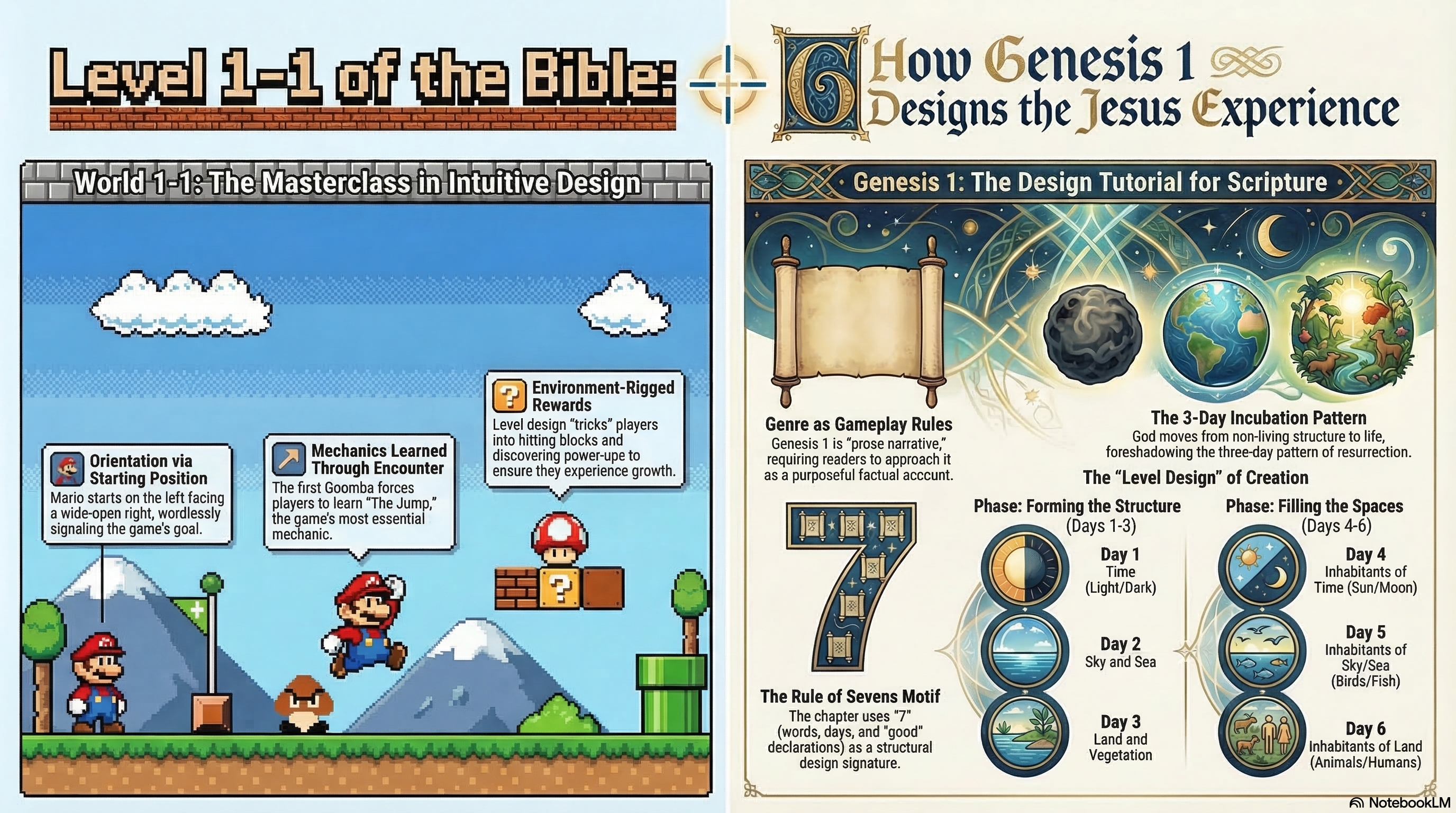
From Genesis to Revelation, the Bible is an interconnected story of Jesus past, present, and future. Like the best-designed games, the Bible teaches its world, lore, and gameplay through mechanics built into the text. God is the ultimate Game Designer. Nothing in Scripture is random; every story, command, and prophecy is part of this Jesus experience. **Good games and good stories are both well-designed, and learning to recognize intentional design in games can help us spot God’s intentional design in Scripture.
Think back to the first time you played a video game, maybe Super Mario Bros. on the NES. Did you have to read a 50-page manual to know that you shouldn't touch the brown mushroom with angry eyebrows? Probably not. You learned by doing.
Today, we're going to look at how the world's most famous video game level, World 1-1, can actually teach us how to read the world's most famous book, starting with Genesis 1. Even if you haven't played it in decades, you probably remember its layout: the question blocks, the first Goomba, the mushroom, the pit. It sticks because it's a masterclass in design. Without a word of explanation, the level teaches you the game's rules movement, obstacles, rewards, and progression. Every element is placed intention ally to guide you without breaking immersion.
Group Discussion:
- When starting a new game, book, or hobby, what makes a "good" introduction?
- What is one game or hobby you learned just by 'jumping in' rather than reading instructions?
Super Mario Bros 1-1
In 1985 the first level Super Mario Bros. introduced a majority of players not only to Mario for the first time, but video games as a whole. Therefore, the introductory levels serve a dual purpose of both educating the player on how to play a video game for the first time as well as retaining players continued interest. Achieving this duality is a core design principle of Nintendo, and can be seen even in their most recent titles.
Because of this the first level of the original Super Mario Bros., known as World 1-1, is often cited by game designers as a masterclass in communication. It manages to teach players how to move, jump, handle enemies, and use power-ups without a single line of tutorial text.
Nintendo designer Shigeru Miyamoto didn't use text boxes. He used Design Principles. Let’s look at three ways he teaches us how to play without saying a word."
1. Moving Right
- Despite the fact that Mario spends most of his time in the center of the screen, the designers made a deliberate choice to start Mario elsewhere.. Mario starts on the left, facing right, with a huge open space. The game tells you immediately: Your goal is to move right..
- Also notice the hill in the background. It teaches you what is the "background' vs. 'playable space.' Mario colors also stick out to reinforce this as well. Just look at the bricks, they are a repeating pattern tokeep you from being distracted by the foreground as well.
- Nothing is moving, nothing is apparently threatening. This static screen gives the player some time to mess around with the controls and get used to them.
2. Enemies and Jumping
- As the player moves right, the first thing we see is a question mark, bright and flashing so we can't miss it. You can approach it at your own pace, so you do. But just as you get close, something else appears.
- A moving object with angry eyes comes toward you. You know it's a enemies because it's the first thing you have encountered that is also moving. You can't pass without jumping, and if you don't the game makes you start over. The design forces you to learn the most important mechanic of the game: The Jump.
- Hitting the top of bricks after the Goomba usually comes first by accident - leading to the bouncy ‘doop’ sound and vertical animation implying their interactivity with little-Mario’s head.
Group Discussion:
What would have happened if any of these design elements were missing from the first level?
Genesis 1
!Pasted image 20260401102941.png
Now that we've seen how Nintendo taught players through world design, let’s see how the Bible introduces readers to God's world in Genesis 1. Just like level 1-1, Genesis 1 isn’t just an origin story—it’s a design tutorial for the Bible and your studies.
Just like the very first second of Mario summarized what we will be doing for the rest of the level, and setting our expectations. Genesis is going to do this for us as well. The first line is going summarize what's going to happen in the following narrative. just like 1-1 was built to teach gameplay, Genesis 1 is built to teach us how to read the Bible and understand God's creation pattern.”
1 In the beginning God created the heavens and the earth.
and verse two will introduce us to a problem.
2 The earth was formless and void, and darkness was over the surface of the deep, and the Spirit of God was moving over the surface of the waters.
When you read your Bible it's important to remember context. Remember that there were real-life circumstances that gave rise to the Bible's narrative books and poetry, the Gospels and the letters. You wouldn’t play a puzzle game expecting fast reflexes, and you shouldn’t read Genesis like poetry. Just like each game genre follows different gameplay rules, each part of the Bible follows different literary rules.
Going back to our video game example. At the time the NES controller had four nondirectional buttons to explore and, as a designer, we already know the player's already used the directionals, it was totally reasonable to expect the players to experiment with them without the need for explicit instructions. The Bible also expects you to have a general understanding of what you are reading.
Group Discussion:
When we played Mario 1-1, what genre of game were we playing?
Does anyone know the genre of Genesis?
Genesis 1 is written as a structured historical narrative or prose narrative, Genesis belongs to the same broad genre of narrative prose as does 1–2 Samuel and 1–2 Kings. It uses orderly language to describe a sequence of events in time, with a clear beginning and progression. This means readers should approach it as a purposeful account of real events —not poetry, myth, or symbolic allegory (Dealing with the Genre of Genesis and its Opening Chapters).
For example, Exod 14:15–31 is an example of prose narrative, and Exod 15:1–18 is one of poetic song. are both about the crossing of the Red Sea and the defeat of Pharaoh’s army in the sea. They both have the same “content,” loosely speaking. Similarly, Judges 4:12–22 and 5:2–31 both have the same content, the first is prose narrative, and the second is a poetic song. The Gospel of Matthew and Acts 10:37–41 both have as their content the life, death, and resurrection of Christ. But the first is a Gospel and the second is part of a sermon.
How not to read the Bible
Imagine if the video game didn't start with you on the left with time to learn
the controls and the world. What if Mario started you right inside bowser castle. It would be very hard to learn the game, and people might think Mario is just for hardcore gamers.
People do this with the Bible as well.
Since it’s a long book and pastors preach out of different sections each week, we get used to entering and exiting portions of Scripture without considering the context of the books in which they are found, let alone their location in the rest of the Bible’s storyline… But this practice can also reinforce our tendency to read passages in isolation.
Take for example this verse from later in the chapter of Genesis.
26 Then God said, 'Let Us make man in Our image, according to Our likeness; and let them rule over the fish of the sea and over the birds of the sky and over the cattle and over all the earth, and over every creeping thing that creeps on the earth.'
Group Discussion:
How do we know that this verse isn't teaching that God is one of many other gods that made man?
Key
Contextualize the verse within its passage
When we read Genesis 1:26—where God says, ‘Let Us make man in Our image’—we can't just grab that one verse and run with it. When you take verses out of context you can get some weird theology, someone could ignore verse 1 and say a bunch of gods are having a meeting. We’ve got to zoom out and look at the whole chapter. Throughout Genesis 1, it’s clear there’s one Creator speaking, acting, and blessing. God is the only one making everything step by step, day by day. There very next verse says that God alone made Man.
Don’t worry—you don’t have to have everything memorized. Just like how most games come with a tutorial or a guide, most study Bibles include an introduction for each book to help you understand the setting, main characters, and mission objectives just like a game. These intros give you the 'level briefing' before you jump in.
Step 3: Narrative structure
We’ve got our context. We know what we’re reading. When you start with those two steps you’ll avoid a lot of false teachings and confusion.
Now let’s look again at verses 1–2.
In verse 2 it said the Earth/Land was "unordered and uninhabited." And the next line uses a image to say the same thing. "And darkness was on the face of the deep abyss." This is a dark, chaotic ocean, a common way the ancients described the non-reality that preceded creation. A dark, formless ocean… no boundaries, no light, no life. But even in that chaos, God’s “Ruach” is already there. That Hebrew word can mean wind, breath, or spirit. You can’t see it, but He’s present and ready to act. So we’ve got our problem: the world is empty and aimless. But God is hovering, about to bring order and purpose.
That sets the tone! Now we’re ready for what comes next.
Back to the Game
An incredible amount of thought and care went into modulating the player's experience and crafting the learning curve, even in the first two screens! Given the tight limits on resources for an 8-bit game, a lot of clever decisions had to be made to make this game appeal to a generation completely unfamiliar with games.
Powerups
Immediately after the first enemy comes the first encounter with the power-up system. The player, being intrigued by the question mark and all the flashing, usually hits this question block, releasing a mushroom.
The mushroom does a few interesting things.
- It moves right, usually following the player. This gives the player plenty of time to watch this new entity and learn how it moves. It also moves slowly away across the screen to invite chase.
- it moves above the player and then drops down. This teaches the player about how other objects are affected by gravity, unlike the block it originally came from.
- As an extension, it bounces off the green pipe, showing how mushrooms interact with other solid objects while virtually ensuring that the player will get it.
- Even if the player decides that, based on what they've experienced so far, that mushroom-shaped objects are generally bad, and tries to jump over it, the natural path to try and jump over the mushroom puts the player on a direct collision course with the blocks above Mario.
- The angle which the player would use to jump over it causes them to be knocked right down into the mushroom. While still allowing the player complete autonomy. The designer wants you to get big. He rigs the environment so you experience the "Power-up" even if you're afraid of it.
We can approach Scripture with this game designer mindset.
Genesis 1 serves a similar function for Scripture, this chapter isn’t just the account of creation; it’s the foundation for the entire biblical story. It introduces God, His character, His power, and His purpose. It sets the patterns and structures that will appear again and again throughout the Bible.
To read Genesis well, we need to approach it with the same awareness we bring to analyzing good design: What is the author showing me? Why is it ordered this way? What patterns am I meant to notice? Verses 3–13 are part of a larger pattern. When you read a bible chapter, it's helpful to see how and why the author is placing things where he does.
Let’s have someone read those out loud. As we listen, I want you to track:
- 🛠️ The structure: How are things organized?
- 🗝️ Key phrases or repetitions: What keeps showing up?
3 Then God said, 'Let there be light'; and there was light. 4 God saw that the light was good; and God separated the light from the darkness. 5 God called the light day, and the darkness He called night. And there was evening and there was morning, one day. 6 Then God said, 'Let there be an expanse in the midst of the waters, and let it separate the waters from the waters.' 7 God made the expanse, and separated the waters which were below the expanse from the waters which were above the expanse; and it was so. 8 God called the expanse heaven. And there was evening and there was morning, a second day. 9 Then God said, 'Let the waters below the heavens be gathered into one place, and let the dry land appear'; and it was so. 10 God called the dry land earth, and the gathering of the waters He called seas; and God saw that it was good. 11 Then God said, 'Let the earth sprout vegetation: plants yielding seed, [and] fruit trees on the earth bearing fruit after their kind with seed in them'; and it was so. 12 The earth brought forth vegetation, plants yielding seed after their kind, and trees bearing fruit with seed in them, after their kind; and God saw that it was good. 13 There was evening and there was morning, a third day.
Group Discussion: Ask the group to look for Repeated Phrases.
🗣️ Repeated Phrases
- Every day begins with “And God said…”- "Let There Be"
- Each day ends with “evening and morning, the ___ day.”
- And after each act, “God saw that it was good.”
- Day 2 is the Only Day God Doesn’t Say is is “Good” I wonder why?
🌍 Three Realms Brought to Order
- Time
- Day and night are separated—that’s the creation of the time cycle.
- Sky and Sea
- God splits the chaos waters, forming the skies above and the seas below.
- Land
- Land emerges from the waters.
Bonus Act with a twist.
Did you notice the pattern break on Day 3? There’s a bonus act: the land is invited to produce vegetation—plants and trees with seeds.
Popular games use this technique all the time. In The Legend of Zelda, dungeon design follows a recognizable formula—map, key, item, boss—but later dungeons refine, challenge, or break that format to surprise the player. Similarly, in New Super Mario Bros. Wii, the game follows the classic pattern: defeat Bowser by dropping him into lava. But just when the player expects the game to end, Peach is revealed to be Kamek in disguise—and a second, unexpected boss fight begins.
Screen 2 and Beyond
In Video games, once you get used to something, the designer likes to introduce you to new challenges and flesh out the game even more. In the Mario level, after the powerup. The next terrifying obstacle the player has to overcome is a set of pipes of increasing height. The increasing height of the pipes requires the player to learn a slightly unintuitive mechanic:
- Mario's jump height is related to how long the player holds the jump button. Again the player cannot advance until they learn this mechanic.
But these pipes have way more to teach. - The movement patterns of the Goombas and how they interact with each other are revealed below the pipes,
- Once the player fails to clear the jump, they're in the pit with the two Goombas where it's possible they'll learn that you receive bonus points for stomping multiple enemies.
- More importantly, these pipes give you a safe space to practice the pit-jumping the player will do later.
Day 4
We saw in Days 1–3 that God created structure—light and dark, sky and sea, land and vegetation. But remember the problem from verse 2? It was unordered and uninhabited. Now God begins filling those ordered spaces with life.
14 Then God said, 'Let there be lights in the expanse of the heavens to separate the day from the night, and let them be for signs and for seasons and for days and years; 15 and let them be for lights in the expanse of the heavens to give light on the earth'; and it was so. 16 God made the two great lights, the greater light to govern the day, and the lesser light to govern the night; [He made] the stars also. 17 God placed them in the expanse of the heavens to give light on the earth, 18 and to govern the day and the night, and to separate the light from the darkness; and God saw that it was good. 19 There was evening and there was morning, a fourth day.
Group Discussion: What is different in how Day 4 works compared to the pattern we saw in days 1-3
- More Details: He creates the sun, moon, and stars to mark days, seasons, and year
- It's related back to day 1, He is filling in everything
- Notice something surprising: plants were created before the sun.
Days 3-6 are going back to the first 3 days and filling them in, expanding them. Keep reading the next days and lets see how it related to the waters above and below
20 Then God said, 'Let the waters teem with swarms of living creatures, and let birds fly above the earth in the open expanse of the heavens.' 21 God created the great sea monsters and every living creature that moves, with which the waters swarmed after their kind, and every winged bird after its kind; and God saw that it was good. 22 God blessed them, saying, 'Be fruitful and multiply, and fill the waters in the seas, and let birds multiply on the earth.' 23 There was evening and there was morning, a fifth day.
God gives His first blessing: “Be fruitful and multiply.” Life is meant to spread and fill these vast domains.
24 Then God said, 'Let the earth bring forth living creatures after their kind: cattle and creeping things and beasts of the earth after their kind'; and it was so. 25 God made the beasts of the earth after their kind, and the cattle after their kind, and everything that creeps on the ground after its kind; and God saw that it was good.
Now we have every realms filled in and the pattern has been holding strong. Do you remember that bonus act of plants and day three? Well now it's time for another bonus act of creation. But this one is different then the rest.
26 Then God said, 'Let Us make man in Our image, according to Our likeness; and let them rule over the fish of the sea and over the birds of the sky and over the cattle and over all the earth, and over every creeping thing that creeps on the earth.' 27 God created man in His own image, in the image of God He created him; male and female He created them. 28 God blessed them; and God said to them, 'Be fruitful and multiply, and fill the earth, and subdue it; and rule over the fish of the sea and over the birds of the sky and over every living thing that moves on the earth.' 29 Then God said, 'Behold, I have given you every plant yielding seed that is on the surface of all the earth, and every tree which has fruit yielding seed; it shall be food for you; 30 and to every beast of the earth and to every bird of the sky and to every thing that moves on the earth which has life, [I have given] every green plant for food'; and it was so. 31 God saw all that He had made, and behold, it was very good. And there was evening and there was morning, the sixth day.
Group Discussion:
What is different about Day six?
Key
- Very Good, better and more valuable then everything else.
- Humans are explicitly made male and female, the animals were not.
- God is talking to someone here, He did not do that before.
- What appears to be collaborative is now singular? Noticed the pronouns in verse 27.
- Another command was given
- Like animals, we are to fill the earth
- However, we are to rule and control it
- All the plants and animals are ours
- Like animals, we are to fill the earth
Here is additional patterns you may or may not have seen in our reading.
- Genesis 1 follows a temple dedication structure
- Humans Are Made Last but Given First Responsibility
- “Let us make man in our image…” — why plural?
- (see Job 1, Psalm 82)
- Word Pairs and Phrases
- “heaven and earth”
- “day and night”
- “male and female”
- “according to their kind”
Day 7
Before we wrap up, let's take a closer look at Day 7, which starts in the next chapter. That might seem like a strange place to end the creation account, but here’s a reminder: chapter divisions aren't inspired—they were added much later to help us study and reference more easily. So always look ahead and behind the chapter you're reading to make sure you’re not missing something. Now, after the six days, we get a concluding line that links back to the keywords of the opening line.
1 Thus the heavens and the earth were completed, and all their hosts. 2 By the seventh day God completed His work which He had done, and He rested on the seventh day from all His work which He had done. 3 Then God blessed the seventh day and sanctified it, because in it He rested from all His work which God had created and made.
Group Discussion:
Why is day 7 in the next chapter, even though it's the end of the creation account. But maybe there’s a reason the division was placed here. Sometimes this is done because there is a natural break in the text or literary section.
What do you guys think, why is this not in chapter one?
*What else is different about day 7
- Very very good
- There is no end
- This day is blessed
- God rested,
This is a standard biblical image where God, after ordering the cosmos, comes to rest and dwell in his sacred space. It's like the whole world is a holy temple where God lives with his people.
Secrets in Video Games
Video games are famous for having secrets, the Bible is also famous for this. In the level there is final pipe and the first pit, where the designers put the game's first two secrets.
- The last pipe in the row allows the player to enter a secret room full of coins, and, really, this is for veteran players to be able to get through the level more quickly and back to a place that challenges them, so it doesn't have much impact on the new player experience.
- The invisible block before the first pit is another story, though. While 95% of new players will never see it, it's placed in such a way that if you're really going to miss your jump and dive right into that pit, you'll find a secret instead!
Group Discussion:
***Did you catch the use of 7’s throughout the passage?.
Key:
- Verse 1 alone uses the number 7 seven times!
- 7 days of creation, 7 announcements that creation is good.
- 7 Hebrew words in the opening verse.
- 2x7 Hebrew words in Verse 2
- . The statement about the seventh day has three lines of 7 words.
- More!
Once you realize the number 7 is a structural motif in Genesis, it changes how you read Scripture. You start seeing it everywhere—woven into sabbath cycles, patterns of forgiveness, lampstands in the temple, seals in Revelation, and the sayings of Jesus. The same thing happens in game design.
Jesus in the Bible
The biggest thing to do when you read the Bible is see how it connects to Jesus, He is everywhere and you will find the Gospel story in every book.
Did you see the 3 day resurrection pattern
- The Genesis account demonstrates God always has a 3-day "incubation" period between no life and life. Creation moves from non-living (light, sky, land) → living (plants, animals). Genesis testifies the period between the lifeless and resurrected body of Jesus would be 3- days. That is to say, just as God waited 3-days between a place with physical life and life in that place, God waited 3-days before that which gives eternal life would emerge from the tomb.
Conclusion
In explaining the philosophy behind the design of the level, Mario creator Miyamoto explained that World 1-1 is a tutorial level with everything needed to help the player “gradually and naturally understand what they’re doing.” He wanted players to quickly “learn what the game is all about” so that they can “start to play more freely." According to the, that’s the approach Nintendo tries to take with all of its games, because “once the player realizes they need to do, it becomes their game.”
Once you learn this kind of design language, you start spotting it in other games and even in film and television.
If you haven't played through at least the first few levels of Super Mario Bros. You definitely should make the time. It's also worth a quick trip down memory lane even if you have played it. and you will see it so much differently looking at it now as a designer rather than simply playing it like your first time through. You'll be surprised how much fundamental game design knowledge displayed here is still used today.
Try breaking down the rest of Level 1-1 as an exercise for yourself.
- Why are these two pyramidlike objects here?
- What's the purpose of these four Goombas right in a row?
Sources
Design Club - Super Mario Bros: Level 1-1 - How Super Mario Mastered Level Design
https://www.logos.com/grow/hall-firmament/