As a quick reminder, we aren't going deep into the signs and symbols yet because we are doing an overview of the full book before we continue.
Passages
D1 (8:2–11:19) [Third Septet] Seven Trumpets
Intro (8:2-8:6)
D2 (15:2–16:17) [Fifth Septet] Seven Bowls of Wrath Containing the Seven Plagues
Intro (15:2-16:1)
Just as the Seven Seals and Seven Condemnations parallel each other as the beginning and end of God’s covenant lawsuit, the Seven Trumpets and the Seven Bowls form another matching structural pair.
In Revelation chapter 7, we saw the seals being open, and when the 7th seal is opens with "silence in heaven for about half an hour", let's learn about why all the court is silent.
Establishing the Location
We will look at the contents and effects of the trumpets and the bowls next week. This week is just about framing them. Before a single trumpet sounds, John slows down to show us a very specific scene.
2 And I saw the seven angels who stood before God, and seven trumpets were given to them.
- The angels are standing directly before --God-- .
5 After these things I looked, and the sanctuary of the tabernacle of the testimony in the heaven was opened.
- John is looking at the --temple/sanctuary-- in heaven.
The Old Testament shows us a layout of this sanctuary and how it follows a three-tiered structure—the Common Space, the Holy Place, and the Most Holy Place.
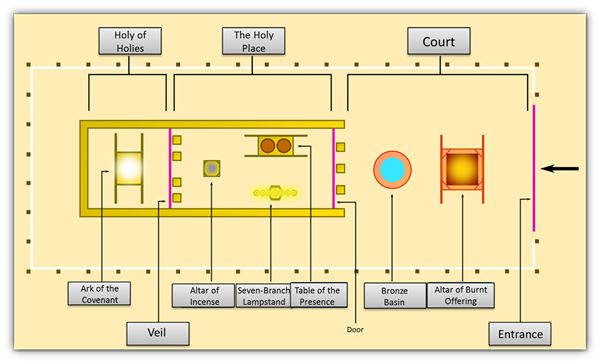
The Trumpet's Intro
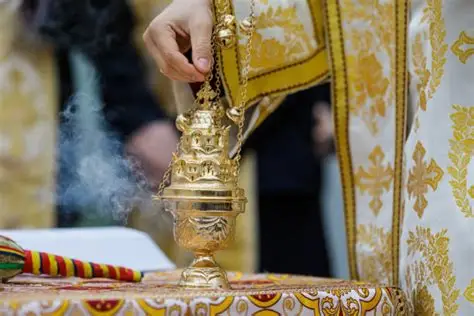
3 And another angel came and stood at the altar, having a golden censer. He was given lots of incense so that he could offer it with the prayers of all the saints upon the golden altar that is before the throne.
- John sees a --golden censer-- and an --altar-- that was sitting right --before the throne.--
1 “You shall make an altar to burn incense on; you shall make it of acacia wood. 2 A cubit shall be its length and a cubit its width—it shall be square—and two cubits shall be its height. Its horns shall be of one piece with it. 3 And you shall overlay its top, its sides all around, and its horns with pure gold; and you shall make for it a molding of gold all around. 4 Two gold rings you shall make for it, under the molding on both its sides. You shall place them on its two sides, and they will be holders for the poles with which to bear it. 5 You shall make the poles of acacia wood, and overlay them with gold. 6 And you shall put it before the veil that is before the ark of the Testimony, before the mercy seat that is over the Testimony, where I will meet with you.
- The golden altar of incense sits in the Holy Place, right before the --veil--.
The Smoke Of Incense
4 And the smoke of the incense with the prayers of the saints went up before God out of the angel’s hand.
- The --smoke-- of incense contains the --prayers-- of the saints.
“Let my prayer be set before You as incense, The lifting up of my hands as the evening sacrifice.”
- David also links the incense to --prayer-- as part of the --evening sacrifice--.
According to Jewish historians like Edersheim, exactly half an hour was the amount of time it took the High Priest to prepare the incense in the earthly temple. Music and sacrifice occurred outside at the bronze altar, but during that time the assembly outside fell into prayerful silence.
Discussion Question "When we consider the context above, why might the Angels in heaven be silent?
The Altar And Coals
12 Then he shall take a censer full of burning coals of fire from the altar before the LORD, with his hands full of sweet incense beaten fine, and bring it inside the veil. 13 And he shall put the incense on the fire before the LORD, that the cloud of incense may cover the mercy seat that is on the Testimony, lest he die.
On the Day of Atonement, the high priest takes a --censer-- full of burning coals from the --altar-- and brings incense before the Lord.
23 And Moses and Aaron went into the tabernacle of meeting, and came out and blessed the people. Then the glory of the LORD appeared to all the people, 24 and fire came out from before the LORD and consumed the burnt offering and the fat on the altar. When all the people saw it, they shouted and fell on their faces.
37 Hear me, O LORD, hear me, that this people may know that You are the LORD God, and that You have turned their hearts back to You again.” 38 Then the fire of the LORD fell and consumed the burnt sacrifice, and the wood and the stones and the dust, and it licked up the water that was in the trench. 39 Now when all the people saw it, they fell on their faces; and they said, “The LORD, He is God! The LORD, He is God!”
- When God appeared, the burnt offering took the --fire--.
1 Then Nadab and Abihu, the sons of Aaron, each took his censer and put fire in it, put incense on it, and offered profane fire before the LORD, which He had not commanded them. 2 So fire went out from the LORD and devoured them, and they died before the LORD.
- When Nadab and Abihu profaned God, His fire --devoured-- them.
God’s ḥerem principle of destruction
24 Then the LORD rained brimstone and fire on Sodom and Gomorrah, from the LORD out of the heavens.
- Sodom and Gomorrah were judged by --fire from heaven--
2 Then He spoke to the man clothed with linen, and said, “Go in among the wheels, under the cherub, fill your hands with coals of fire from among the cherubim, and scatter them over the city.” And he went in as I watched.
5 Then the angel took the censer, filled it with fire from the altar, and threw it at the land. And there were noises and thunders and lightnings and an earthquake.
- In Ezekiel's account of God's Judgement, the coals are scattered over the --city--, which tells of the destruction of Jerusalem.
- In John's account, the fire is cast down from the altar directly onto the --land--.
God’s ḥerem (meaning ban) principle of destruction was intended to be lit from the altar. In the Old Testament, certain cities could be placed under ḥerem meaning they were devoted over to total destruction as an act of covenant judgment (Num. 21:1–3; Josh. 6:15–19; Judg. 1:17). Unlike regular old-covenant warfare (where you take spoil, cattle, and land), the ḥerem warfare is where everything is burned and belongs exclusively to God. Jericho is the clearest example: it was treated as a city claimed by God in judgment. Jericho was ḥerem because it was the firstfruits of the land.
Ezekiel 10 applies that same principle to Jerusalem. In Ezekiel’s vision, coals of fire are taken from the throne and scattered over the city, showing that Jerusalem’s destruction would come frome heaven itself.
The holy fire that once brought mercy to Israel is now falling as the retributive fire of Sodom.
Discussion Question: What determines whether God’s holy fire brings atonement or judgement?
Thunder Lightning, Earthquake, and Trumpet
“And there were noises, thunderings, lightnings, and an earthquake.”
This language is also familiar:
16 Then it came to pass on the third day, in the morning, that there were thunderings and lightnings, and a thick cloud on the mountain; and the sound of the trumpet was very loud, so that all the people who were in the camp trembled. 17 And Moses brought the people out of the camp to meet with God, and they stood at the foot of the mountain. 18 Now Mount Sinai was completely in smoke, because the LORD descended upon it in fire. Its smoke ascended like the smoke of a furnace, and the whole mountain quaked greatly. 19 And when the blast of the trumpet sounded long and became louder and louder, Moses spoke, and God answered him by voice.
- This is the same language as what happened on Mount --Sinai--.
The Bowls intro
Now compare that to the introduction of the Bowls. Again, John does not begin by immediately pouring out the first bowl. He gives us another sanctuary scene first. But this time the details are different:
5 After these things I looked, and the sanctuary of the tabernacle of the testimony in the heaven was opened.
- If John is seeing the inner temple open, he must be standing --outside-- of it.
The Sea of Glass Mingled with Fire
2 And I saw as it were a sea of glass mingled with fire, and those who prevailed over the Beast and over his image and over the number of his name, standing on the glassy sea, having harps of God.
6 and before the throne it was like a sea of glass, similar to crystal.
John had already seen this sea of glass back in Revelation 4; it is the pavement of God's throne room. But why does John bring it up here?
Because of who else saw it:
9 Then Moses went up, also Aaron, Nadab, and Abihu, and seventy of the elders of Israel, 10 and they saw the God of Israel. And there was under His feet as it were a paved work of sapphire stone, and it was like the very heavens in its clarity.
When you look closely at both texts, both prophets highlight the unearthly transparency.
- Moses calls it sapphire (crystal?), but specifically adds that it is "like the very heavens in its clarity" (Exodus 24:10).
- John calls it a sea of glass, specifically noting it is "similar to crystal" (Revelation 4:6).
Moses and John are looking at the exact same floor under God's throne
and trying to describe a brilliantly clear, crystalline, shining floor.
Life on earth can be compared to sand; shifting, unstable, and when things go wrong, it acts as a constant irritant. But what happens when you subject sand to intense fire or heat? You get very useful, durable, and beautiful glass.
- The fire represents the intense heat of the persecutions and trials these believers just went through. But the fire did not destroy them. The "sand" of their earthly suffering has been permanently transformed by the fire into eternal glory.
- And the fact that they are standing on the glass means that they have joined Christ in God's throne room.
The Sea and the Song of Moses
3 They sing the song of Moses, the slave of God, and the song of the Lamb, saying: “Great and marvelous are Your works, O Lord God, the Almighty! Just and true are Your ways, O King of the nations! 4 Who could not fear You, O Lord, and glorify Your name? Because You alone are holy; because all the nations will come and do obeisance before You, because Your righteous judgments have been manifested.”
John also explicitly names the Song of --Moses--
27 And Moses stretched out his hand over the sea; and when the morning appeared, the sea returned to its full depth, while the Egyptians were fleeing into it. So the LORD overthrew the Egyptians in the midst of the sea. 28 Then the waters returned and covered the chariots, the horsemen, and all the army of Pharaoh that came into the sea after them. Not so much as one of them remained. 29 But the children of Israel had walked on dry land in the midst of the sea, and the waters were a wall to them on their right hand and on their left.
- Israel has just crossed the --sea--.
1 Then Moses and the children of Israel sang this song to the LORD, and spoke, saying: “I will sing to the LORD, For He has triumphed gloriously! The horse and its rider He has thrown into the sea! 2 The LORD is my strength and song, And He has become my salvation; He is my God, and I will praise Him; My father’s God, and I will exalt Him.
- This is the song Israel sang watching God destroy --Egypt--.
9 All nations whom You have made Shall come and worship before You, O Lord, And shall glorify Your name. 10 For You are great, and do wondrous things; You alone are God.
7 Who would not fear You, O King of the nations? For this is Your rightful due. For among all the wise men of the nations, And in all their kingdoms, There is none like You.
2 The works of the LORD are great, Studied by all who have pleasure in them.
This is a song about God’s works, righteousness, Kingship over the nations, and the certainty that the nations will eventually fear and worship Him.
While the song is in mind, the direct reference in revelation is not this song.
28 Gather to me all the elders of your tribes, and your officers, that I may speak these words in their hearing and call heaven and earth to witness against them. 29 For I know that after my death you will become utterly corrupt, and turn aside from the way which I have commanded you. And evil will befall you in the latter days, because you will do evil in the sight of the LORD, to provoke Him to anger through the work of your hands.” 30 Then Moses spoke in the hearing of all the assembly of Israel the words of this song until they were ended:
- Moses speaks and teaches another song that functions as a covenant --witness-- against Israel’s future rebellion.
3 They sing the song of Moses, the slave of God, and the song of the Lamb, saying:
- The song of Moses is likened to the song of the --Lamb--
Just as the Israelites stood safely on the shores of the Red Sea after watching Egypt get destroyed, the true Church is safely standing on the heavenly sea of glass watching the new Egypt get destroyed.
The Tabernacle of the Testimony Opened
Then John says something extremely important:
5 After these things I looked, and the sanctuary of the tabernacle of the testimony in the heaven was opened. 6 And out from that heaven came the seven angels, the ones having the seven plagues; they were clothed in pure bright linen and were girded around the chests with golden belts. 7 Then one of the four living beings gave the seven angels seven golden bowls filled with the fury of God, the One who lives forever and ever. 8 The sanctuary was filled with smoke from the glory of God and from His power, and no one was able to go into the sanctuary until the seven angels’ plagues were completed.
- In English it is often translated from Hebrew as the “tabernacle of meeting.” However, when the Jews translated the Hebrew into Greek, they didn't write "meeting." They explicitly used the legal word martyrion (μαρτύριον), which translates directly to testimony or witness.
- Throughout the Pentateuch, the Greek Old Testament uses this phrase over 130 times to describe the specific tent housing the Ark. This is where we get our word martyr. A martyr isn't just someone who dies; legally, a martyr is a witness who gives an unyielding testimony in court.
Let's find out why:
16 And you shall put into the ark the Testimony which I will give you.
The ark contains the --Testimony--
- The First tablet (God): How to love God
- The Second tablet (Man): How to love man
18 And when He had made an end of speaking with him on Mount Sinai, He gave Moses two tablets of the Testimony, tablets of stone, written with the finger of God.
- The "Testimony" refers explicitly to the two stone tablets of the --Ten Commandments-- that is later stored inside the Ark of the Covenant. So the Tabernacle is literally the "Tent of the --Ten Commandments--"
53 but the Levites shall camp around the tabernacle of the Testimony, that there may be no wrath on the congregation of the children of Israel; and the Levites shall keep charge of the tabernacle of the Testimony.”
- The Levites camped around this structure to keep --wrath-- away from the congregation.
Discussion Question: While Moses was up on Mount Sinai receiving the original Ten Commandments, what was Israel doing down below?
The Original Rebellion at Sinai
Israel was already breaking the covenant before Moses even came down the mountain. While God was giving the Testimony, Israel was worshiping the golden calf (Exod. 32). When Moses came down and saw the rebellion, he threw the tablets from his hands and shattered them at the foot of the mountain (Exod. 32:19). The covenant had been broken almost as soon as it was given.
Then judgment followed. Moses burned the calf, scattered it on the water, made Israel drink it, and the Levites struck down the guilty in the camp (Exod. 32:20, 26–28). Only after that rebellion and judgment do we get covenant renewal. In Exodus 34, God tells Moses to cut two new tablets like the first, and the Lord writes the words of the covenant on them again. Those tablets become the Testimony that is placed inside the ark (Exod. 25:16; 31:18; Deut. 10:1–5).
Just like their ancestors at Mount Sinai, Revelation is showing that someone has broken a covenant. In fact, during the trumpet judgments, Revelation explicitly shows that the rebellious nation broke both tables of the law:
- The First Table (God): They refused to repent of worshipping demons and idols, which Revelation 9:20 perfectly describes as "the --works of their hands--" (just like the golden calf!).
- The Second Table (Man): Revelation 9:21 says they refused to repent of their --murders--, their sorceries, their sexual immorality, and their thefts.
The Temple Filled with Smoke
34 Then the cloud covered the tabernacle of meeting, and the glory of the LORD filled the tabernacle. 35 And Moses was not able to enter the tabernacle of meeting, because the cloud rested above it, and the glory of the LORD filled the tabernacle.
10 And it came to pass, when the priests came out of the holy place, that the cloud filled the house of the LORD, 11 so that the priests could not continue ministering because of the cloud; for the glory of the LORD filled the house of the LORD.
In both cases, God’s glory fills the sanctuary so powerfully that entry is --blocked--.
5 After these things I looked, and the sanctuary of the tabernacle of the testimony in the heaven was opened. 6 And out from that heaven came the seven angels, the ones having the seven plagues; they were clothed in pure bright linen and were girded around the chests with golden belts. 7 Then one of the four living beings gave the seven angels seven golden bowls filled with the fury of God, the One who lives forever and ever. 8 The sanctuary was filled with smoke from the glory of God and from His power, and no one was able to go into the sanctuary until the seven angels’ plagues were completed.
The entire purpose of the priesthood was to go into the sanctuary to offer incense (prayers) and sprinkle blood to make atonement, which kept God's wrath away from the people.
Discussion Question:: "What does it mean if no one can enter the temple?
- --There are no more prayers being accepted on behalf of the rebellious nation, and God's longsuffering has reached its limit.--
Putting the Two Introductions Together
John frames them through the sanctuary so we can see who cries out, what covenant has been broken, and from where the judgment proceeds. God proves that His actions are perfectly just by answering 2 questions:
1. WHO asks for the judgment? In Revelation 8, the angel offers incense with the prayers of the saints, and then fire from the altar is cast to the earth. The cries of God’s people rise before God, and the Trumpets begin only after those prayers have ascended into His presence.
2. WHY does God judge? In Revelation 15, John sees the Tabernacle of the Testimony opened. The bowls of wrath are introduced in the context of a broken covenant.
Ending Question: When you stand before God, will you be recognized as a faithful witness, or will God's Law witness against you?