The Holiday of Christmas has always been Christian in origin, see Christmas Is Not Pagan for more on this.
There have many attempts to date the birth of Christ, see The Date Of December 25th Is Unique. We may never confirm the data with 100% accuracy, but there is one theory first put forth by Martin that seems to be a plausible date for the birth of Christ. It is based of a passage in Revelations, and centers around the dating of Stars, Jewish holidays, traditions surrounding Noah and the Messiah as well as new data on the dating of King Herod in the Bible.
And a great sign appeared in heaven: a woman clothed with the sun, with the moon under her feet, and on her head a crown of twelve stars. 2. She was pregnant and was crying out in birth pains and the agony of giving birth. 3. And another sign appeared in heaven: behold, a great red dragon, with seven heads and ten horns, and on his heads seven diadems. 4. His tail swept down a third of the stars of heaven and cast them to the earth. And the dragon stood before the woman who was about to give birth, so that when she bore her child he might devour it. 5. She gave birth to a male child, one who is to rule all the nations with a rod of iron, but her child was caught up to God and to his throne, 6. and the woman fled into the wilderness, where she has a place prepared by God, in which she is to be nourished for 1,260 days. 7. Now war arose in heaven, Michael and his angels fighting against the dragon. And the dragon and his angels fought back, 8. but he was defeated, and there was no longer any place for them in heaven. 9. And the great dragon was thrown down, that ancient serpent, who is called the devil and Satan, the deceiver of the whole world — he was thrown down to the earth, and his angels were thrown down with him. 10. And I heard a loud voice in heaven, saying, “Now the salvation and the power and the kingdom of our God and the authority of his Christ have come, for the accuser of our brothers has been thrown down, who accuses them day and night before our God. 11. And they have conquered him by the blood of the Lamb and by the word of their testimony, for they loved not their lives even unto death. 12. Therefore, rejoice, O heavens and you who dwell in them! But woe to you, O earth and sea, for the devil has come down to you in great wrath, because he knows that his time is short!” 13. And when the dragon saw that he had been thrown down to the earth, he pursued the woman who had given birth to the male child. 14. But the woman was given the two wings of the great eagle so that she might fly from the serpent into the wilderness, to the place where she is to be nourished for a time, and times, and half a time. 15. The serpent poured water like a river out of his mouth after the woman, to sweep her away with a flood. 16. But the earth came to the help of the woman, and the earth opened its mouth and swallowed the river that the dragon had poured from his mouth. 17. Then the dragon became furious with the woman and went off to make war on the rest of her offspring, on those who keep the commandments of God and hold to the testimony of Jesus. And he stood on the sand of the sea.
This is not a study on Revelation 12, there is much context that is needed to understand the passage (See Bible Studies/Revelation/Revelation 12 - The Woman and The Dragon). Rather this will focus on the taking the Signs as astrology and using them in conjunction with the Star Of Christmas. John says "I looked up at the heavens and saw...", this may be an example of astronomical prophecy, lets take a deeper dive.
What Are, The Sun, Moon And Stars Representing?
Virgo as the Woman Clothed with the Sun:
In astrology, there is specific star constellation called Virgo, this is only sign of a woman which exists along the ecliptic (the track of the Sun in its journey through the stars). She occupies, in body form, a space of about 50 degrees along the ecliptic. The head of the woman actually bridges some 10 degrees into the previous sign of Leo and her feet overlap about 10 degrees into the following sign of Libra, the Scales. Virgo is depicted as a woman holding a sheaf of wheat or grain, which can symbolize fertility and motherhood. The imagery of the woman "clothed with the sun" indicates that the position of the Sun in the vision was located somewhere mid-bodied to the woman, between the neck and the knees (about 150 and 170 degrees along the ecliptic). The sun is known to transition this area between August 23 and September 22 on average ([Britannica])(https://www.britannica.com/place/Virgo).
While the sun is in the woman, the moon is at her feet. For this specific arrangement to happen, the constellation representing the woman must be located along the ecliptic. The ecliptic is an imaginary line in the sky that marks the path the sun and the moon take as they move through the different zodiac constellations. So the moon has to be below the constellation of the woman while the sun is in the midst of the constellation. The moon is at the feet of Virgo about once a month around September. It was a new moon, symbolically birthed at the feet of The Virgin.
Twelve Stars:
The twelve stars that form her crown symbolize the twelve tribes of Israel.
Leo: The constellation Leo is directly above Virgo’s head, containing 9 bright stars. Through the first half of the month of September, there are 3 planets (Mars, Venus, Mercury) aligned with the constellation Leo, bringing the number of bright “stars” above the head of Virgo to 12. This connection is weak without further support
This may be a reference to Jupiter in the womb of Virgo. Throughout late August and most of September, the planet Jupiter is lined up with the abdomen of Virgo. Jupiter was understood by the ancients to be the king of the planets, thus ruler is seen in the belly of Virgo. Jupiter is aligned with Virgo about once every 11-12 years, spending over a month in the “belly” (depending on where you think her abdomen is).
The Great Red Dragon
The imagery of the dragon is used throughout the OT to represent evil kingdoms that persecute God’s people, and this is in mind here. The fact that the Dragon’s tail sweeps (present tense) away a third of the stars of the sky further points to a location generally lacking in stars compared to other sky locations. The color red locates it in the southern sky
There are two potential constellations for the "red Dragon" in Revelation 12
Hydra (Proposed by Franz Boll): Hydra is described as a sea serpent, resonating with the imagery of the beast that emerges from the sea in Revelation 13:1 and parallels the Old Testament leviathan (Isaiah 27:1). Corax (Raven) and Crater (Cup) are both located above Hydra and may add symbolic detail to its identification as the dragon. Corax contains seven stars, which could symbolically represent the "seven heads" of the dragon in Revelation 12:3. Crater has ten stars, potentially corresponding to the dragon's "ten horns" in the same passage. Although Hydra is near the ecliptic (the sun’s path through the sky), it is slightly below the position of Virgo (the "woman" in Revelation 12). Thus, it’s near the child but not directly "under the feet" of the woman, which could still fit John's vision since the text doesn’t specify precise positioning.
Scorpio (Proposed by Lehmann-Nitsche): Scorpio was originally larger, covering what are now the modern constellations of both Scorpio and Libra. In ancient star charts, it was depicted as a massive figure, which fits the concept of a powerful and expansive "dragon" figure. In ancient astronomy, Scorpio's reach included "claws" (now Libra) extending its form, making it even more imposing and dragon-like. Scorpio is on the ecliptic, potentially placing it directly under Virgo, which aligns with the imagery of a dragon "standing before the woman" as described in Revelation 12. While Scorpio might be more accurately positioned, it does not have the seven heads.
The Dragon/Chaos Monster Thoughout The Bible
evelation 12:3The imagery of the dragon is used throughout the OT to represent evil kingdoms that persecute God’s people, and this is in mind here. “Dragon” (drakōn) is another word in the OT for the sea monster that symbolizes wicked kingdoms that oppress Israel [MH: the Leviathan/chaos image]. Often the wicked kingdom of Egypt is portrayed by this emblem. God is spoken of as defeating Pharaoh as a sea dragon at the exodus deliverance and at later points in Egypt’s history (Ps. 74:13–14; 89:10; Isa. 30:7; 51:9; Ezek. 29:3; 32:2–3; Hab. 3:8–15; Pss. Sol. 2:29– 30; see Ps. 87:4, where “Rahab” is a synonym for Egypt [MH: Rahab is one of thewords in Psalm 89 for the chaos monster]; cf. Jer. 51:34, where Babylon is the subject [MH: in the same context]; see also Amos 9:3)…
It's a reference to the birth and the ascension. This description is an allusion to Psalm 2:7-9, which prophesied that the Messiah would defeat God's enemies and be installed as ruler over all the nations. The Psalm allusion is coupled with a description of an ascent of the child up to God and his throne. In short, John’s wording here and the immediate context is designed to create the impression that it appeared as if the devil had won the day. The dragon is right there waiting Naked Bible Podcast Episode 138: What Day Was Jesus Born? 14 to kill the child when it's born. The child is going to be killed and devoured—but the resurrection (and of course, the ascension—the ultimate return to the right hand of God) resulted in victory for the Messiah, the child. The dragon was therefore defeated. So John is combining all these elements in just the space of a few verses. We're very clear who the child is. Now the third figure—the dragon. Scholars of the book of Revelation have long noted the connection of the dragon to Old Testament terminology for the sea monster that symbolized chaos. Again, this is very well-known. I even have a motion graphic video on my website and my YouTube channel about the chaos theme of the sea monster. This is Old Testament 101. As Grant Osborne notes in his commentary on Revelation: Throughout the ancient Near East, the sea monster symbolized the war between good and evil, between the gods and chaos. . . Obviously, in similar fashion to the meaning of “abyss” in 9:1–2, this builds on the fact that for the nations surrounding the Mediterranean basin, the sea meant unfathomable depths and the chaos of death. Thus, Leviathan or the “dragon” came to represent all the terrors of the sea and thus the presence of evil and death. . . . [I]t also signified nations that stood against God and his people. This is because the nations become agents of chaos, agents of destruction, agents of destroying the order God wants (which, of course, includes this thing called Israel and the Messiah) because he wants to restore Eden. This is wellknown imagery. There are two major candidates for the dragon with respect to constellations. Malina (again, in his book on Revelation) explains it this way: The second sign is the fire-colored Dragon. The color red locates it in the southern sky. . . The fact that the Dragon’s tail sweeps (present tense) away a third of the stars of the sky further points to a location generally lacking in stars compared to other sky locations. This, again, is the south, in the region of the Abyss [MH: which is another constellation]. . . The question we might pose now is, which constellation does John label as the red Dragon, the Dragon in the south? Obviously it is not Draco, which is found at the North Pole. Boll [MH: Franz Boll, another author] opts for Hydra. . . Immediately above Hydra and accompanying it are the constellations of Corax (Raven) and Crater, which have seven and ten stars respectively. Corax with seven, corresponding to the number of heads [in Rev 12] lies closer to Virgo. . . On the other hand, Lehmann-Nitsche [MH: another author] argues that the prototypical Dragon of the sky is really ancient Scorpio, originally a larger set of stars than the present constellation. It was truly gigantic, even by celestial zodiac standards, since it originally consisted of two [modern] 45:00 Naked Bible Podcast Episode 138: What Day Was Jesus Born? 15 zodiacal signs (Libra/Claws and Scorpio). [MH: Libra would form the claws of Scorpio in the ancient world.] You have two options... just some opinion of my own. Hydra has the advantage of matching the description of the seven heads atop the dragon (Revelation 12:3). It's also conceived of as a sea serpent (imagery that matches descriptions from Revelation, like 13:1 that tells of the beast that emerges from the sea, which in turn come from leviathan material of the Old Testament like Isaiah 27:1). However, Hydra is not precisely on the ecliptic, so we have to ask ourselves if that matters. It's adjacent to the ecliptic and only slightly below the woman. In other words, Hydra is not positioned directly under the feet of the woman waiting to devour the child as soon as it emerges from the woman, but it's close. The ecliptic problem is resolved if we opt for Scorpio as John's reference point. But that said, the text of Revelation 12 only has the dragon present ("it stood before the woman"). It doesn't really say it has to be directly under the feet. So both options are sort of workable and possible. Pick the one that you like. I have a bit of a disagreement here with my astronomer friend. He might win me over, who knows. But anyway, you've got two options there.
How To Read Signs In The Bible
It is important to remember that these signs are symbolic in nature and John is showing us a larger narrative at play. These signs are The are passages from the Bible that show starts can be signs and are used to mark times and seasons (Genesis 1:14, Psalm 104:19).In the Book of Job, Chapter 9, Job credits God with creation of the stars and constellations: He is the Maker of the Bear [Ursa Major] and Orion, the Pleiades and the constellations of the south. And in Job Chapter 38, God makes much the same point. He, not man, is sovereign over the creation, particularly the constellations: 31 “Can you bind the beautiful Pleiades? Can you loose the cords of Orion? 32 Can you bring forth the constellations in their seasons… Many other Biblical writers in many other passages state that God arranged the stars. For example, says the Book of Isaiah in Chapter 40: Lift your eyes and look to the heavens: Who created all these? He who brings out the starry host one by one, and calls them each by name. Because of his great power and mighty strength, not one of them is missing. Paul references the Old Testament (Psalm 19:4) to discuss signs in the stars and the birth of the King in Romans 10:18
The heavens declare the glory of God, and the sky above proclaims his handiwork. 2. Day to day pours out speech, and night to night reveals knowledge. 3. There is no speech, nor are there words, whose voice is not heard. 4. Their voice goes out through all the earth, and their words to the end of the world. In them he has set a tent for the sun,
There are a number of terms in those first four verses thatconvey the idea that the heavens communicate information:
"The heavens declare; the sky proclaims."
The cycle of days and nights "pours out speech" and "reveals knowledge."
The heavens have a voice and speech and words that can be heard since their message "goes out through all the earth." In verse 4, the original Hebrew text uses the word line, which can also mean a measuring line or path. This likely refers to the ecliptic—the path the sun takes across the sky each day. By quoting this Psalm, Paul may be suggesting that the celestial "message" in the stars was intended to be a universal sign—visible to all people, pointing to the arrival of the Messiah.
Dating The Birth Of Jesus
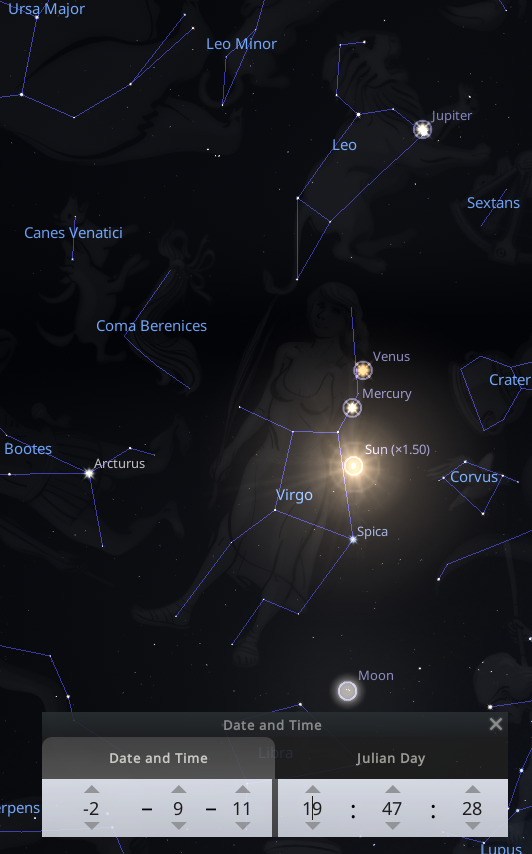
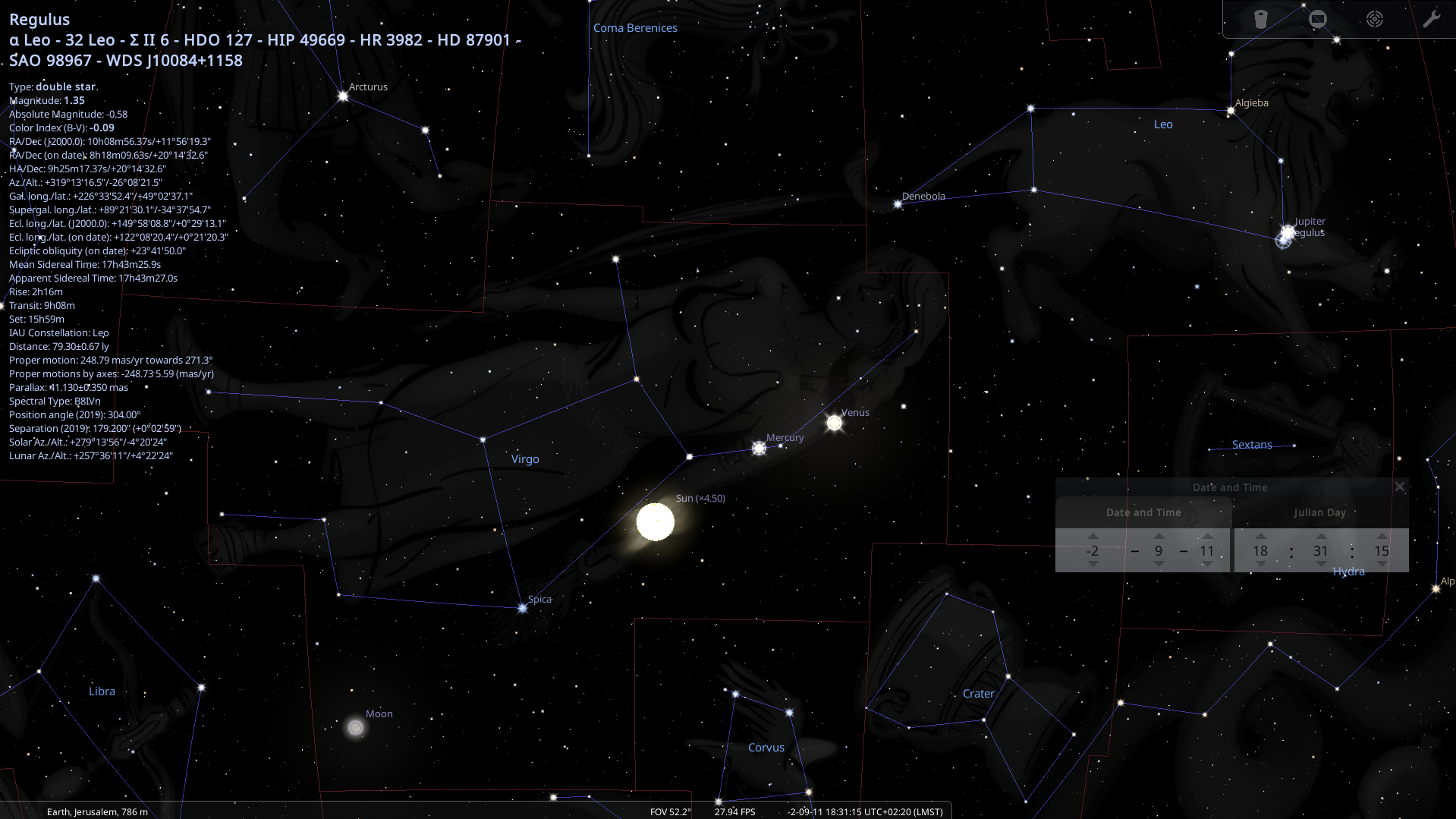
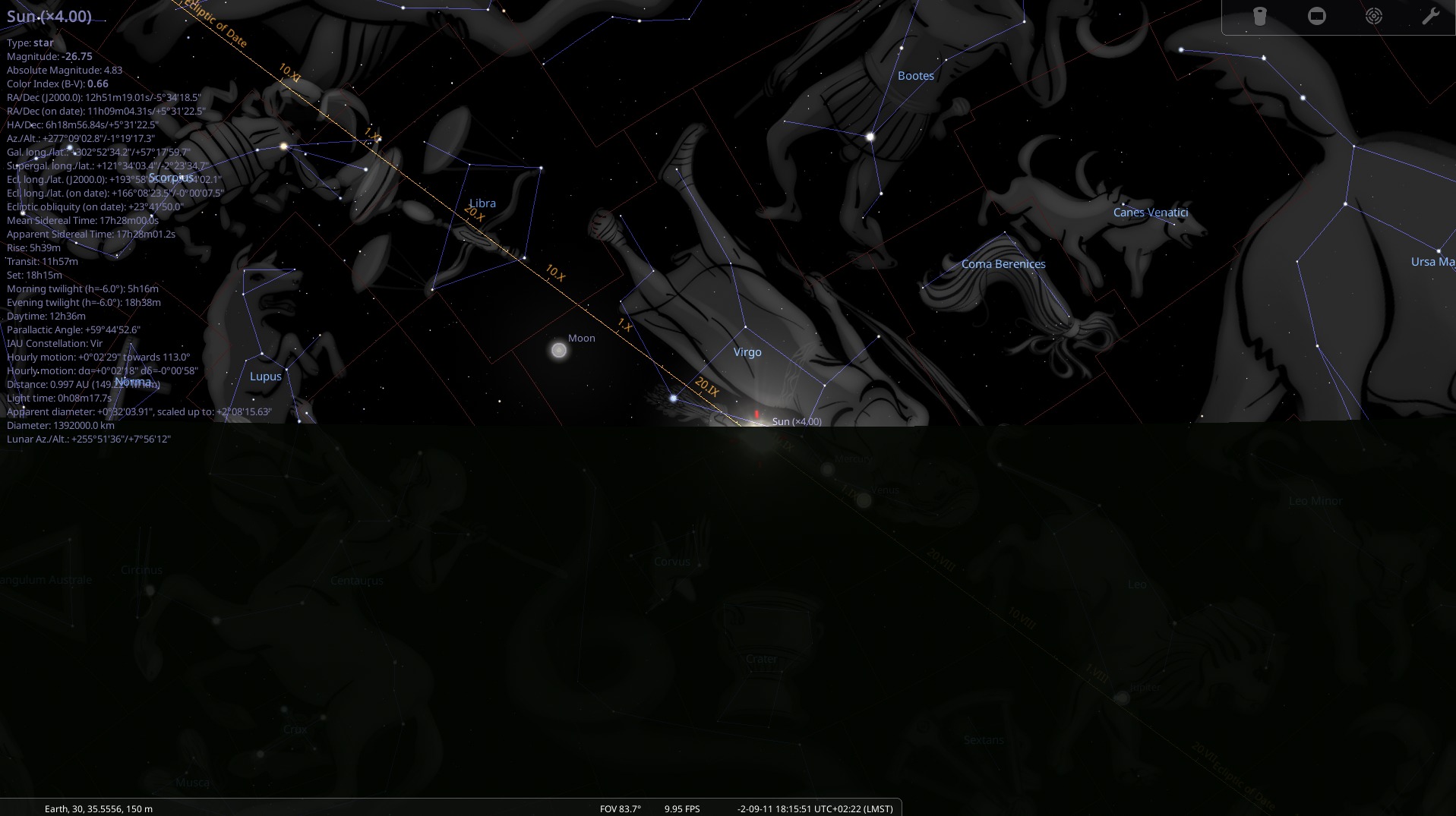
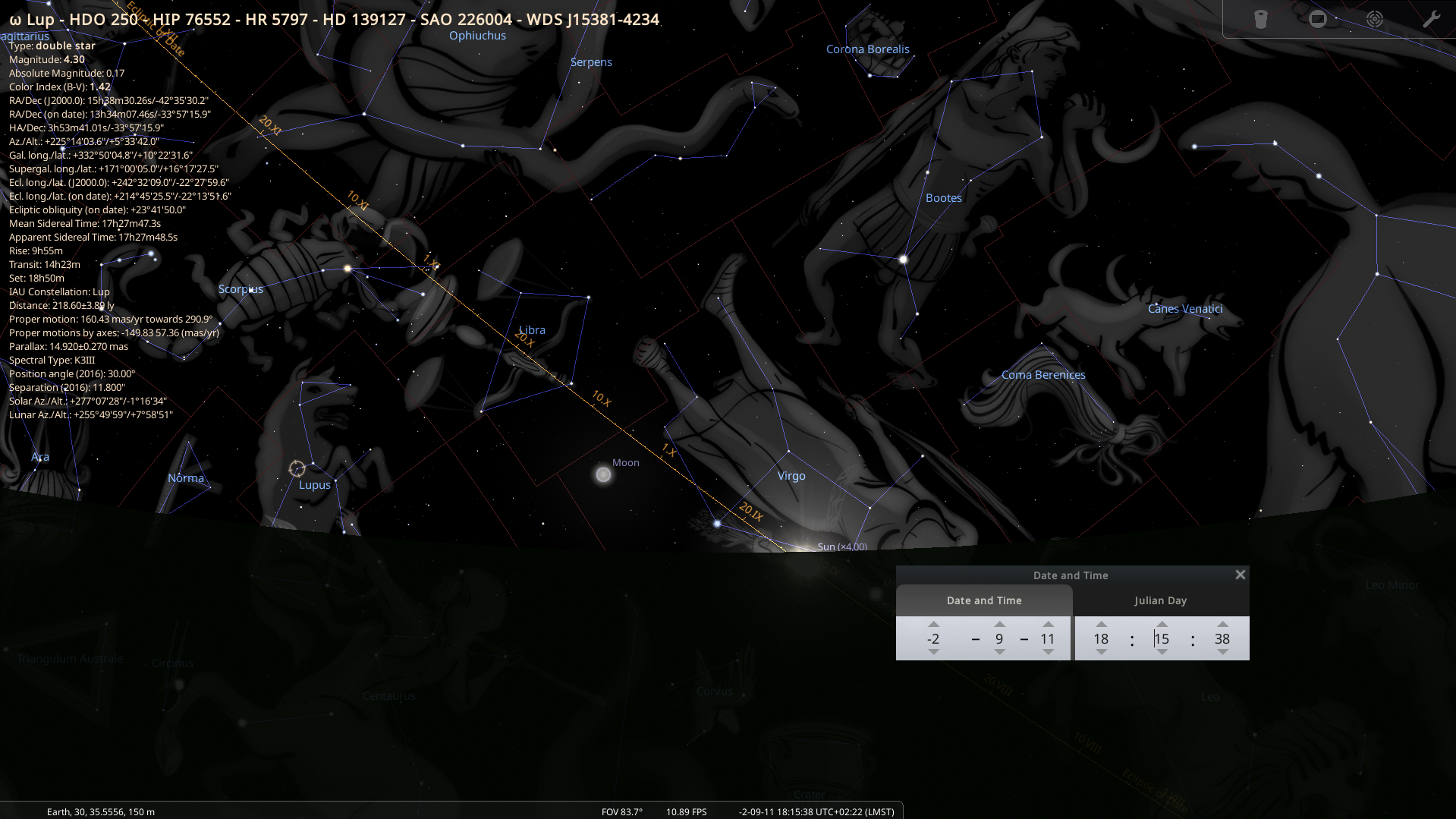
Putting these signs into a astrometry program can help us find what day they may be referring to. Scholars Mike Heiser and Ernest Martin have proposed that the date of September 11, 3 B.C. is the day that the sun and moon are in the correct positions from about 6:15 p.m. (sunset), to around 6:55 p.m. (moonset). Even one day before ― on September 10 ― the Moon would have been located above the Virgin’s feet with the crescent not visible, while one day farther ― on September 12 ― the Moon had moved too far beyond the feet of the Virgin. Only one day applies. That day was just after sunset on September 11th, 3 B.C..
. . . [T]he apostle John saw the scene when the Sun was “clothing” or “adorning” the woman. This surely indicates that the position of the Sun in the vision was located somewhere mid-bodied to the woman, between the neck and the knees. The Sun could hardly be said to clothe her if it were situated in her face or near her feet. The only time in the year that the Sun could be in a position to “clothe” the celestial woman called Virgo (that is, to be mid-bodied to her, in the region where a pregnant woman carries a child) is when the Sun is located between about 150 and 170 degrees along the ecliptic. This “clothing” of the woman by the Sun occurs for a 20-day period each year. This 20 degree spread could indicate the general time when Jesus was born.
Pictures
Note: The date -2 is 3BC in Stellariam.
Was Jesus Born On Tishri 1 (September 11, 3 B.C.)?
New Testament scholar Greg Beale notes the the astronomical reconstruction of the circumstances of Revelation 12:1-7 that produces a September, 3 B.C, date for the birth of the Messiah was also the beginning of the Jewish new year in 3 B.C. (@Rodkinson2018-qf). Tishri 1, also known as Rosh Ha-shanah, Tishri 1, the Day/Feast of the Trumpets, was also the day that many of the ancient kings and rulers of Judah reckoned as their inauguration day. This procedure was followed consistently in the time of Solomon (1 Kings 6:1, 37), Jeremiah, and Ezra (Rosh Hashanah 10b-11a) and sources suggest that the patriarchs Abraham, Jacob, and Isaac and even the prophet Samuel were all born on Tishri 1. According to Jewish tradition, Tishri 1 is also the day that marked the beginning of Israel’s freedom from Egyptian slavery when labor ceased as they awaited Moses’ leadership after the 10 plagues (@Scherman1986-ka).
[A] trumpet was to be blown on Tishri 1, which in the rabbinic period came to be viewed as the beginning of the New Year. God’s eschatological judgment of all people was expected to fall on this day. . . The New Year trumpet also proclaimed hope in the ongoing and ultimate kingship of God, in God’s judgment and reward according to people’s deeds, and in Israel’s final restoration.
Genesis 8:13 shows us that this was the same Day that Noah came out of the ark on Tishri 1 was also his birthday. If September 11 3 B.C. is the birthday of Jesus, this would mean he shares a birthday with Noah. To many Jews, they would have believed that the Messiah and Noah shared a birthday as the Messiah would be like Noah and bring ultimate judgment
This info also lines up with The Death Of Herod that is present in the birth account
Could This Be The Sign Of The Magi?
The Magi, or wise men from the East, would have been well-positioned to recognize the astronomical signs heralding the birth of the Messiah, largely due to their exposure to Jewish teachings and prophetic texts during their time in Babylon and Persia. Historically, these regions housed significant Jewish populations following the Babylonian exile, leading to a cultural exchange that included the study of Hebrew Scriptures. For instance, the Book of Daniel, in which Daniel served as a high official, contained prophecies and wisdom that would have influenced the Magi’s understanding of celestial events as indicators of divine significance (Daniel 2:48; Daniel 5:11).
The Star Of Christmas
In the Gospel of Matthew, we read about Maji from the east that see the Star that points to the birth of the newborn king.
Now after Jesus was born in Bethlehem of Judea in the days of Herod the king, behold, wise men from the east came to Jerusalem, 2. saying, “Where is he who has been born king of the Jews? For we saw his star when it rose and have come to worship him.” 3. When Herod the king heard this, he was troubled, and all Jerusalem with him; 4. and assembling all the chief priests and scribes of the people, he inquired of them where the Christ was to be born. 5. They told him, “In Bethlehem of Judea, for so it is written by the prophet: 6. “‘And you, O Bethlehem, in the land of Judah, are by no means least among the rulers of Judah; for from you shall come a ruler who will shepherd my people Israel.’” 7. Then Herod summoned the wise men secretly and ascertained from them what time the star had appeared. 8. And he sent them to Bethlehem, saying, “Go and search diligently for the child, and when you have found him, bring me word, that I too may come and worship him.” 9. After listening to the king, they went on their way. And behold, the star that they had seen when it rose went before them until it came to rest over the place where the child was.
The word used in verse 2 and 9 is the same word that can be used for constellations, comments and other star phenomenon (@Whiton2018-ce). Do a study on this chapter you can find out some points that any sign or star has to meet to be the sign of the Maji:
It signified birth.
It signified kingship.
It had a connection with the Jewish nation.
It rose in the east, like other stars.
It appeared at a precise time.
Herod didn’t know when it appeared.
It endured over time.
It was ahead of the Magi as they went south from Jerusalem to Bethlehem.
It stopped over Bethlehem.
Many theory over the years have been proposed to figure out what it could be, in hopes it may lead to the day Christ was born. Based on the passage above, it can not be a comet, Supernova, or supernatural star as it doesn't meet the above criteria. There is one star that does seem to match the account that Matthew gives- Jupiter.
More Context For The Star Of The Messiah
Before we go into the Star that the Magi saw, it is important to get some additional context from the Bible. For millennia the coming Messiah has been associated with the appearance of a star. One of the first references to a star showing the arrival of the Messiah is the words prophesied over Israel by the pagan sorcerer, Balaam, while we were encamped in the wilderness.
17. I see him, but not now; I behold him, but not near: a star shall come out of Jacob, and a scepter shall rise out of Israel; it shall crush the forehead of Moab and break down all the sons of Sheth.
This passage has been used though history to show that a literal star will be associated with the Messiah, such in the recordings of the Dead Sea Scrolls (@Vermes2004-tj).
Quote
The star is the Interpreter of the Law ... as it is written, ‘A star has left Jacob, a staff has risen from Israel.’”6
Rabbi Akiva gave the name “Bar Kochba” to a rebel military leader named Shimon ben Kosiba, and then proclaimed him to be the Messiah (@Astor2010-lw). Similar sentiments are also recorded by Philo, the Peshitta, Targums Neofiti, Onkelos, Pseudo-Jonathan, and the Fragmentary Targum, as well as the testimonies of both Judah and Levi in The Testament of the Twelve Patriarchs.
Perhaps the most fascinating reference to this phenomenon is in the post-rabbinic midrash Aggadat HaMashiach:
Quote
It is taught in the name of our Sages [that]... a star will emerge in the east. This is the star of the Messiah.... A star shall appear from the east and on top of it a rod of fire like a spear. The Gentile nations will claim “this star is ours,” but it is not so; rather, it pertains to Israel, as Scripture forecasts: “a star shall step forth from Jacob..." 9 10
The Jewish nation is composed of twelve ancient tribes. Jewish prophecy states that a particular tribe will bring forth the Messiah: the tribe of Judah. The symbol of Judah’s tribe is the lion. You can see these connections in an ancient prediction of Messiah’s coming found in the first book of the Bible, the Book of Genesis, Chapter 49:
Genesis, Chapter 49
9 You are a lion’s cub, O Judah; you return from the prey, my son. Like a lion he crouches and lies down, like a lioness– who dares to rouse him? 10 The sceptre will not depart from Judah, nor the ruler’s staff from between his feet, until he comes to whom it belongs and the obedience of the nations is his.
The lion/king association is confirmed in Revelation 5:5
5. And one of the elders said to me, “Weep no more; behold, the Lion of the tribe of Judah, the Root of David, has conquered, so that he can open the scroll and its seven seals.”
Jupiter, the Star Of Bethlehem
Starting from the day given in Revelation 12 you will see that there is a number of astronomical sign that seem to match the account in Matthew—namely Jupiter in its retrograde motion. It circles the Sun far beyond Earth, in an orbit of about twelve years duration. In ancient times, planets like Jupiter were considered “wandering stars”. Near opposition, Jupiter will appear to go into retrograde motion for a period of about 121 days, moving backward through an angle of 9.9° before returning to prograde movement.[139]
Planet
Synodic Period (days)
Synodic Period (mean months)
Days in Retrogradation
Jupiter
399
13.1
121
Jupiter’s movements in 3–2 BC present a strong case for it being the Star of the Magi, fulfilling all the key signs the Magi sought. Here’s how Jupiter meets each of the criteria detailed in Matthew's account:
Signified Birth: around September 11 3 B.C., a sequence of Jupiter’s movements began, coinciding with the Jewish New Year, Rosh ha-Shanah—a day associated with new beginnings and divine judgment. For the magi, the triple conjunction between Jupiter (the “King Planet”) and Regulus (the “King Star”) in the constellation Leo would have indicated the birth of a royal figure. The significance of Regulus cannot be overstated; known as the “King Star,” it was associated with rulership and kingship in multiple ancient cultures. The Babylonians called Regulus Sharu, which means ‘king.’ The Romans called Regulus Rex, which means ‘king.’ Positioned in Leo, the constellation representing the tribe of Judah, this alignment would have been a clear sign pointing to a Jewish king. It was the chief or head sign of the zodiac and had special importance in astrological circles (@Hastings2000-wp).
Signified Kingship: Jupiter’s conjunction with Regulus wasn’t a singular event but occurred three times over several months due to Jupiter’s retrograde motion. Starting September 14, 3 BC, Jupiter met with Regulus, creating a "crown" effect. As Jupiter moved forward and then retrograde, it returned to align with Regulus on February 17, 2 BC, and once more on May 8, 2 BC. This triple conjunction would have appeared as Jupiter “crowning” Regulus three times, underscoring the kingly symbolism. In Hebrew, Jupiter was also called Sedeq, meaning “righteousness,” a term associated with the Messiah. For the magi, these movements were powerful signs of divine authority and kingship linked specifically to a Jewish Messiah.
Connection with the Jewish Nation: Leo, the constellation of the lion, represented the tribe of Judah in Hebrew tradition, and prophecy pointed to a ruler from Judah. This connection would not have been lost on the Magi. They would have seen Jupiter and Regulus’ repeated alignments in Leo as an astronomical signal tied directly to Israel. They recognized that these celestial events were pointing to the fulfillment of Jewish Messianic prophecies, making the events specifically meaningful as a signal of a Jewish king’s birth.
Rising in the East: As Jupiter rose in the eastern sky, it met the description from Matthew’s account: the star that the magi “saw in the east.” Ancient magi interpreted the position of stars and planets as meaningful indicators, and it oriented the magi toward Jerusalem and signaled the start of their journey westward, following the “star.”
Appeared at a Precise Time: The timing of these conjunctions—especially between Jupiter and Regulus—would have been observable and precise, fitting the description of a star that appeared at specific, identifiable times as intentional signs, not random celestial phenomena.. This pattern allowed the magi to track Jupiter’s journey over time.
Unnoticed by Herod: Herod and others in Jerusalem, unfamiliar with the symbolic meanings and celestial patterns, were unaware of the conjunctions until the Magi explained them.
Endured Over Time: The retrograde motion of Jupiter around Regulus spanned several months, providing a lengthy timeframe for the magi to journey from the East to Jerusalem. By the time they arrived, the series of conjunctions was still in progress, ensuring that they could follow Jupiter’s motion as a guide during their trip. The timing allowed for a realistic journey, with the Magi able to observe the celestial signs both at their point of origin and as they approached their destination.
Guided the Magi South from Jerusalem: By the time the Magi reached Jerusalem, Jupiter had moved in a way that, from their perspective, would have appeared to lead them southward toward Bethlehem, where Jesus was born.
Stopped Over Bethlehem: Jupiter’s retrograde motion created a stationary effect in the sky on December 25, 2 BC. From Earth’s perspective, Jupiter appeared to “stop” over Bethlehem for several days. This phenomenon, known as the “stationary point” in retrograde motion, gave the appearance that the star had come to rest over the town, guiding the Magi to their destination.
In fulfilling each of these criteria, Jupiter stands out as a plausible and meaningful candidate for the Star of the Magi, merging astrological significance, cultural symbolism, and observable astronomy into the momentous event described in Matthew.
See the table here for more information.
Date
Celestial Event
Constellation
Significance
Conjunction Sequence
Additional Notes
Observation Direction
August 12, 3 B.C.
First conjunction of Jupiter (King Planet) and Venus (Fertility Planet)
Leo
Jupiter and Venus unite as a "morning star" Represents union of "King Planet" and "Mother Planet"
Conjunction 1
Occurs in Leo, the "Lion of Judah," symbolizing Israel
East
September 11, 3 B.C
The Sun and Moon are in Virgo
Virgo
Revelation 12 matches this day. the beginning of the Jewish New Year, traditionally regarded as the anniversary of Noah’s landing after the Great Flood. See The Star Of Jesus - The Day That Jesus Was Born
---
This is the potential birth day of Christ, when all the Stars of Revelation 12 are aligned.
September 14, 3 B.C.
First conjunction of Jupiter (King Planet) with Regulus (King Star)
Leo
The "royal planet" meets the "royal star" in the "royal constellation" Regulus, the brightest star in Leo, aligns with Jupiter, representing kingship and authority
Triple Conjunction 1/3
Regulus, the brightest star in Leo, aligns with Jupiter, representing kingship and authority
East
December 1, 3 B.C.
Jupiter begins retrograde movement
Leo
Starts its journey back toward Regulus
---
Retrograde motion creates repeated alignments with Regulus
February 17, 2 B.C.
Second conjunction of Jupiter (King Planet) with Regulus (King Star)
Leo
Strengthens the "crowning" effect with a second alignment
Triple Conjunction 2/3
Continued "crowning" over Regulus in Leo, Occurs about nine months after the initial Venus conjunction, similar to the length of human pregnancy
West
May 8, 2 B.C.
Third conjunction of Jupiter (King Planet) with Regulus (King Star)
Leo
Completes “crown” effect with final conjunction, symbolizing kingship over Israel
Triple Conjunction 3/3
Creates a circling effect over Regulus, emphasizing kingly symbolism over Judah
West
June 1, 2 B.C.
Ongoing retrograde movement of Jupiter (King Planet) around Regulus (King Star)
Leo
Retrograde pattern completes
---
Retrograde motion observed advancing calendar every 3 days; completes its movement around Regulus
June 17, 2 B.C.
Second conjunction of Jupiter (King Planet) and Venus (Fertility Planet)
Leo
Another close union of King Planet and Fertility Planet
Conjuction 2
reunion almost 10 months later
August 26, 2 B.C.
Conjunction of Jupiter (King Planet), Mars,and Mercury
Leo
Conjunction 3
December 25, 2 B.C.
Jupiter becomes stationary over Bethlehem
Virgo
Aligns with winter solstice, where Jupiter appears to "stand still" over Bethlehem in Virgo
---
Magi viewing from Jerusalem would have seen it stopped in the sky above the little town of Bethlehem. This was 6 months after the last conjunction such alignments are not uncommon
West
This research has made use of the Stellarium planetarium
Zotti, G., Hoffmann, S. M., Wolf, A., Chéreau, F., & Chéreau, G. (2021). The Simulated Sky: Stellarium for Cultural Astronomy Research. Journal of Skyscape Archaeology, 6(2), 221–258. DOI: 10.1558/jsa.17822