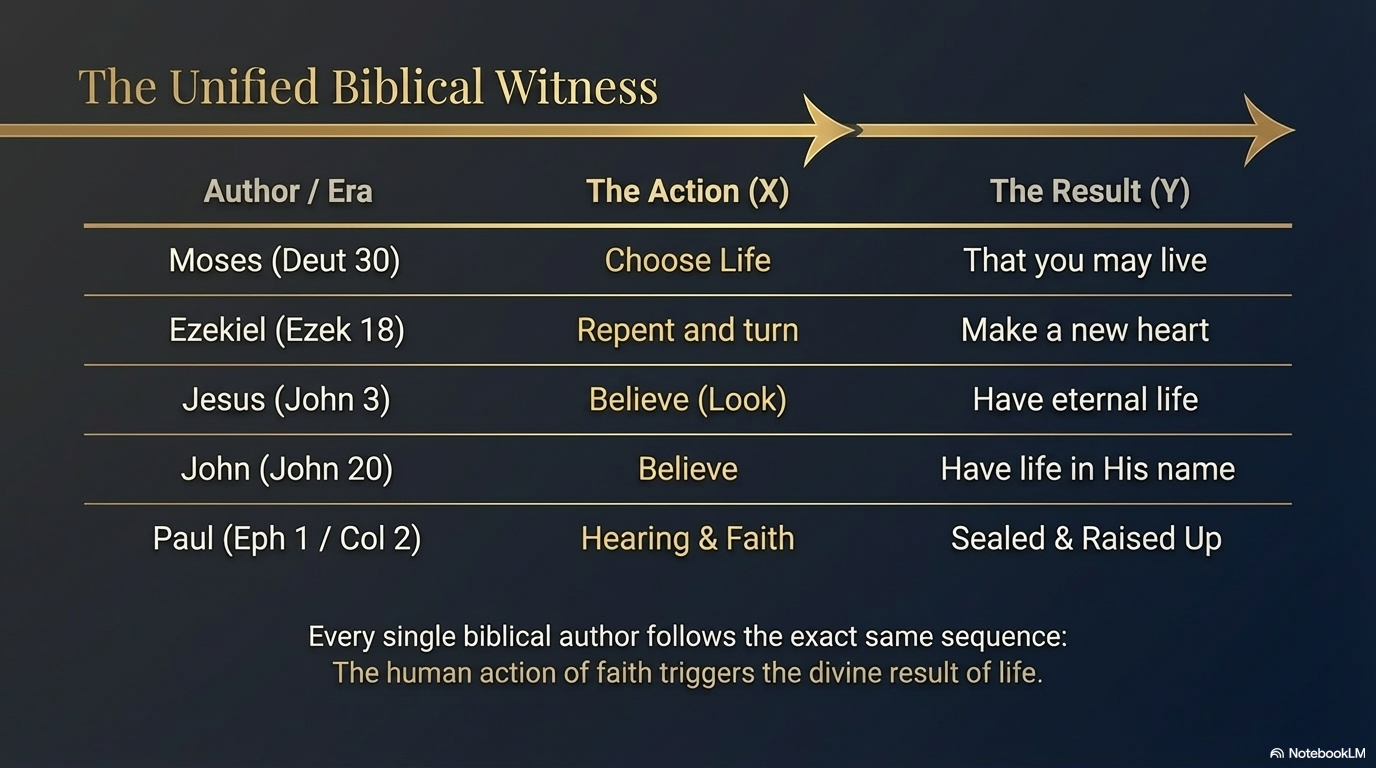
The Scriptures consistently present a specific sequence regarding salvation: A person must first believe the gospel in order to be given new spiritual life (regeneration). After all:
17 So faith [comes] from hearing, and hearing by the word of Christ.
Just three verses prior, in Romans 10:14, the Apostle Paul asks, "How will they believe in Him whom they have not heard?". The obvious answer is that you cannot believe in someone you do not know about. However, the logical implication of Paul's rhetorical question is that if a person does hear the message, they are then fully capable of believing it
To explain the accessibility of the gospel, the Apostle Paul explicitly quotes Moses from Deuteronomy 30:11-14.
11 'For this commandment which I command you today is not too difficult for you, nor is it out of reach. 12 'It is not in heaven, that you should say, 'Who will go up to heaven for us to get it for us and make us hear it, that we may observe it?' 13 'Nor is it beyond the sea, that you should say, 'Who will cross the sea for us to get it for us and make us hear it, that we may observe it?' 14 'But the word is very near you, in your mouth and in your heart, that you may observe it.
In the Old Testament, Moses told the Israelites that God's command to choose life was "not too difficult" or out of reach, nor did it require someone to ascend to heaven or descend across the sea to retrieve it. Paul applies this exact Old Testament text to the New Testament "word of faith which we are preaching". By using this text, Paul demonstrates that God's requirement of faith does not require a prior, supernatural miracle of regeneration for a person to understand and obey it. The word is already near you, in your mouth and heart, so that you may freely confess and believe in order to be saved
4 For Christ is the end of the law for righteousness to everyone who believes. 5 For Moses writes that the man who practices the righteousness which is based on law shall live by that righteousness. 6 But the righteousness based on faith speaks as follows: 'DO NOT SAY IN YOUR HEART, 'WHO WILL ASCEND INTO HEAVEN?' (that is, to bring Christ down), 7 or 'WHO WILL DESCEND INTO THE ABYSS?' (that is, to bring Christ up from the dead).' 8 But what does it say? 'THE WORD IS NEAR YOU, IN YOUR MOUTH AND IN YOUR HEART '-- that is, the word of faith which we are preaching, 9 that if you confess with your mouth Jesus [as] Lord, and believe in your heart that God raised Him from the dead, you will be saved; 10 for with the heart a person believes, resulting in righteousness, and with the mouth he confesses, resulting in salvation. 11 For the Scripture says, 'WHOEVER BELIEVES IN HIM WILL NOT BE DISAPPOINTED.' 12 For there is no distinction between Jew and Greek; for the same [Lord] is Lord of all, abounding in riches for all who call on Him; 13 for 'WHOEVER WILL CALL ON THE NAME OF THE LORD WILL BE SAVED.' 14 How then will they call on Him in whom they have not believed? How will they believe in Him whom they have not heard? And how will they hear without a preacher? 15 How will they preach unless they are sent? Just as it is written, 'HOW BEAUTIFUL ARE THE FEET OF THOSE WHO BRING GOOD NEWS OF GOOD THINGS!' 16 However, they did not all heed the good news; for Isaiah says, 'LORD, WHO HAS BELIEVED OUR REPORT?' 17 So faith [comes] from hearing, and hearing by the word of Christ.
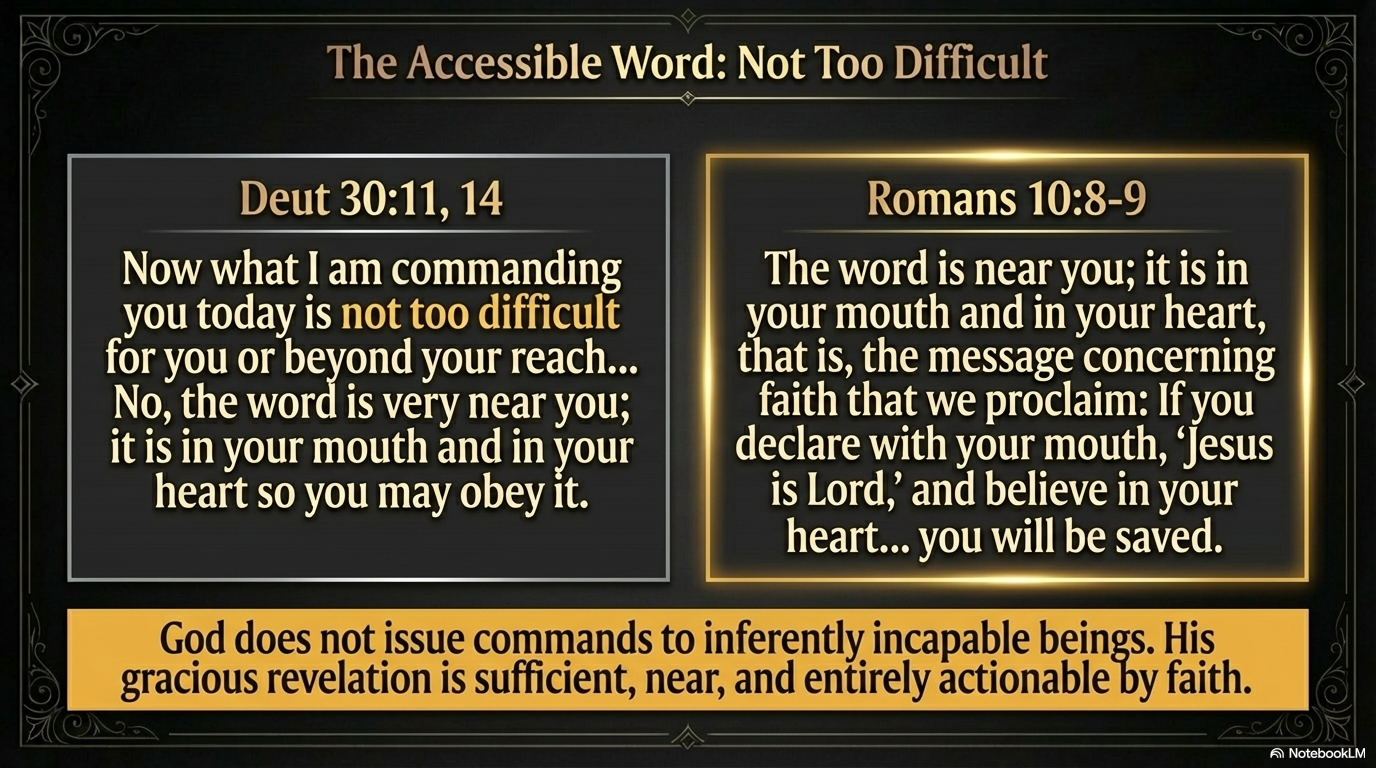
However, Moses and Paul both say that God’s Word is "not too difficult" and "not out of reach." This proves that faith is a choice you can actually make when you hear the Gospel, rather than a gift given only to a few through a process they can't control.
Gods Word Is Enough
The Bible teaches that the Word itself is the supernatural, spiritual weapon that impacts the inner person.
12 For the word of God is living and active and sharper than any two-edged sword, and piercing as far as the division of soul and spirit, of both joints and marrow, and able to judge the thoughts and intentions of the heart.
The biblical authors repeatedly testify that the written and spoken word is all that is necessary to lead a person to faith.
23 for you have been born again not of seed which is perishable but imperishable, [that is], through the living and enduring word of God.
- The Apostle John states his explicit purpose for writing his gospel: "But these are written that you may believe that Jesus is the Messiah, the Son of God, and that by believing you may have life in his name"; it was written specifically so that they could believe and thereby receive new life.
- The Apostle Paul tells Timothy that the holy Scriptures "are able to make you wise for salvation through faith in Christ Jesus".
- Jesus Himself declares, "The words I have spoken to you—they are full of the Spirit and life".
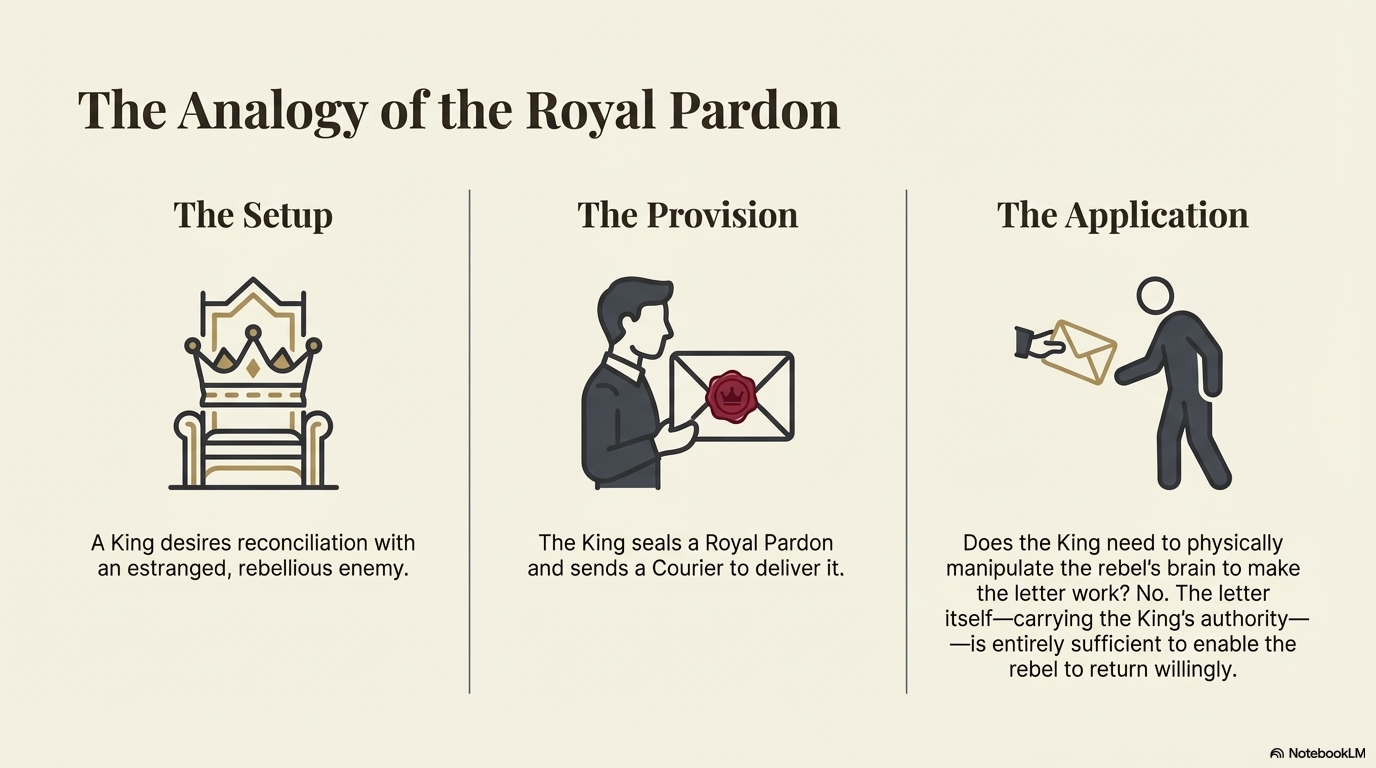
God holds humanity accountable precisely because He has graciously provided the light of His truth, and we possess the God-given capacity to either accept it or suppress it. The Holy Spirit actively brings conviction to the world by means of the gospel, ensuring that the word proclaimed is entirely sufficient to call a sinner to repentance and faith. You do not need a separate, mystical infusion of grace to make the Word work; God's grace does not need "more grace" to be effective.
Believing Results in Life
The Apostle John explicitly outlines the purpose of his gospel and the order in which life is received in John 20:31: "
31 but these have been written so that you may believe that Jesus is the Christ, the Son of God; and that believing you may have life in His name.
The text establishes that life is the result of believing. Similarly, in John 5:40
40 and you are unwilling to come to Me so that you may have life.
The grammatical structure shows that coming to Christ (faith) is the prerequisite for receiving life. Furthermore, Jesus teaches in John 6:53 that unless you eat the flesh of the Son of Man and drink his blood, you have no life in you, demonstrating that partaking in faith must happen in order to possess life.
53 So Jesus said to them, 'Truly, truly, I say to you, unless you eat the flesh of the Son of Man and drink His blood, you have no life in yourselves.
Old Testament Examples
As I have already shown in Deuteronomy 30:19-20, Moses sets the conditions of the covenant before the Israelites, stating:
19 'I call heaven and earth to witness against you today, that I have set before you life and death, the blessing and the curse. So choose life in order that you may live, you and your descendants, 20 by loving the LORD your God, by obeying His voice, and by holding fast to Him; for this is your life and the length of your days, that you may live in the land which the LORD swore to your fathers, to Abraham, Isaac, and Jacob, to give them.'
God provides the options, but He places the responsibility on the people to actively trust and follow Him. Throughout the historical books of the Old Testament, God's restorative work is always contingent upon the people first humbling themselves in faith.
- 2 Chronicles 7:14 sets the sequence: "If my people who are called by my name humble themselves, and pray and seek my face and turn from their wicked ways, then I will hear from heaven and will forgive their sin and heal their land".
- 2 Kings 22:19 records God speaking to King Josiah, affirming this order: "Because your heart was responsive and you humbled yourself before the Lord when you heard what I have spoken... I also have heard you, declares the Lord".
A great example is in Ezekiel where God explicitly outlines the order of how a spiritually rebellious person receives a new heart and new spirit. In Ezekiel 18:30-31, the Sovereign Lord declares:
30 'Therefore I will judge you, O house of Israel, each according to his conduct,' declares the Lord GOD. 'Repent and turn away from all your transgressions, so that iniquity may not become a stumbling block to you. 31 'Cast away from you all your transgressions which you have committed and make yourselves a new heart and a new spirit! For why will you die, O house of Israel? 32 'For I have no pleasure in the death of anyone who dies,' declares the Lord GOD. 'Therefore, repent and live.'
The text does not say God will force a person to be made alive so that they will repent; rather, it commands the individual to humbly repent so as to receive a new heart and live. In Isaiah 55:2-3, God appeals to the people to turn to Him for spiritual nourishment and life. He commands:
2 'Why do you spend money for what is not bread, And your wages for what does not satisfy? Listen carefully to Me, and eat what is good, And delight yourself in abundance. 3 'Incline your ear and come to Me. Listen, that you may live; And I will make an everlasting covenant with you, [According to] the faithful mercies shown to David.
The prophet parallels the act of listening, coming, and inclining the ear with receiving life for the soul. A person must come and hear so that their soul may live, perfectly establishing the condition of a faithful response prior to the granting of spiritual life.
!Pasted image 20260330163705.png
New Testament Examples
Acts 11:18 - "...God has granted to the Gentiles also the repentance that leads to life",. Repentance is what leads to life; life does not lead to repentance.
In Colossians 2:12, the Apostle Paul explains how a spiritually dead person is brought to new life.
12 having been buried with Him in baptism, in which you were also raised up with Him through faith in the working of God, who raised Him from the dead.
The syntax of the verse identifies faith as the instrumental means through which a person is raised up. Because a person is raised to new life through faith, faith must logically precede the raising.
In Ephesians 1:13, he writes:
13 In Him, you also, after listening to the message of truth, the gospel of your salvation-- having also believed, you were sealed in Him with the Holy Spirit of promise,
The biblical order is hearing, then believing, and finally being sealed with the Spirit.
Paul reinforces this exact order in Galatians 3:2, asking rhetorically, "Did you receive the Spirit by the works of the law, or by hearing with faith?".
2 This is the only thing I want to find out from you: did you receive the Spirit by the works of the Law, or by hearing with faith?
He answers this a few verses later in Galatians 3:14
14 in order that in Christ Jesus the blessing of Abraham might come to the Gentiles, so that we would receive the promise of the Spirit through faith.
Jesus Told Us Plainly
Jesus Himself uses the Old Testament narrative of Moses lifting the bronze serpent in the wilderness to explain the order of salvation. When the Israelites were bitten by venomous snakes, God provided a single means of healing for the whole camp. The people were dying and could not heal themselves, yet God provided a means: look and live. Those who looked were healed; those who refused perished. The condition (being bitten) did not prevent the response—it made the response necessary. Some died because they refused. The Old Testament illustration mandates that the faithful look (faith) must logically precede the healing (new life/regeneration).
!Pasted image 20260330163730.png
14 'As Moses lifted up the serpent in the wilderness, even so must the Son of Man be lifted up; 15 so that whoever believes will in Him have eternal life. 16 'For God so loved the world, that He gave His only begotten Son, that whoever believes in Him shall not perish, but have eternal life. 17 'For God did not send the Son into the world to judge the world, but that the world might be saved through Him. 18 'He who believes in Him is not judged; he who does not believe has been judged already, because he has not believed in the name of the only begotten Son of God. 19 'This is the judgment, that the Light has come into the world, and men loved the darkness rather than the Light, for their deeds were evil. 20 'For everyone who does evil hates the Light, and does not come to the Light for fear that his deeds will be exposed. 21 'But he who practices the truth comes to the Light, so that his deeds may be manifested as having been wrought in God.'
- Jesus explicitly links His mission to the grammar of Numbers 21. He uses the Greek word dei ("it is necessary") to connect the two events.
- The participle for "believes" (pisteuōn) is the condition, and the verb "have" (echē) is the result.
- In the Greek text, the act of believing is the means through which the "having of life" occurs. Jesus does not say "whoever has been given life will believe," but rather that the belief is the look that leads to the life.
!Pasted image 20260330155830.png
Jesus continues this logic by explaining the mechanics of salvation for the "whole world."
- The Offer: "For God so loved the world, that He gave His only begotten Son, that whoever believes in Him shall not perish, but have eternal life" (v. 16).
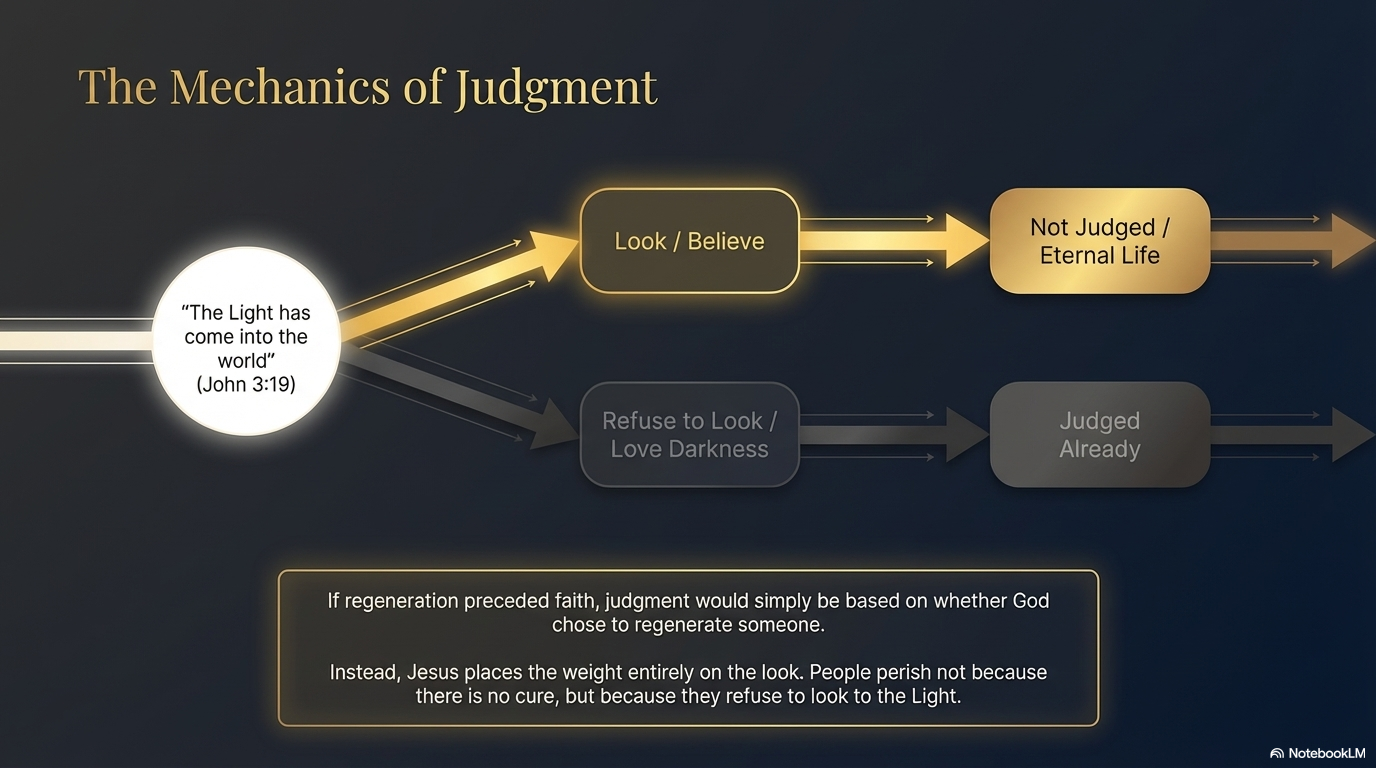
- The Verdict: "He who believes in Him is not judged; he who does not believe has been judged already" (v. 18).
- If regeneration preceded faith, the "judgment" would essentially be based on whether God chose to regenerate someone or not.
- However, Jesus places the weight on the look. The judgment is based on the refusal to look at the Light that has come into the world. Just as some Israelites died in the desert because they refused to look at the bronze serpent, people "perish" not because there was no cure, but because they did not believe (look) in the name of the Son of God.
8 For by grace you have been saved through faith; and that not of yourselves, [it is] the gift of God; 9 not as a result of works, so that no one may boast.
Just like the bronze serpent was the "gift" from God, the healing was the result of the look. The "look" (faith) isn't the gift—the remedy is. Just as the Israelites had to look at the serpent in order to be healed, humanity must look to the Son in faith in order to receive eternal life.