Introduction to the "Son of Man"
The term "Son of Man" is a central and distinctive title used by Jesus in the Gospels (Hebrew: בֶּן־אָדָם, ben-adam). Jesus often referred to Himself as the "Son of Man,", in fact it seems to have been His favorite term, it is used around 80 times in the New Testament. In the Hebrew Bible, "Son of Man" generally refers to a human being or mortal, as seen in the Psalms and Ezekiel. In Ezekiel 2:1-8, the term “Son of Man” is used extensively and is typically understood as a way of addressing the prophet Ezekiel himself (Swanson2015-le). However, the most significant and debated usage of "Son of Man" is found in Daniel 7:13-14. Here, the "Son of Man" appears in a vision as a heavenly figure coming with the clouds of heaven, approaching the Ancient of Days, and receives dominion, glory, and a kingdom that all peoples, nations, and languages should serve. It as this passage that Jesus claimed for himself in His trial (Mark 14:60-64).
The "Son of Man" Passage In Daniel
In Daniel 7:13-14, the "Son of Man" is described in a vision as coming with the clouds of heaven and approaching the Ancient of Days. He is given authority, glory, and sovereign power; all nations and peoples of every language worship him. His dominion is everlasting and will not pass away, and his kingdom is one that will never be destroyed.
9. “As I looked, “thrones were set in place, and the Ancient of Days took his seat. His clothing was as white as snow; the hair of his head was white like wool. His throne was flaming with fire, and its wheels were all ablaze. 10. A river of fire was flowing, coming out from before him. Thousands upon thousands attended him; ten thousand times ten thousand stood before him. The court was seated, and the books were opened. 11. “Then I continued to watch because of the boastful words the horn was speaking. I kept looking until the beast was slain and its body destroyed and thrown into the blazing fire. 12. (The other beasts had been stripped of their authority, but were allowed to live for a period of time.) 13. “In my vision at night I looked, and there before me was one like a son of man, coming with the clouds of heaven. He approached the Ancient of Days and was led into his presence. 14. He was given authority, glory and sovereign power; all nations and peoples of every language worshiped him. His dominion is an everlasting dominion that will not pass away, and his kingdom is one that will never be destroyed.
There are two subjects, the Ancient Of Days, which is God the Father based on passages like Ezekiel chapter 1, where the his throne is descripted in the same manor with fire and wheels. Then a second person described as the Son of Man Riding On The Clouds. In Ezekiel, the prophet sees a human figure sitting on Gods throne (Ezekiel 1:26-27) as well.
Cross References Of The Son Of Man Passage
It's easy to read this passage and miss everything being claimed. It's important to cross reference your Bible and read the context slowly.
Coming On The Clouds Of Heaven?
Daniel Boyarin observes that the phrase "Riding in the clouds", is used roughly 70 times in the Hebrew Bible (Such as Deuteronomy 33:26-27 or Psalm 104:3), consistently refers to God. In ancient Near Eastern cultures, including Jewish thought, cloud imagery was often associated with divinity. For example, in ugaritic texts the god Baal is called the "The one who rides the clouds" and it was the title of him. The old testament writes would take this title and give it to God, Deuteronomy 33:26, Psalm 68:32-33, Psalm 103:1-4 and Isaiah 19:1. This passage is the sole exception in the entire bible and its applied to a human. Everlasting Kingship was to belong only to the offspring of david, now we have a messianic king as both himan (Son of Man) and diety (The rider on the clouds) Heiser2015-it. Furthermore, Boyarin points out that the dominion, glory, and kingship given to the "Son of Man" in Daniel's vision are attributes typically reserved for God (See Attributes of God Credited To Jesus). The everlasting nature of his dominion and the universal scope of his authority suggest a role far beyond that of a mere human leader or king (Boyarin2012-pi).
The Attributes Of God Are Given To The Son Of Man
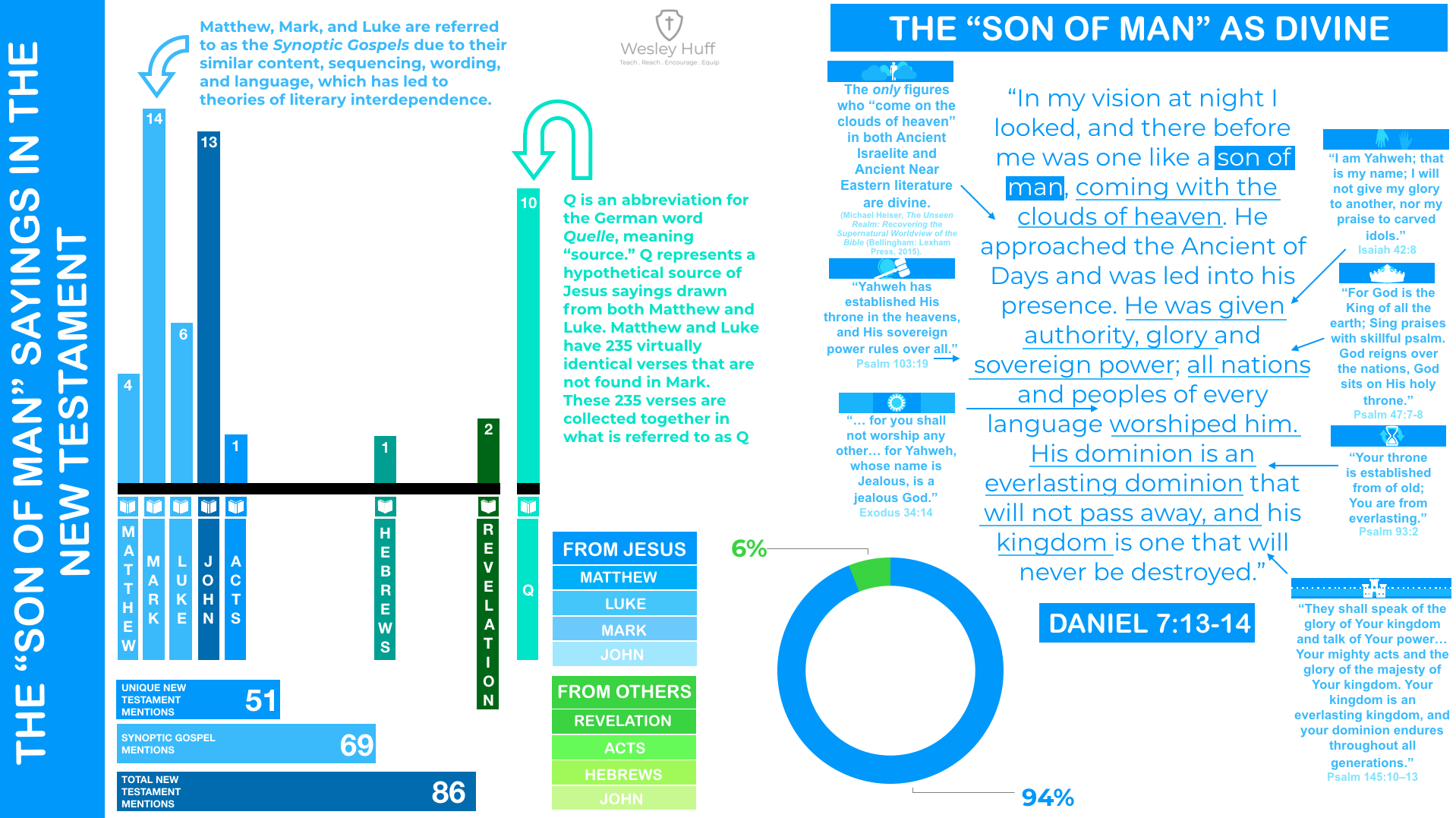
- Glory And Authority
The Son Of Man in this passage was given glory and Authority by the Ancient of Days. Jesus himself claims this authority as the Son of Man in the Gospels, tying it to His ability to forgive sins (See Jesus Claims Gods Authority and Jesus Is The Forgiver Of Sins), but Isaiah the prophet said that:
8. I am the LORD; that is my name; my glory (יָקַר yâqar) I give to no other, nor my praise to carved idols.
-
Sovereign Power
The Son Of Man is given the Sovereign power/kingdom (מַלְכוּ malkûw) of the Ancient of Days, this is to share in the essence of the Father for the Psalms say:
- The LORD has established his throne in the heavens, and his kingdom (מַלְכוּ malkûw) rules over all.
-
Reign of the Nations
The Bible is clear that it is God alone that ultimately rules all nations.
- For God is the King of all the earth; sing praises with a psalm! 8. God reigns over the nations; God sits on his holy throne.
-
Worship
The word worship is the Hebrew פְּלַח pelach which means to "Serve or Worship" is the same word used though the book of Daniel (Daniel 3:12, 14, 3:17-18, 3:28; 6:20; 7:14, 7:27 ) to describe worship to other Gods and the Ancient of Days, see also Jesus Is Worthy Of Worship. Moreover, the Septuagint Greek translation of Daniel uses the word latreuo for pelach (@Bowman2007-gc). -
The Everlasting Dominion
Everlasting in this context means no beginning and no end, a eternal kingdom that God alone controls (See also Jesus' claim to be The Alpha and Omega/First and Last):
- Your throne is established from of old; you are from everlasting.
10. All your works shall give thanks to you, O LORD, and all your saints shall bless you! 11. They shall speak of the glory of your kingdom and tell of your power, 12. to make known to the children of man your mighty deeds, and the glorious splendor of your kingdom. 13. Your kingdom is an everlasting kingdom, and your dominion endures throughout all generations. [The LORD is faithful in all his words and kind in all his works.]
Just Who Is The Son Of Man?
This figure has been interpreted in various ways. In Jewish thought, the Son of Man in this passage often represents an idealized Israel or a messianic figure who plays a role in the eschatological (end times) redemption. This second thought can be seen in additional Jewish texts, like the Book of Enoch from the Second Temple period, that depicts the "Son of Man" as a heavenly being (Enoch 46:1-3, Enoch 62:5-9, Enoch 69:26-29). while Ezekiel's visions (Ezekiel 1:26 and Ezekiel 8:2) describes a figure akin to "the appearance of the likeness of the glory of the LORD,".
Jesus favorite title for himself is Son of Man, but He did not mean it as a simple human as used throughout the Old Testament, but claims to be The Son of Man in Daniels visions during his trial (Mark 14:60-64, Matthew 26:57-66). It is with this context that we see He makes more claims about what the Son Of Man must do in Luke 17:24-26. Without the context of Daniel 7 and the actions/claims of Jesus in the Gospels, it's easy to miss just what Jesus is saying about himself when he calls himself the "Son of Man".The trial of Jesus, as narrated in Mark and Matthew, show us the most famous use of the title.
57. Then those who had seized Jesus led him to Caiaphas the high priest, where the scribes and the elders had gathered. 58. And Peter was following him at a distance, as far as the courtyard of the high priest, and going inside he sat with the guards to see the end. 59. Now the chief priests and the whole council were seeking false testimony against Jesus that they might put him to death, 60. but they found none, though many false witnesses came forward. At last two came forward 61. and said, “This man said, ‘I am able to destroy the temple of God, and to rebuild it in three days.’” 62. And the high priest stood up and said, “Have you no answer to make? What is it that these men testify against you?” 63. But Jesus remained silent. And the high priest said to him, “I adjure you by the living God, tell us if you are the Christ, the Son of God.” 64. Jesus said to him, “You have said so. But I tell you, from now on you will see the Son of Man seated at the right hand of Power and coming on the clouds of heaven.” 65. Then the high priest tore his robes and said, “He has uttered blasphemy. What further witnesses do we need? You have now heard his blasphemy. 66. What is your judgment?” They answered, “He deserves death.”
60. And the high priest stood up in the midst and asked Jesus, “Have you no answer to make? What is it that these men testify against you?” 61. But he remained silent and made no answer. Again the high priest asked him, “Are you the Christ, the Son of the Blessed?” 62. And Jesus said, “I am, and you will see the Son of Man seated at the right hand of Power, and coming with the clouds of heaven.” 63. And the high priest tore his garments and said, “What further witnesses do we need? 64. You have heard his blasphemy. What is your decision?” And they all condemned him as deserving death.
When confronted by the high priest about is Jesus is the Christ, Jesus not only confirms it but also claims that He is the Son of Man, and will be sitting at the right hand of Power, and coming with the clouds of heaven. This reference to Daniel 7:13 is perceived as a divine claim to be God, leading to accusations of blasphemy by the high priest, a term in Judaism defined as cursing God (according to myjewishlearning.com). This response indicates that Jesus's claim was interpreted as an assertion of divinity, given the exclusive association of such imagery with God in Jewish thought. Additionally, events like the Transfiguration (Matthew 17:1-9), where the Son of God is also called the Son of Man that would rise from the dead, or his teachings in Mark 8:31 further show his authority over life and death. Jesus use of "Son of Man" is a deliberate claim to divine authority.